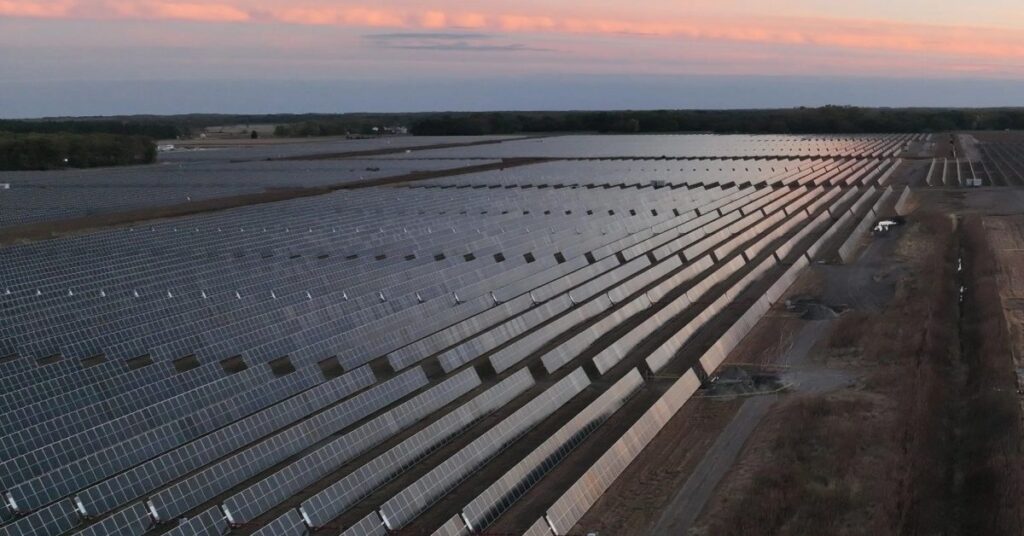
Renewable energy sources have shown a notable increase in their contribution to the United States’ power generation. During the first third of 2026, renewables contributed 30% to the total electrical generation, an increase of 2.2% compared to the same period last year, according to the US Energy Information Administration (EIA) and analyzed by the SUN DAY Campaign.
Renewable Energy Sees Significant Growth
The latest “Electric Power Monthly” report from the EIA reveals a 10.03% increase in electricity produced by renewable sources in the first four months of 2026 compared to the previous year. This growth is primarily driven by a 21.3% rise in utility-scale solar, a 15.7% increase in hydropower, an 11.9% uptick in small-scale solar, and a 3.4% boost in wind energy.
Meanwhile, coal-fired power generation dropped by 11.6%, whereas nuclear power saw a modest increase of 0.5%. Electricity from natural gas plants rose by 2.8%. Together, wind and solar energy, including small-scale solar systems, accounted for 21.8% of the nation’s electrical output.
In April, wind and solar energy production surpassed that of coal, while the combined output of solar and wind was 57.0% higher than that of nuclear power. Overall, renewable sources, including biomass and geothermal, made up 30.0% of the total US electrical generation during this period, up from 27.8% the previous year.
Expansion in Renewable Energy Capacity
Between May 1, 2025, and April 30, 2026, the installed capacity for utility-scale solar increased by 27,572.3 MW. Small-scale solar and wind also grew by 6,492.2 MW and 5,976.4 MW, respectively. The total capacity increase across all renewable energy sources, including hydropower, biomass, and geothermal, was 39,884.2 MW.
In April, utility-scale solar capacity exceeded wind capacity for the first time, recorded at 160,208.1 MW versus 160,100.6 MW for wind. Additionally, utility-scale battery energy storage saw a 58.1% increase, adding 17,703.5 MW. In contrast, nuclear capacity grew by just 18.4 MW.
Coal capacity decreased by 3,511.4 MW, while natural gas capacity increased by 7,754.2 MW.
Future Projections for Renewable Energy
As of May 1, 2026, renewable energy constituted 33.8% of the total US utility-scale generating capacity. The EIA forecasts this to rise to 36.8% by April 30, 2027. Utility-scale solar is expected to add 42,527.2 MW, increasing its share from 13.1% to 15.9%. Wind capacity is projected to grow by 13,154.4 MW, including 3,355.0 MW from offshore wind, raising its share from 13.1% to 13.6%. Other renewables such as hydropower, biomass, and geothermal will contribute an additional 298.7 MW.
The anticipated growth in utility-scale renewable capacity over the next year (55,980.3 MW) represents a significant increase of 67.6% over the previous year’s additions (33,392.0 MW). The EIA predicts no new nuclear capacity and a net decrease of 5,200.5 MW in fossil fuel capacity.
Potential for Renewables to Overtake Natural Gas
The past year saw small-scale solar systems increase by 6,492.2 MW, totaling 61,521.5 MW. Although the EIA hasn’t provided specific forecasts for small-scale solar, the SUN DAY Campaign estimates similar growth in the coming year, potentially adding another 6,000 MW or more.
This projected growth could bring total renewable energy capacity to approximately 537,606.9 MW by May 1, 2027, surpassing the estimated natural gas capacity of 515,744.9 MW. Solar alone could constitute over one-fifth (20.1%) of the nation’s total capacity.
Growth in Battery Storage
Battery energy storage is set to expand by 22,828.9 MW by May 1, 2027, increasing the total to 71,007.4 MW, a rise of over 47%. Combined with utility-scale renewable energy sources, this would result in 78,809.2 MW of new clean energy capacity by mid-spring 2027. Including small-scale solar, the total could approach 85,000 MW.
Ken Bossong, executive director of the SUN DAY Campaign, commented, “The steadily accelerating march of solar, wind, and battery storage continues.”
Read more: California solar is crushing natural gas this year
Original Story at electrek.co