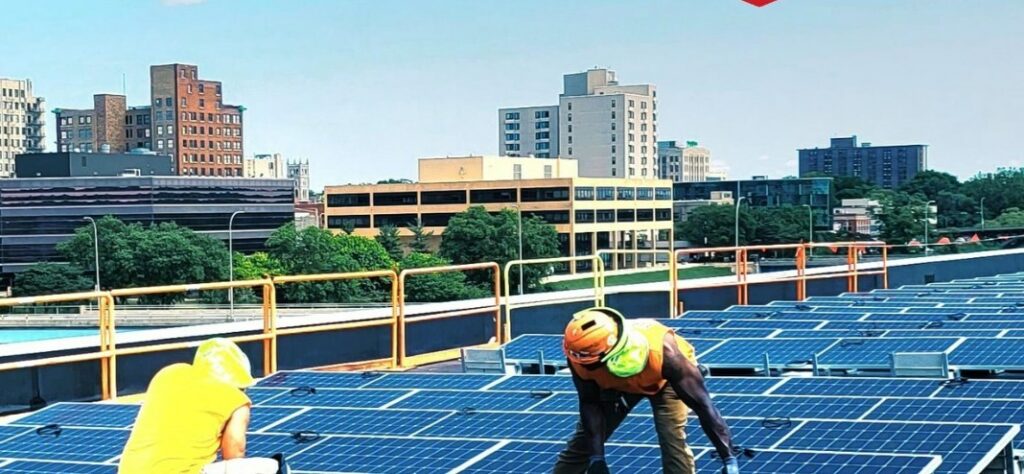
Amidst the bustling cityscape of Chicago, Nexamp, the largest community solar developer in the United States, recently inaugurated its second headquarters in the city. This event, organized in collaboration with the Clean Energy Leadership Institute (CELI), gathered an array of policymakers, regulators, and advocates, alongside CELI fellows and students from the Nexamp and City Colleges of Chicago renewable energy fellowship. The primary focus was on community investment and workforce development, showcasing Illinois’ commitment to advancing renewable energy with an equitable approach.
While many states are transitioning to renewable energy, Illinois is setting itself apart by embedding equity, labor standards, and consumer protection into its renewable energy framework. The result is not just visible in increasing megawatts but also in tangible benefits for the local population.
Nexamp’s CEO, Zaid Ashai, emphasized the transformative potential of this transition. He noted, “Disruption on this scale can build a more decentralized, equitable economy or produce a K-shaped outcome where the value accrues to the few who hold capital.” According to Ashai, the key is to ensure that clean energy initiatives are paired with affordability, making distributed solar and storage a path to price stability for the average consumer.
The political support for this vision was evident, with State Representative Marcus C. Evans Jr. underscoring the importance of decisive governmental action. He asserted that infrastructure projects progress when the government commits to a clear direction, and Illinois has done just that, with Springfield unified in its mission to create a clean energy economy.
The Numbers Behind Illinois’ Renewable Success
Brian Granahan, the director of the Illinois Power Agency (IPA), highlighted the state’s progress, noting that Illinois boasts more than 6,000 MW of solar energy, a significant increase from around 80 MW a decade ago. The state’s Renewable Portfolio Standard has facilitated the development of over 13 GW of wind and solar energy, with an additional 800 MW of wind and 740 MW of solar projects approved, pushing the pipeline towards 14.5 GW.
Beyond sheer numbers, Illinois excels in equity and consumer protection, earning a B on the Institute for Local Self-Reliance Community Power Scorecard, surpassing states like New York, Massachusetts, and California. Other states now seek Illinois’ guidance on these matters.
Advancing Through Batteries and VPPs
A panel discussion, led by Jess Collingsworth, Nexamp’s central policy director, delved into the Clean and Reliable Grid Affordability Act (CRGA, SB 25), effective since June 1. Audrey Steinbach, the IPA’s energy storage director, discussed Illinois’ target of 3,000 MW of cumulative storage by 2030, starting with an initial procurement in August. The policy provides the necessary certainty for the IPA to operate efficiently.
Additional initiatives include the residential virtual power plant (VPP) program, opening mid-July for ComEd and Ameren customers, offering payments for grid services. The first statewide Integrated Resource Plan, due for a draft in November, aims to enhance resource planning. JC Kibbey, a climate advisor for Illinois, highlighted that 71% of residents support the goal of 100% clean energy by 2050.
Kavi Chintam, Vote Solar’s Illinois campaign manager, pointed out federal challenges like the phasing out of the investment tax credit, which impacts Illinois Solar for All projects. Nevertheless, increased REC prices offer some protection against these federal changes.
Ensuring Equity in Renewable Projects
Illinois mandates that 14% of a project’s workforce must be equity-eligible, including graduates of job training programs, formerly incarcerated individuals, and residents from eligible communities. However, JC Kibbey acknowledged a gap between workforce demand and training program capacity. Bridging this gap is crucial for true success.
Chintam illustrated the community impact with an example of a church near Carbondale, which, through the Illinois Solar for All program, managed to maintain a free Sunday breakfast, demonstrating the tangible benefits of these initiatives.
The Role of Fellowship Programs
Marion Jones, Nexamp’s VP of Community Engagement & Workforce Development, alongside Chancellor Juan Salgado of City Colleges of Chicago, highlighted their STEM-based renewable energy fellowship program. Launched at Olive-Harvey College, this initiative aims to reach 80 students by year’s end, offering paid positions that involve real project work, enhancing both learning and productivity.
Salgado’s “Chicago Moonshot” aims to expand paid apprenticeships to 500 annually within five years, challenging other companies to adopt similar models.
The Importance of Illinois’ Approach
Illinois demonstrates that it’s possible to integrate solar, wind, and batteries into the grid while ensuring that the workforce, savings, and ownership extend to communities previously marginalized by the energy sector. This approach not only enhances grid reliability but also sets a precedent for an equitable transition, despite federal challenges.
Tim Montague is the President of Clean Power Consulting Group, host of the Clean Power Hour podcast, and author of Wired for the Sun: The Commercial Solar Playbook.
Original Story at pv-magazine-usa.com