Alarming Decline in Migratory Bird Populations Revealed in New Report
In a concerning revelation for conservationists and environmentalists alike, the latest edition of BirdLife International’s State of the World’s Birds report highlights a significant decline in migratory bird species. The report, unveiled at the Global Flyways Summit in Nairobi, Kenya, underscores that 45% of these species are experiencing population decreases, with 11% facing the threat of extinction.
Migratory birds are not just crucial for biodiversity; they serve as vital indicators of ecosystem health. According to Lucy Haskell, the report’s lead author and senior science officer at BirdLife, “This report is about migratory birds, but it also serves as a warning about the state of the planet in general.”
Critical habitats for these birds are under threat from a combination of human-induced pressures, including invasive species, agricultural expansion, climate change, and development activities. The report specifically calls attention to the plight of seabirds and shorebirds, alongside species reliant on marine habitats, forests, and coastal wetlands.
In a sobering reminder of the challenges facing bird conservation, the IUCN noted last year the extinction of the slender-bill curlew, a migratory bird last observed in Morocco in 1995. This marks one of several species confirmed or suspected to have disappeared in the past 150 years.
The report also highlights recent assessments of over 100 North American shorebird species, revealing that nine have been reclassified from “least concern” to “vulnerable,” while 16 have been elevated to “near threatened.” Ian Burfield, BirdLife International’s global science coordinator, commented on these findings, stating that “new analyses of data from long-term monitoring schemes reveal that the global populations of some species have declined by more than a third in recent decades.”

A Call to Action and Signs of Hope
Alarmingly, only 9% of migratory bird species benefit from adequate protection throughout their life cycles, which is notably lower compared to 45% for non-migratory species. An analysis of Key Biodiversity Areas reveals that over half are in poor or very poor condition.
Katie-Jo Luxton from the Royal Society for Protection of Birds expressed cautious optimism, stating that “The findings of this report are sobering, but there are also reasons for hope, with increasing ambition around the world to halt and reverse species declines.” Conservationists emphasize the urgent need to conserve and restore habitats, which can benefit all biodiversity.
The report’s release coincided with the signing of the Nairobi Flyways Declaration, a commitment by governments and organizations to protect vital flyways. International development banks, like the Asian Development Bank, have pledged significant financial resources toward habitat protection efforts.
Stuart Butchart, chief scientist at BirdLife International, highlighted the importance of these initiatives: “We’ve established a number of what we call regional flyway initiatives, where we’re partnering with multilateral development banks.” Such collaborations are expected to yield benefits for both birds and local communities, while also contributing to climate mitigation.
Highlighting a success story, the recovery of the Egyptian vulture in the Balkans demonstrates the potential of international cooperation in conservation. “This is probably one of the first really great success stories to come out of this flyway scale conservation,” noted Lucy Haskell.
Overall, the report underscores the dual role of migratory birds as both indicators of environmental health and symbols of hope. As Stuart Butchart eloquently put it, “We can and we have to safeguard this amazing wonder of migration, both for its own sake, but also because the ecosystems that those birds depend on underpin our economies, our livelihoods, and human health as well. Migratory birds provide both a warning but also a source of hope.”
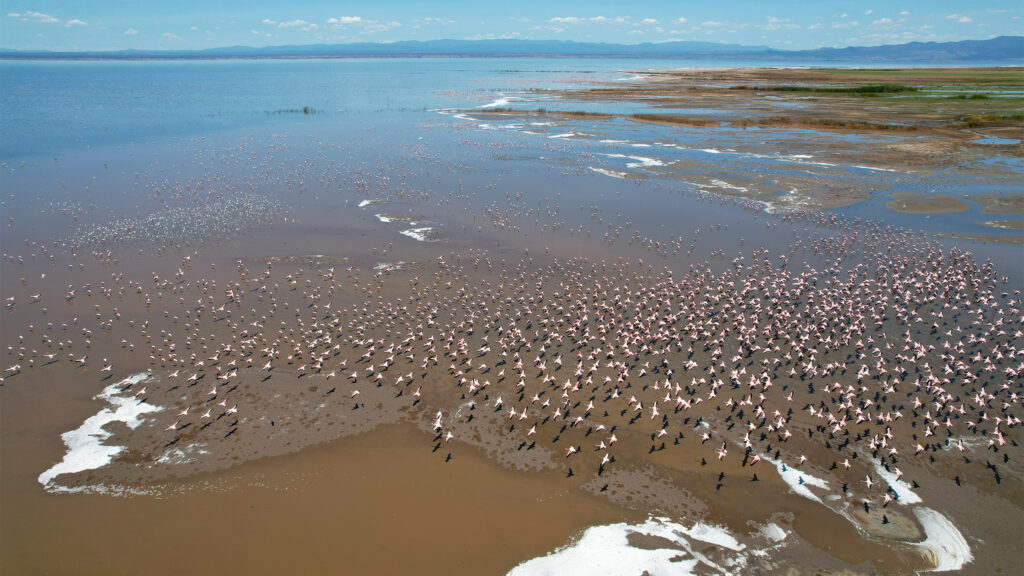
Banner image: Lesser and greater flamingos gather at Lake Natron, northern Tanzania. The report finds that 58% of assessed Key Biodiversity Areas for migratory birds are in poor or very poor condition. Image © Akshita Rabdiya.
Up to half the bird species using the African-Eurasian flyway are declining
Tiny trackers reveal where migratory shorebirds need protection across Africa
Feedback: Use this form to send a message to the author of this post. If you want to post a public comment, you can do that at the bottom of the page.
Original Story at news.mongabay.com