Innovative Solutions in Uganda: Transforming Shea Waste into Sustainable Fuel
Alebtong, Uganda – Lucy Everlyn Atim’s return home was marked by the absence of her cherished shea tree, a symbol of her youth and daily routine. The local shea, or moyao, had been a constant in her childhood, offering sweet fruit for her and her friends before their school day began.
Unfortunately, this was not an isolated instance. Northern Uganda has seen many of these indigenous trees cut down, primarily for charcoal production.
“I got concerned,” Atim, a climate advocate in her mid-thirties, expressed to Al Jazeera.
“The destruction of shea trees is alarming. These trees need to be protected, but people also need an alternative source of fuel.”
Uganda faces an annual deforestation rate of approximately 122,000 hectares, driven largely by the demand for charcoal. With around 90 percent of households relying on this fuel, indigenous trees like shea and Afzelia africana are rapidly disappearing.
A study by Makerere University revealed a decline in mature shea tree populations on fallow land, dropping from about 20 trees in 2008 to between 10 and 15 by 2017.
Dr. Patrick Byakagaba, who led the study, highlighted the lack of comprehensive data, telling Al Jazeera, “More needs to be done to determine their density, sapling survival, and regeneration.” Monitoring this issue is challenging, as charcoal producers often remove entire trees, leaving no evidence behind.
While working in South Sudan, Atim encountered a woman in Yida who was creating fuel briquettes using discarded shea husks, sparking her interest.
“I got curious. I knew this was something that could be replicated back home,” she recalled.
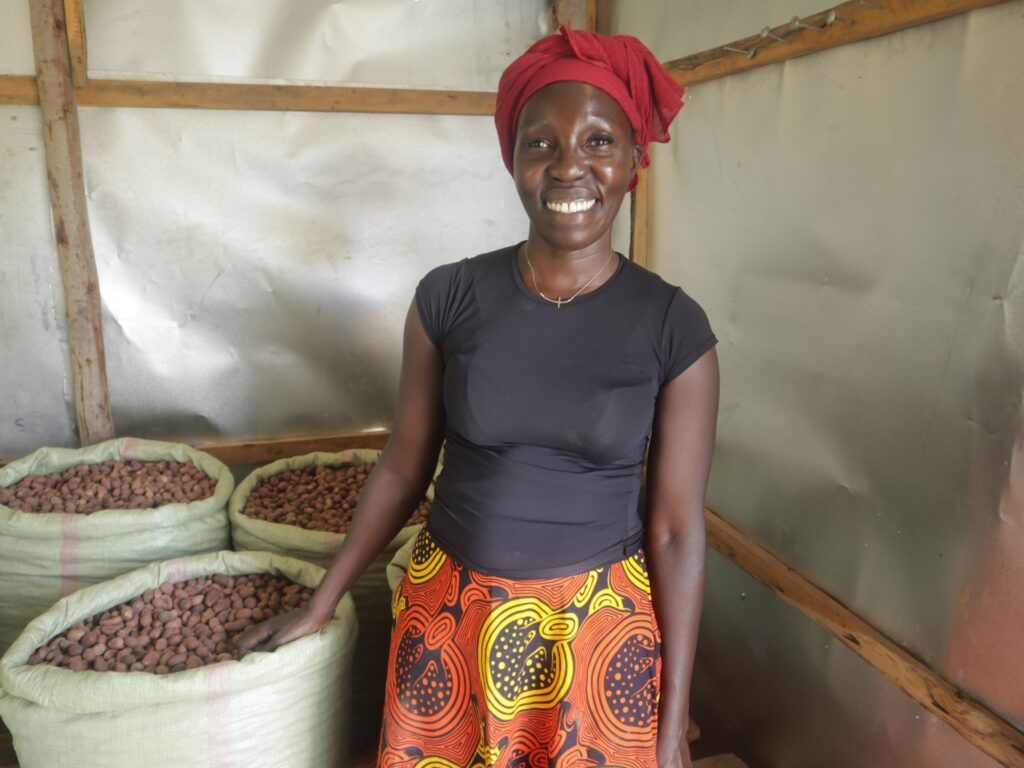
In 2023, she founded Moyao Africa Initiative, a social enterprise focusing on converting shea waste into briquettes and empowering women through shea butter production.
The initiative employs a small team and collaborates with over 1,200 women in savings groups to gather shea waste, create briquettes, and process butter.
“In most households, women carry the burden of finding cooking fuel. By training them to make and sell briquettes and shea butter, we’re creating an income while providing an affordable alternative to charcoal,” Atim explained.
Training and Empowerment
On a sweltering afternoon in Alebtong, 15 women gather on woven mats for a training session hosted by Moyao Africa Initiative. These women lead savings groups and are learning to transform discarded shea husks into cooking fuel.
During the session, when asked about the process, they collectively respond: collect the husks, crush them, mix with clay and cassava flour, mould, dry, and store.
The training soon transitions from theory to hands-on practice. Participants pound dried shea husks, dig clay soil, and prepare cassava paste, which binds the mixture before it is shaped and sun-dried.
Catherine Akello, leader of the Oteno Moyao Africa Women’s Group, used to value only the shea kernels for butter, discarding the husks. Now, they serve as a fuel source.
“I don’t have to worry about buying charcoal whenever I want to cook because I make my own briquettes from shea husks,” said Akello, a 47-year-old mother of five.
“As a group, we’re also able to save money from the products we sell, and that helps us support our families when emergencies arise,” she added.
Despite rising demand, production is limited by the seasonal nature of the shea harvest. Atim plans to invest in equipment like a carboniser, crusher, and briquette-making machine, costing around $530, to increase production year-round.
“Our plan is to increase shea butter production from 600 litres to 6,000 litres. That means more shea husks and, in turn, more briquettes. It will help us meet demand even when raw materials are scarce,” she stated.
A Vision for the Future
Renewable energy expert Bosco Odyek pointed out that converting shea husks into briquettes offers a sustainable alternative to charcoal by utilizing waste material.
He noted that using a carboniser would result in cleaner-burning, smokeless briquettes.

Besides fuel production, Moyao Africa Initiative also runs environmental clubs in 20 schools across Alebtong District and collaborates with the National Agricultural Research Organisation (NARO) to distribute tree seedlings, aiming to restore local landscapes.
Paul Mwirichia, an expert in humanitarian and development projects, emphasized the importance of such initiatives, but noted that access to clean energy remains a challenge for many rural households.
“We have very good policies,” he remarked.
“The challenge is implementation. Government needs to support indigenous organisations like Atim’s because they understand the problems affecting their communities, and people trust them to address those challenges.”
For Atim, the mission is deeply personal—it’s about preserving the trees that shaped her early life.
While her cherished shea tree is gone, she hopes that by transforming waste into fuel, fewer trees will be cut down and more women can earn a living from conserving them.
“We are leaving no one behind.”
Original Story at www.aljazeera.com