New Zealand’s Electric Vehicle Market Bounces Back from Setbacks
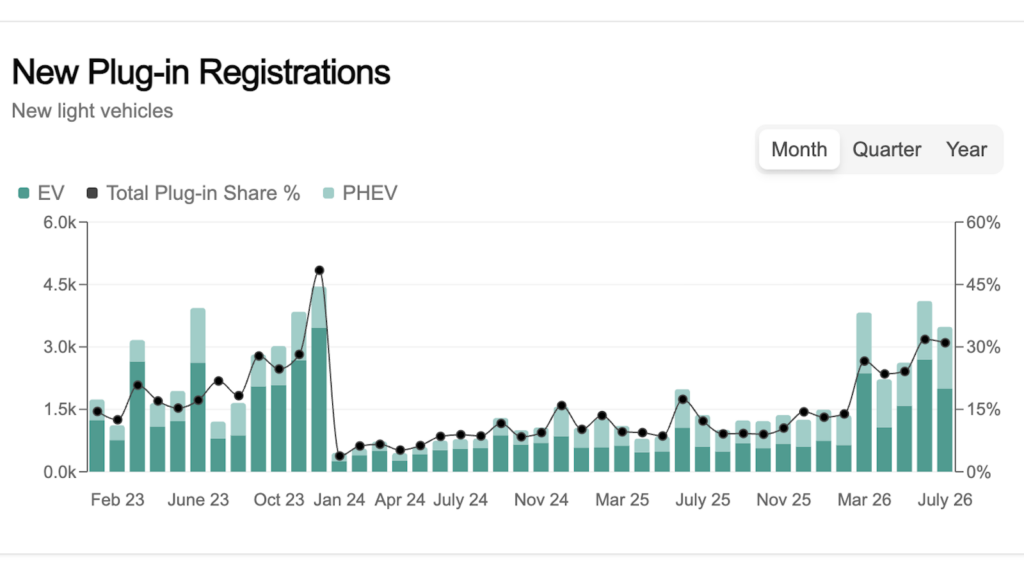
New Zealand’s journey toward electric vehicle (EV) adoption has been a rollercoaster ride, with the nation once compared to the “Norway of the Pacific.” However, a government shift led to the reversal of tax incentives for EVs and the introduction of road user charges, causing a significant drop in EV sales. Despite this setback, the market is showing signs of recovery, with EV penetration reaching nearly 30% in recent months, reviving from a low of 2% in January 2024.
In a remarkable turnaround, sales of battery electric vehicles have surged by 231% compared to the same period last year, while plug-in hybrid electric vehicle (PHEV) sales have almost doubled. For more detailed statistics, visit this page. As fossil fuel supplies face uncertainty, dealerships have reported shortages of second-hand EVs, a situation previously detailed here. New plug-in car sales have increased, whereas mild hybrids, petrol, and diesel vehicle sales have declined.
Fuel prices in New Zealand remain high, with regular petrol (91 Octane) costing between $NZ 3.00 and $NZ 3.15 per liter. The equivalent cost for premium petrol (95 Octane) is $NZ 3.25 to $NZ 3.40 per liter, and diesel ranges from $NZ 2.30 to $NZ 2.55 per liter. With a conversion rate of $NZ to $US at 58 cents, this means regular petrol costs approximately $US 7.83 per gallon.
Fuel prices fluctuate based on location, being cheaper in urban areas and more expensive in tourist and remote regions. Around half the cost is attributed to excise duties, emissions levies, and a 15% Goods and Services Tax (GST). Although diesel seems cheaper upfront, the Road User Charge, calculated by weight and distance, balances the cost.
Electricity, mainly generated from hydro sources, costs about 39–50 cents NZ per kWh. Concept Consulting predicts that electrifying land transport could replace around 190 PJ of imported liquid fuels with 49 PJ of domestic electricity, saving approximately $2.9 billion annually in fuel costs.
New Zealand has achieved a milestone with 100,000 battery electric vehicles (BEVs) and 50,000 PHEVs now operational. Though significant, these figures represent only 3.38% of the total vehicle fleet. The shift towards electrification will be gradual, especially given New Zealanders’ tendency to retain vehicles for extended periods and the country’s reliance on used car imports from Japan, which is slow to embrace EV technology.
Anticipating future trends, “Even if 100% of new vehicle registrations were electric from 2030, the entire light fleet would still only be 50% electric by 2040,” an expert projects. In July, over 200 used Nissan Leafs were imported, underscoring the model’s popularity, with CHADeMO connectors being a common sight at public charging stations.
July 2026 was a strong month for EV sales, with the Tesla Model Y leading the pack. Here’s a breakdown of the top-selling battery electric vehicles for the month:
- Tesla Model Y — 403 units
- Zeekr 7X — 151 units
- BYD Atto 3 — 121 units
- Geely EX 5 — 111 units
- Toyota BZ4X — 110 units
- Sea Lion 7 — 99 units
- MG 4 — 98 units
- Jaecoo J5 — 87 units
- Dongfeng Box — 84 units
- BYD Atto 2 — 82 units
- ORA 5 — 78 units
- BYD Atto 1 — 50 units
- Kia EV5 — 46 units
- Omoda E5 — 41 units
- Leapmotor C10 — 28 units
The dominance of Chinese-made vehicles in New Zealand mirrors trends in Australia, with notable entries from the USA, Japan, and South Korea as well. Enthusiasts can find more information and share experiences in the Facebook group dedicated to life with electric vehicles in New Zealand.
While Māori mythology lacks a resurrection narrative, due to Māui’s failed quest for immortality, New Zealand’s electric vehicle market appears to be defying this fate, suggesting a future that’s increasingly electric.
Original Story at cleantechnica.com