Georgia’s Electric Vehicle Industry Perseveres Amid Policy Shifts
In the face of significant policy changes and federal tax adjustments, Georgia’s electric vehicle (EV) manufacturers are navigating a complex landscape to maintain momentum. Despite recent challenges, the state continues to adapt and invest in clean-energy manufacturing.
This ongoing effort stems from the vision of Georgia Governor Brian Kemp, who has long been committed to establishing Georgia as a hub for EVs and renewable energy products. This initiative includes enticing manufacturers with tax incentives and workforce training programs, which have successfully attracted substantial investments from industry giants.
Notably, Georgia-based Blue Bird has been at the forefront, selling electric buses since 2018 and expanding its production capabilities. In 2022, Hyundai initiated construction on an EV-dedicated plant near Savannah, while Kia began EV production at its West Point facility in 2024. Rivian followed suit in 2025, breaking ground on a major plant near Atlanta. These projects represent some of the largest economic developments in the state’s history, alongside substantial investments in battery and solar panel manufacturing.
Policy Changes and Industry Adjustments
However, the landscape has shifted under the second Trump administration, which has implemented tariffs on key components, revoked federal EV tax credits, and relaxed emissions standards for gas-powered vehicles. These changes have introduced uncertainty for EV manufacturers and consumers.
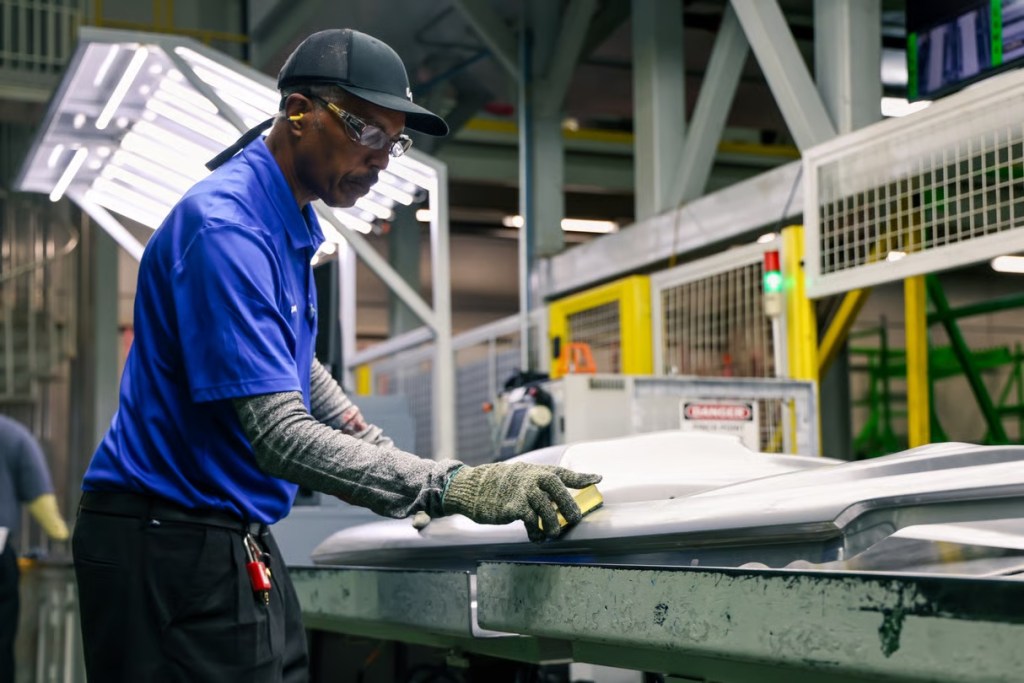
At Kia’s West Point plant, production strategies have evolved to meet market demands. The assembly line now produces a diverse range of vehicles, including gas-powered, hybrid, and electric models. “What we’ve seen is a transition back away from maybe full EV vehicle building to this kind of a middle-of-the-road opportunity,” stated factory CEO Stuart Countess. The shift towards hybrid production reflects changing consumer preferences, driven partly by the absence of federal tax incentives.
Hyundai has similarly adapted its production line near Savannah to include hybrid models. Despite the current volatility, industry experts like Stephanie Valdez-Streaty of Cox Automotive believe manufacturers are adjusting effectively to these shifts.
Additionally, Georgia’s battery manufacturers are diversifying their production to include storage batteries for electricity, alongside vehicle batteries. “The state continues to have a lot riding on the success of both the electric vehicle but also the battery market,” noted Stan Cross of the Southern Alliance for Clean Energy (SACE).
Challenges and Future Prospects
While Georgia leads the region in EV and battery manufacturing, the industry has faced setbacks, including layoffs and reduced investments. Nevertheless, the nearly $74 billion in ongoing manufacturing investments outweighs the $4 billion in scaling back or cancellations.
An unresolved issue is whether Georgia residents will purchase the EVs and hybrids produced locally. Unlike other states, Georgia lacks incentives to promote EV adoption and imposes an extra registration fee for EVs. “When it comes to electric vehicles, Georgia politics remains utterly confused,” commented Cross.
Despite legislative inaction, private investment in charging infrastructure is progressing. Kia and Hyundai, through the IONNA consortium, have established charging stations statewide, including at the West Point Kia plant. Utility companies are also increasing their commitment to vehicle charging infrastructure, with a 14% rise in EV-related investment reported by SACE this year.
Valdez-Streaty believes that local EV production will eventually encourage more Georgia residents to buy these vehicles. “It’s like that familiarity, right? People have jobs at those companies and familiarity with those products,” she explained.
Although the EV market has experienced instability, industry experts see signs of stabilization. The transition to electric vehicles continues, albeit at a slower pace than initially anticipated.
Original Story at valdostadailytimes.com