The growing concern over environmental impacts has led to a shift in how people consider their final resting places. Moira Cathleen Delaney, who cherished nature, chose to become part of the earth itself through a process known as natural organic reduction. Her decision reflects a broader trend toward eco-friendly body disposal methods.
Diagnosed with aggressive intestinal cancer, Delaney passed away in October at 57. Her remains were distributed among her loved ones and used to nurture her beloved backyard tree. “For her, it was a very comforting thought to be able to return to the earth in that kind of way,” explained her son, Marcos Moliné.
Research by the National Funeral Directors Association highlights a rising interest in environmentally conscious body disposal. Concerns over the ecological and health impacts of traditional methods like embalming, fire cremation, and conventional burials drive this trend. Some people prefer their afterlife to remain connected to nature.
“How we die does lead to a substantial impact on not only the people around us and our communities, but the earth itself,” said Mark Shelvock, a psychotherapist and lecturer at Western University in Canada, who co-authored a paper on green death practices.
Conventional Body Disposal Practices
Embalming uses carcinogenic formaldehyde to preserve bodies but poses health risks, as identified by the Environmental Protection Agency. Despite low soil and groundwater contamination risks, the procedure is under scrutiny.
Fire cremation, favored by nearly two-thirds of Americans, relies heavily on fossil fuels. The Cremation Association of North America estimates that the energy used equates to powering a home for a week.
Traditional caskets and vaults, made from energy-intensive materials like wood and concrete, contribute significantly to carbon emissions. Concrete production alone accounts for about 8% of global CO2 emissions.
Furthermore, cemeteries require ongoing maintenance, which demands resources for landscaping. “There’s all of this management that goes into conventional cemeteries that looks very much like a golf course,” remarked Samuel Perry, president of the Green Burial Council.
Natural Burials
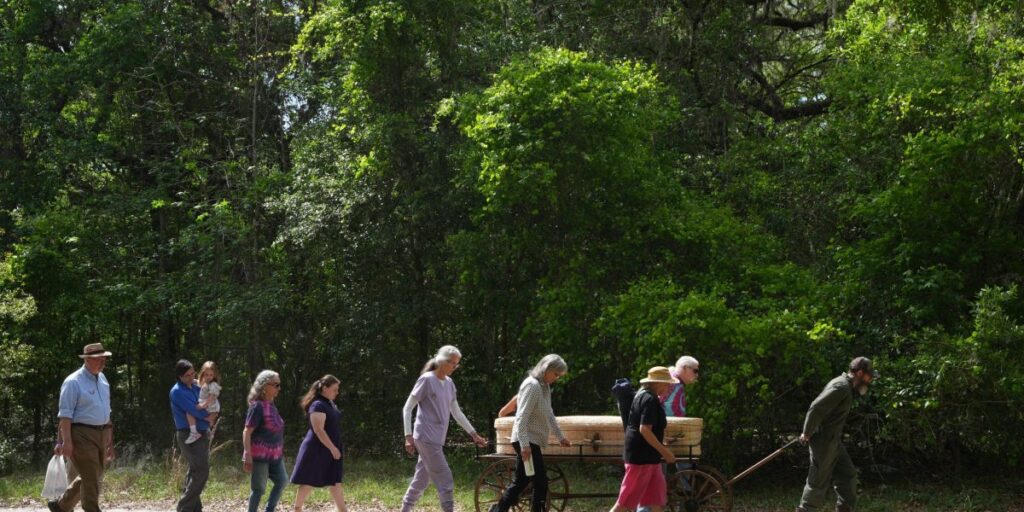
At Prairie Creek Conservation Cemetery in Florida, natural burials emphasize land conservation. Bodies are interred in biodegradable materials like bamboo or cotton, eschewing embalming and vaults. Cremated remains must be in eco-friendly urns.
Initially skeptical, Scott King embraced the simplicity after researching natural burials. His mother, Linda, was laid to rest at Prairie Creek, and his brother Kenneth soon followed. “Through death, life begets life,” King noted.
The cemetery collaborates with a land trust for land management, boosting biodiversity and aiding carbon sequestration. Heather Grove, the cemetery’s executive director, pointed out the ecological benefits.
The Green Burial Council estimates that a green burial can sequester about 25 pounds of carbon.
Researcher Elena Slominski praised conservation burials as an effective carbon sink but acknowledged their impracticality in space-constrained areas.
Natural Organic Reduction — Turning Bodies into Soil
Earth Funeral offers natural organic reduction, or human composting, where bodies are decomposed in a vessel with organic materials. The process, which takes 30 to 45 days, utilizes renewable energy to expedite natural decomposition.
“What we are fundamentally doing is using science and technology to accelerate a completely natural process,” said Tom Harries, co-founder and CEO of Earth Funeral. The resultant soil is distributed to families and conservation projects.
This practice is legal in 14 U.S. states, with legislation pending in 15 more. It presents a viable option for urban areas with limited burial space.
Alkaline Hydrolysis — Using Water for Cremation
Alkaline hydrolysis mimics natural decomposition using water and potassium hydroxide. At Be a Tree in Colorado, bodies undergo a process taking about 18 hours, resulting in remains returned as powder or stones.
Founder Emily Nelson noted that the process uses liquid waste for conservation efforts, utilizing 90% less energy than fire cremation.
While the environmental impact of individual choices may be minimal, Samuel Perry emphasized the importance of industry-wide change to achieve significant ecological benefits.
___
Daniel Kozin contributed to this report from Gainesville, Fla.
___
The Associated Press receives support from the Walton Family Foundation for coverage of water and environmental policy. The AP is solely responsible for all content. For all of AP’s environmental coverage, visit https://apnews.com/hub/climate-and-environment
Original Story at fortune.com