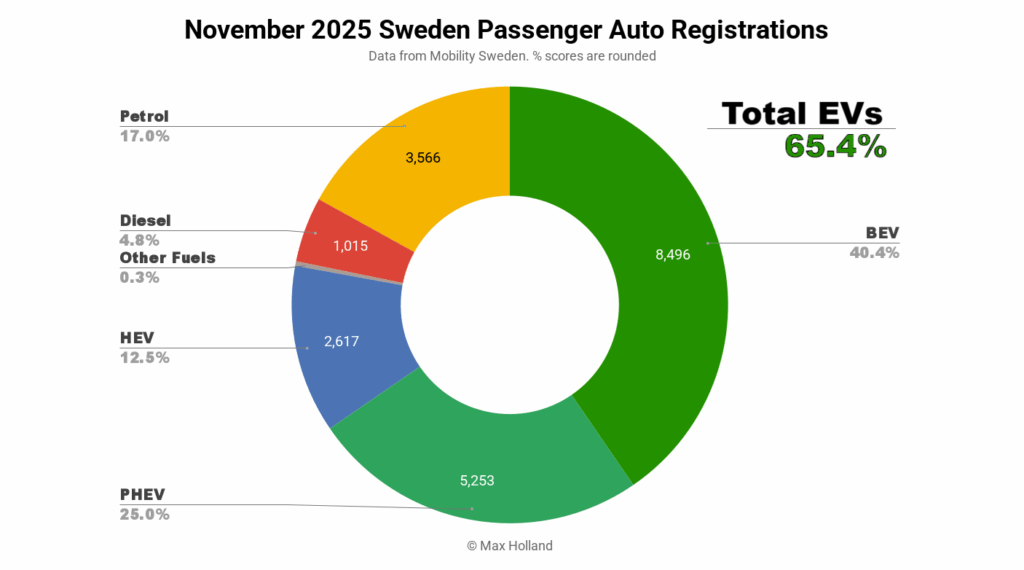
Electric vehicles are steadily taking over the Swedish automotive market, with November’s sales figures reflecting this ongoing transformation. Plug-in electric vehicles (EVs) dominated the market with a notable 65.4% share, a rise from the 61.7% recorded in the same month last year. While battery electric vehicles (BEVs) saw an increase in market share despite a drop in volume, plug-in hybrid electric vehicles (PHEVs) maintained steady figures.
In total, 21,016 vehicles were sold in Sweden last month, marking a 15% decline in overall sales compared to the previous year. Notably, the Volvo EX40 emerged as the best-selling BEV for the month, continuing its strong performance in the market.
Market Dynamics and Trends
The breakdown for November showed BEVs holding a 40.4% share, with PHEVs at 25.0%. This is in contrast to last November’s figures of 36.3% for BEVs and 25.4% for PHEVs. Despite a 6% drop in BEV volumes year-on-year, the overall market contraction, particularly in internal combustion engine (ICE) vehicles, allowed for an improved share for BEVs. A significant factor in the decline of BEV volumes was the Tesla Model Y, which delivered approximately 850 fewer units than in the previous year.
Looking ahead, the market may be influenced by new government incentives aimed at promoting BEV adoption, specifically targeting lower-income consumers in rural areas. Although these incentives will commence in the first half of 2026, they may already be affecting purchasing decisions as consumers anticipate their potential benefits.
Meanwhile, the share of combustion-only vehicles reached near-record lows, accounting for just 21.8% of the market, with volumes dropping over 30% year-on-year.
Top Performers and New Entrants
Volvo’s EX40 retained its position as the top-selling BEV, a title it has held for four out of the past five months. Following closely were the Volkswagen ID.7 and the Kia EV3, maintaining a consistent top-three lineup since October.
In November, Renault’s new model, the Renault 5, had its best month yet with 198 units sold, while the Mercedes CLA sedan achieved a record volume of 146 units. Newcomers to the market included the Kia EV5, which debuted with an impressive 76 units sold, and the Kia PV5, which launched with 55 units. These models, alongside the Suzuki Vitara’s modest entry with 29 units, are expanding the variety and competition within the Swedish EV market.
Future Prospects and Economic Context
The introduction of a new BEV incentive scheme in early 2026 is expected to further accelerate Sweden’s transition to electric vehicles. This scheme will not only apply to new BEV purchases but also to used BEVs, potentially boosting their market value and encouraging existing owners to upgrade.
In the broader economic landscape, Sweden’s economy appears to be on an upswing with a recent report showing a 2.6% year-on-year GDP growth in Q3 2025. Inflation rates have decreased significantly, and interest rates have remained stable since late September, creating a favorable environment for continued growth in the EV sector.
For more insights and updates on Sweden’s EV market, visit CleanTechnica’s Substack or support their work via Stripe.
Original Story at cleantechnica.com