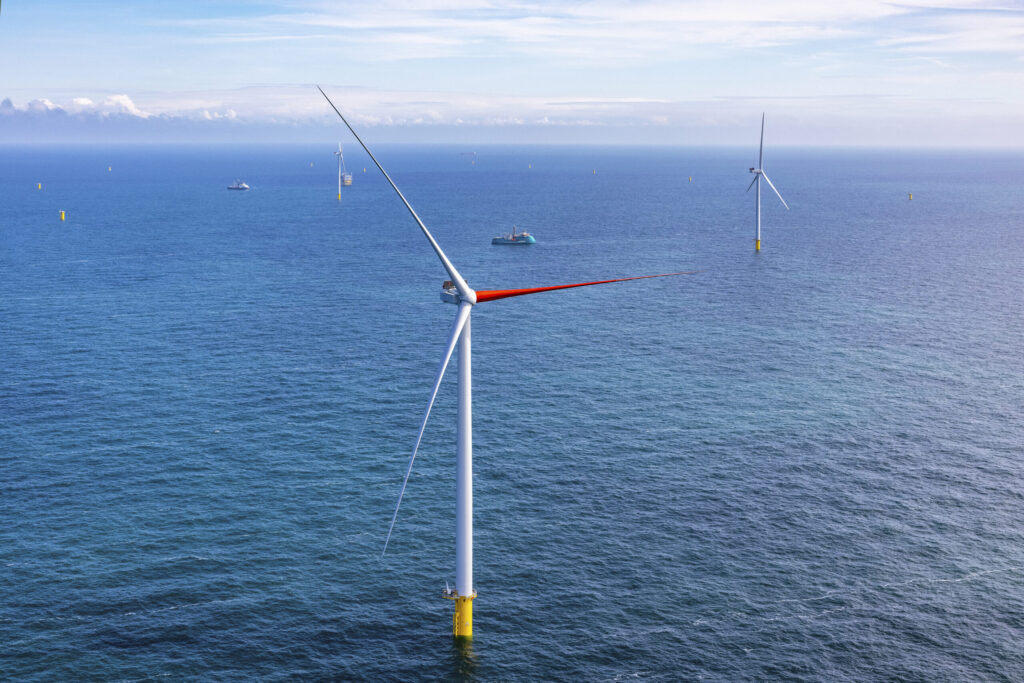
The 760 MW Hollandse Kust West VI offshore wind farm has been successfully linked to TenneT’s offshore grid. It recently began generating its first carbon-free energy.
Developed by Ecowende, a joint venture between Shell, Chubu, and Eneco, the wind farm is situated 53 kilometers off the Dutch coast. Comprising 52 wind turbines, each with a power output of 15 MW, offshore construction began in December 2025 with the setup of the first monopile. Full commercial operations are expected by late 2026.
Upon completion, the wind farm will produce 3.3 TWh of renewable electricity annually, equivalent to about 3% of the Netherlands’ total electricity demand.
“We are thrilled to see the first green electrons from Ecowende. Achieving first power is a significant milestone. Our focus continues on safely commissioning the remaining assets to ensure long-term clean electricity generation,” said Ekansh Aggarwal, Commissioning Manager, Ecowende.
The Ecowende wind farm connects to the Dutch onshore grid through TenneT’s high-voltage offshore infrastructure. TenneT, the developer of the ‘offshore power socket,’ collaborates closely with Ecowende and relevant ministries and coastal authorities.
“Linking Ecowende to our offshore grid is crucial for advancing the Netherlands’ renewable energy infrastructure. TenneT is proud to help deliver clean power from the North Sea to Dutch consumers,” said Robin van Buchem, Head of Operations NL, TenneT.
Day-to-day operations and maintenance are handled by Eneco Wind Offshore Operations and Vestas Services.
Electricity trading is managed by Next Kraftwerke, SEEL, and EET. Next Kraftwerke began marketing Ecowende’s electricity on July 4, functioning as Balancing Service Provider (BSP) and Congestion Service Provider. It manages system integration and congestion across day-ahead, intraday, and balancing energy markets.
“Ecowende illustrates successful renewable energy integration and market optimization, contributing to grid stability and economic performance,” said Marc Rühs, CEO, Next Kraftwerke.
The wind farm supports grid stability by providing balancing energy, such as automatic negative frequency reserve (aFRR), which helps maintain power grid frequency by adjusting electricity supply.
In a bid to reduce bird collision risk, Vestas is testing seven turbines with a red-painted blade. Additional above-water measures include a bird corridor, wider turbine spacing, elevated nacelles, adaptive curtailment, and AI-assisted radar monitoring for birds and bats.
Underwater, specialized scour protection creates habitats for fish and other marine species, while the monopile foundations include fish holes to enhance fish habitat. These measures are part of Ecowende’s goal to harmonize offshore wind development with nature.
Original Story at www.offshorewind.biz