Solid-state batteries, often hailed as the “holy grail” of electric vehicle (EV) battery technology, are making significant strides toward reality. As these promising energy solutions transition from research labs to the open roads, they bring with them the potential to extend driving ranges to over 800 miles.
New Horizons for EV Range with Solid-State Batteries
In a noteworthy development, several leading Chinese car manufacturers are preparing to test solid-state batteries in their vehicles soon. Among them, BYD and CATL, which together commanded over 55% of global EV battery sales last year, anticipate commencing small-scale production by 2027.
Dongfeng Motors has already embarked on testing a solid-state battery prototype under extreme cold conditions. This prototype features an energy density of 350 Wh/kg, enabling a range exceeding 1,000 km (620 miles) based on CLTC standards. Learn more here.
Changan Automobile is gearing up for trial installations by the end of Q3 2026. Their “Golden Bell” all-solid-state battery claims an energy density of 400 Wh/kg, offering a driving range surpassing 1,500 km (932 miles) on the CLTC cycle. Read more here.
During a recent “Battery Night” event, Chery unveiled its all-solid-state battery, which also promises a range of over 1,500 km (932 miles). The battery features a 600 Wh/kg energy density and forms part of the “Rhino” series, set to be tested in vehicles like the Exeed ES8 next year.
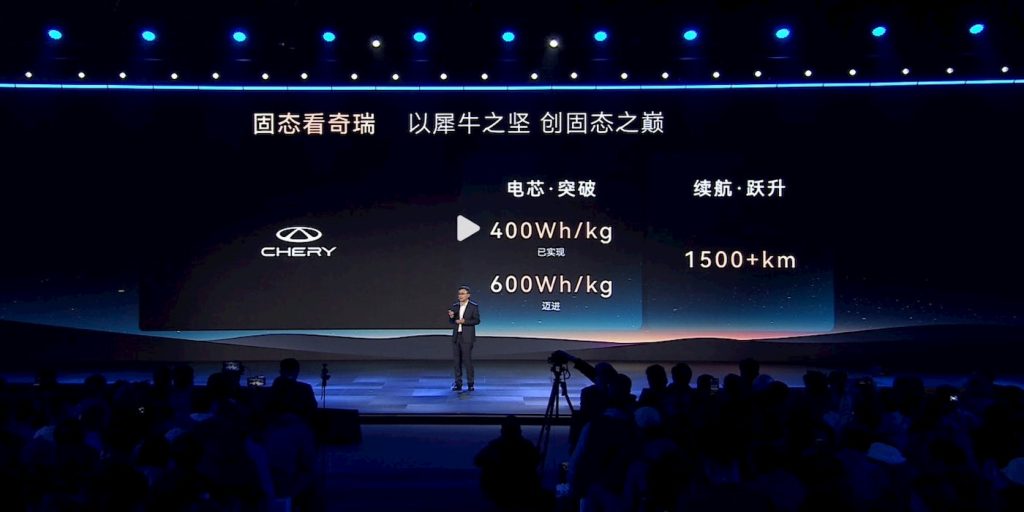
Chery’s Rhino range also includes a 400 Wh/kg solid-state “S-Series” battery and the “E liquid” semi-solid-state battery. The S-Series is slated for the Exceed ES sedan, while the semi-solid-state variant will debut in the Exceed EX7 later this year.
Chery’s “E liquid” battery can add 500 km (310 miles) of range in just 8 minutes with up to 1,200 kW of charging power.
Meanwhile, BYD has introduced its Blade Battery 2.0 and Flash Charging Technology, offering vehicles the capability to charge from 10% to 70% in 5 minutes and achieving 1,000 km (621 miles) CLTC range.
Solid-state batteries are increasingly becoming the focal point of advanced EV battery technology, offering enhanced energy density, longer lifespan, increased driving range, swift charging, and heightened safety.
Global Race for Solid-State Battery Advancement
While China endeavors to sustain its leadership in battery innovation, other regions, including Japan, Europe, Korea, and the United States, are swiftly advancing toward bringing solid-state technology to market.
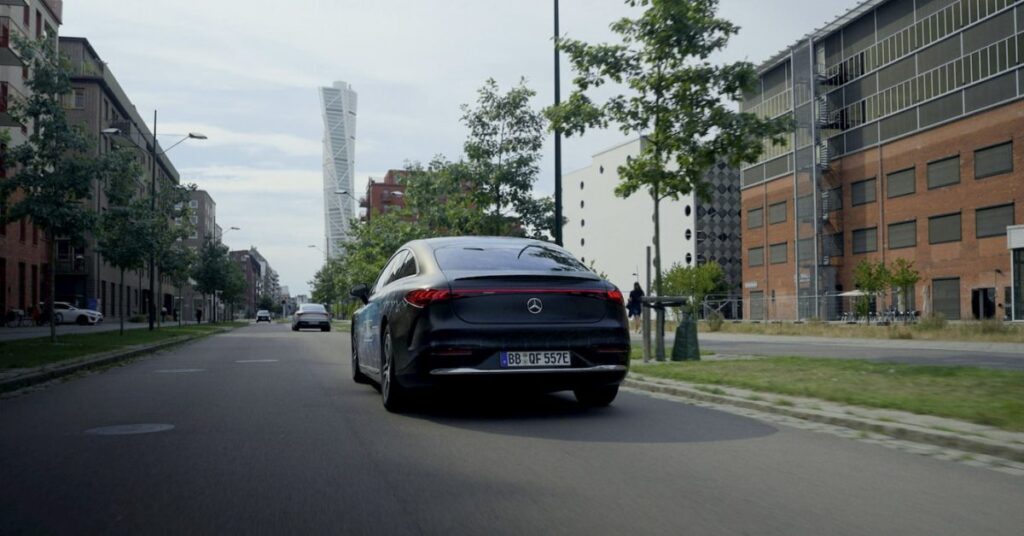
Mercedes, for example, has tested a modified EQS driving over 1,200 km (745 miles) with 106 Ah solid-state battery cells from the US-based Factorial Energy. Factorial has also launched the first commercial solid-state battery program in the US in partnership with Karma Automotive.
During an interview with The New York Times, Factorial stated that their solid-state batteries could be available in EVs by 2027.
The company’s Solstice platform boasts an energy density of up to 450 Wh/kg, about 80% higher than traditional lithium-ion batteries, potentially offering over 600 miles of range.
Factorial has secured collaborations with leading OEMs such as Mercedes-Benz, Stellantis, Hyundai, and Kia to advance solid-state battery technology.
Original Story at electrek.co