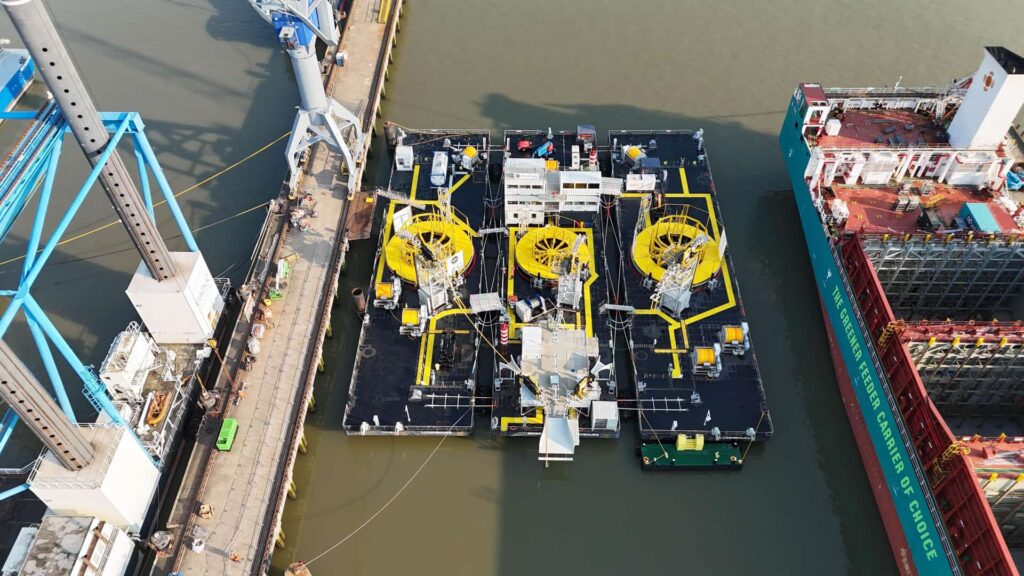
Belgian offshore contractor Jan De Nul plans to simultaneously install three subsea power cables and a fibre optic cable on several upcoming offshore grid connection projects for TenneT, introducing an industry-first installation approach.
This project involves the BalWin4, LanWin1, LanWin5, and BalWin5 grid connections in the German North Sea. Jan De Nul will initiate the first subsea cable project this summer.
Approximately 2,000 kilometres of cables will be installed and protected to connect upcoming offshore wind farms to the onshore grid. Jan De Nul will install three power cables and a fibre optic cable simultaneously on the seabed—a first in the sector. Part of this work will occur in the eco-sensitive Wadden Sea, requiring specialized methods due to shallow waters and intertidal conditions.
Jan De Nul has built a special cable-laying barge, Waadrinner, comprising three linked pontoons with cable carousels. These pontoons function as a single platform to lay cables simultaneously over about six kilometres, minimizing seabed pressure in the shallow environment.
The company upgraded its cable burial machine, Sunfish, to bury three power cables and a fibre optic cable at once. This system uses high-frequency vibrations, a less invasive method compared to traditional techniques like cutting or high-pressure jetting.
The nearshore installation phase is planned for 2026, with offshore sections in deeper North Sea waters scheduled from 2027. This will involve Jan De Nul’s vessels Fleeming Jenkin and William Thomson.
These projects are part of a long-term agreement between TenneT and a consortium including Jan De Nul, LS Cable & System, and Denys, signed in 2023. The consortium was awarded contracts for designing, manufacturing, and installing 525 kV HVDC cable systems for the BalWin4, LanWin1, and LanWin5 grid connections in 2023, alongside a letter of allocation for HVDC cables for the BalWin5 project in 2024.
Original Story at www.offshorewind.biz