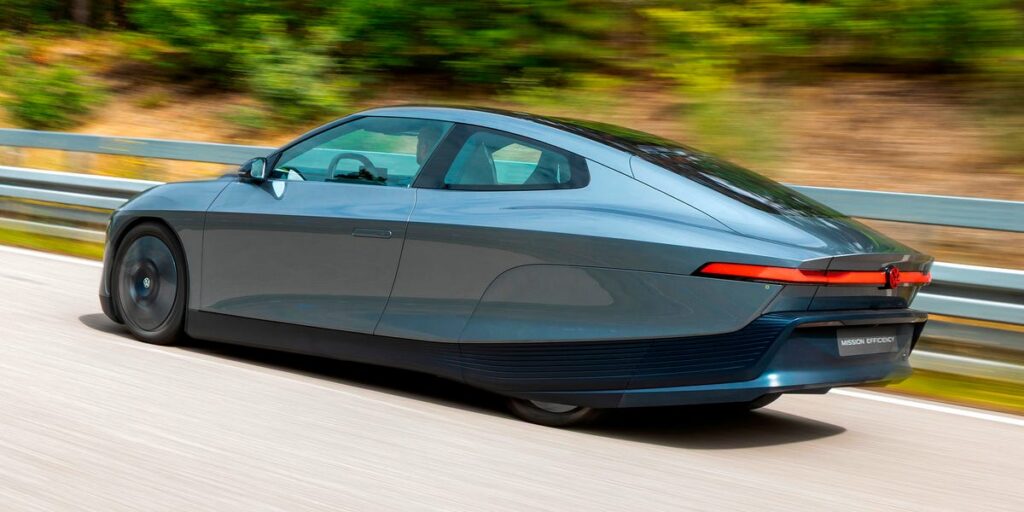
Volkswagen’s Mission Efficiency: A New Era of Aerodynamic Electric Vehicles
In an era where efficiency is paramount, Volkswagen’s latest prototype, the Mission Efficiency, pushes the boundaries of aerodynamics and electric vehicle (EV) design. Drawing inspiration from the historic Volkswagen XL1 diesel-hybrid, this new concept car showcases remarkable advancements in energy optimization.
A decade ago, the XL1 astonished the automotive world with its ability to travel 100 kilometers on a single liter of fuel, achieving an impressive 250 miles per gallon. Volkswagen produced a limited number of these vehicles, which were priced similarly to a Porsche 911. The automaker also experimented with a 197-hp Ducati engine in the XL1, highlighting its innovative spirit.
Despite recent financial challenges, Volkswagen continues to invest in research and development. The Mission Efficiency project embodies this commitment, utilizing the ID. Polo’s 133-hp powertrain and a 55-kWh battery pack. The prototype’s aerodynamic design enhances its efficiency by 30% at speeds above 50 mph.
The Mission Efficiency car is unlikely to reach showrooms, but it serves as a proof of concept for maximizing range from a modest battery. The vehicle boasts a drag coefficient of just 0.158, allowing it to achieve 9.6 miles per kWh of charge under optimal conditions.
Volkswagen conducted a real-world test, driving from its Wolfsburg R&D center to Vienna. The Mission Efficiency traveled 794 miles with just one charging stop, and still had 102 miles of range remaining. This equates to approximately 8.3 miles per kWh, accounting for energy lost during charging.
This remarkable efficiency is attributed to the car’s innovative design, featuring faired-in rear wheels, a teardrop silhouette, active aerodynamic cooling flaps, and a focus on weight reduction. Notably, the vehicle lacks an onboard touchscreen for infotainment, emphasizing its minimalist approach.

By showcasing the potential for aerodynamic optimization, Volkswagen challenges the conventional reliance on larger batteries for extended range. The Mission Efficiency sets a new standard for future electric vehicles, demonstrating that efficiency can be achieved through innovative design.
While the Mission Efficiency may not feature a Ducati engine, its performance and design have certainly accomplished their mission. As Volkswagen continues to refine its electric vehicle technology, the insights gained from this prototype could shape the next generation of EVs.
Original Story at www.caranddriver.com