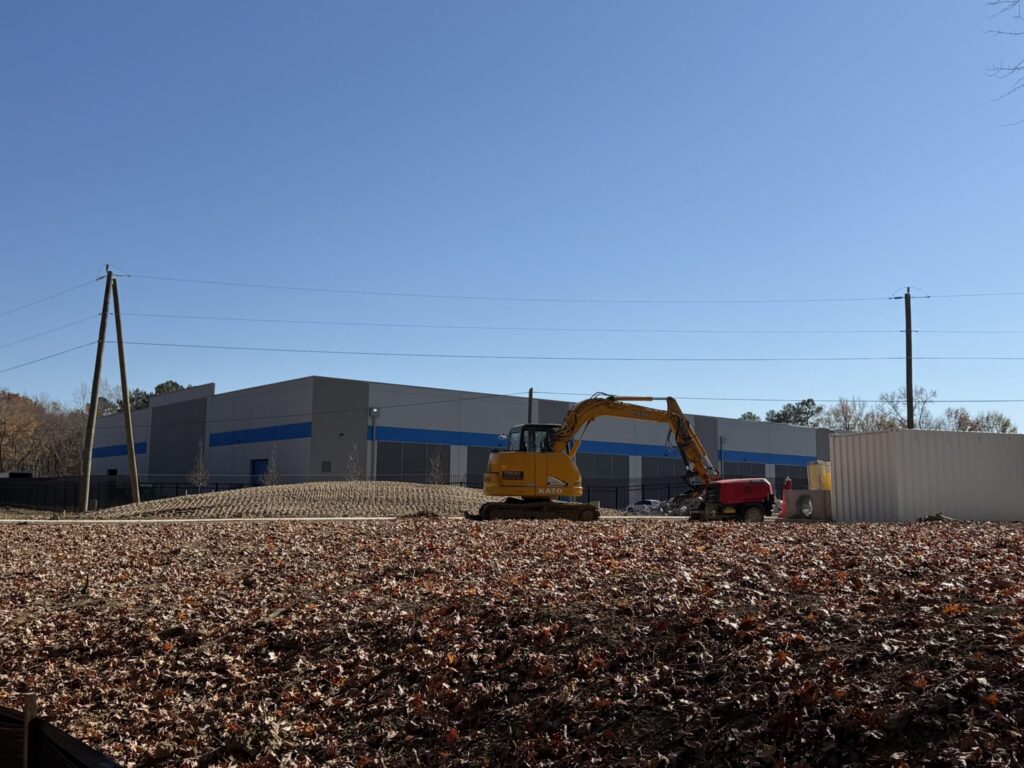
Virginia is at a crossroads over one of the fastest-growing industries in the country, and communities across the state are demanding the government slow down before the consequences become irreversible. On Wednesday, more than a dozen environmental organizations gathered in Hanover County — steps away from a hyperscale data center already under construction — to call for an immediate statewide halt to new data center approvals.
The demonstration took place outside the Hanover Humane Society in Ashland, where a large data center facility was built through a “by-right” permit — a process that required no public hearings and no vote by county supervisors. For many residents and environmental advocates, that lack of oversight is exactly the problem.
Blair St. Ledger Olson of the Virginia League of Conservation Voters captured the frustration felt by many in attendance:
“Here in Ashland, Big Tech swoops in, pulls the wool over our eyes and breaks ground before we’re able to fight back.”
A Growing Industry, A Growing Backlash
Virginia is already home to more than 400 data centers in operation, with roughly 280 more planned or proposed. The scale of that expansion has prompted a broad coalition of groups — ranging from longtime advocates like the Sierra Club to newer voices like the Chesapeake Bay Foundation — to unite around a single demand: pause all new data center permit approvals and grid connections until stronger regulations are in place.
The groups are asking the state to address several specific concerns: greater transparency in how data centers are permitted and operated, stronger protections for nearby residents, clean energy requirements for new facilities, safeguards for drinking water sources and private land, and assurances that ratepayers won’t bear the cost of energy infrastructure built primarily to serve data centers.
Regulatory Efforts Underway, But Critics Say Not Fast Enough
Nate Benforado of the Southern Environmental Law Center acknowledged that some reforms are already moving through Virginia’s regulatory system — including a new GS5 rate class for large-load customers under Dominion Energy and efforts to shift more transmission costs onto those customers. But he cautioned against relying solely on those efforts.
“There are some utility reforms underway at our utility commission. But I’ll tell you from being in that courtroom, it is slow and it is incomplete,”
Benforado said.
Gov. Abigail Spanberger unveiled her own data center accountability framework last month, which some of Wednesday’s groups had initially supported. Her plan includes a proposed ban on nondisclosure agreements, enhanced air and water protections, requirements for cleaner backup generators, and measures to direct infrastructure costs toward the data center industry. However, several of the environmental organizations at Wednesday’s rally broke with the governor’s approach on a key point: her plan does not call for a full moratorium while the legislature works through a broader regulatory package.
Elena Schlossberg of the Coalition to Protect Prince William County made the urgency plain:
“We don’t have six months, we don’t have a year. The pause needs to happen now. Not one more hookup if it means another Virginian loses their property, if it means they’re gonna breathe in more diesel generator fumes. Enough is enough.”
Water Concerns Draw New Groups Into the Fight
One of the most significant developments at Wednesday’s event was the formal opposition from the Chesapeake Bay Foundation, an organization that had previously declined to support a moratorium. This year’s historically dry conditions throughout the Chesapeake Bay Watershed pushed the Foundation to reconsider its position.
Data centers that use evaporative cooling systems — a common design — can consume hundreds of millions of gallons of water per year. Virginia’s Department of Environmental Quality is currently studying areas east of Interstate 95 that may be designated as “water scarcity zones,” where data center development using those cooling systems would be restricted. That report is expected to be released this month.
Jay Ford, the Chesapeake Bay Foundation’s Virginia Policy Manager, explained the shift in his organization’s stance:
“Last General Assembly, we did not support a moratory. But I think that is really representative of how this issue has moved and something that we hope that the governor and her team are taking note of.”
DEQ is also working to establish noise regulations for data centers, examining how quietly these facilities can realistically operate in order to set consistent statewide standards. Spanberger has proposed legislation to expedite that process.
Legislation and Industry Opposition Ahead of January Session
Several moratorium bills have already been filed for the 2027 General Assembly session, which opens January 13. Among them is a proposal from Sen. Russet Perry, D-Loudoun, calling for a three-year pause on approvals — time the senator says is needed to build a comprehensive regulatory framework that protects both communities and utility customers.
The data center industry is pushing back firmly. Nicole Riley of the Data Center Coalition argued that a moratorium would put Virginia at a competitive disadvantage:
“We join the many local governments, economic developers, business leaders, and labor unions who believe a top-down, statewide moratorium is the wrong approach to regulating this economically impactful industry. States and communities that signal that they are closed for business and investment risk relinquishing substantial long-term economic investment, high-wage jobs, and critical tax revenue to neighboring areas or other states.”
Virginia’s economic development and energy and environment debates are now deeply intertwined, and reporting by journalists like Shannon Heckt has helped bring the scope of the issue into public view. As legislators return to Richmond in January, the competing pressures of economic growth, environmental protection, and community safety will all be on the table.