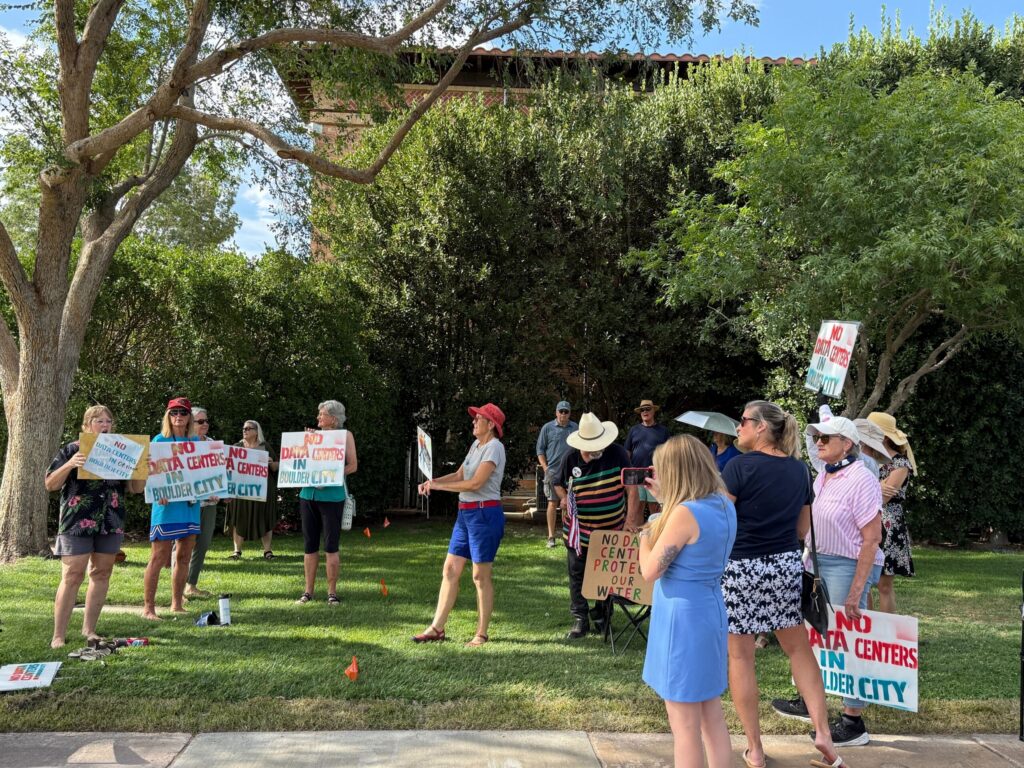
Water bills, power costs, and who gets to decide what gets built in your backyard — these are the kinds of kitchen-table concerns that drove voters across Nevada to send a clear message on Election Day. In one small desert city, that message came through louder than almost anything else on the ballot.
Residents of Boulder City, Nevada, voted by nearly 71 percent to block data centers from being built on city-owned land in the Eldorado Valley — a margin that outpaced even high-profile statewide questions on abortion rights and voter ID. The lopsided result is striking in a city where registered Republicans outnumber Democrats more than 2 to 1, showing that opposition to data centers cut across party lines in a big way.
The vote was part of a broader national trend. Voters rejected data center proposals in 40 out of 41 local ballot measures last week, according to preliminary tallies. But an analysis by Heatmap, a climate and energy news site, found that opposition to data centers didn’t dramatically reshape how communities voted for candidates — people mostly voted for the same candidates they would have anyway.
What Families Are Worried About
At the heart of the debate are concerns that many ordinary families understand instinctively: Where does the water come from? Who pays when the power grid gets strained? And do regular residents have any say in what gets planted next door?
There are now more than 80 data centers operating, under construction, or planned across Nevada, according to a tracker maintained by More Than Just Parks, a group focused on protecting public lands. These massive facilities consume enormous amounts of water and electricity — resources that families in the arid Southwest rely on and pay for every month.
Rashonda Stubblefield, a 40-year-old small-business owner, said the issue was important enough to bring her to the polls for her first midterm election. She told The Nevada Independent on Election Day that the Reno mayor’s race, partly driven by the data center debate, motivated her to vote.
“I’m not an AI or data center fan … especially on public land. I love Nevada and it’s beautiful and I don’t think [they] should be taking up our resources, put them somewhere else,”
she said.
Adam Schultheis, a Boulder City candidate who built his campaign around opposing data centers, echoed those concerns after talking with roughly 2,000 voters while knocking on doors.
“I’m not against data centers per se. I’m against them in the Southwest, where the water element is huge,”
he said.
A Pocketbook Issue — But Not the Top One
Nationally, a majority of voters said AI and data centers were a crucial or major factor in their vote for Congress. But the Associated Press found the issue was less motivating than the cost of living — a reminder that for most families, putting food on the table and paying rent still tops the list.
In Nevada, exit polling found that a quarter of voters called data centers a crucial factor in their vote. Those voters backed Attorney General and now Governor-elect Aaron Ford (D) over Republican incumbent Gov. Joe Lombardo by more than 2 to 1. Sixty-nine percent of Nevada voters surveyed said they opposed building a new data center in their community.
David Damore, a political science professor at UNLV, said data centers weren’t a single cause of the Democrats’ gains, but they fed into something bigger — a sense that those in power were siding with large corporations over everyday people.
“I think it was just sort of the perfect populist issue at the perfect populist moment,”
he said.
Damore noted that the voters most fired up about data centers were likely already leaning toward Democrats anyway. The issue gave them one more concrete reason to vote that way. He said he hasn’t seen evidence that data center opposition drove higher turnout on its own.
Outgoing Assemblywoman Rebecca Edgeworth (R-Las Vegas), one of five Republicans whose legislative seat flipped to Democrats this cycle, summed up the broader dynamic:
“It seemed like the main thing that people were interested in this voting cycle in the entire country was if you were a D or an R.”
Boulder City’s Complicated Result
Boulder City’s ballot measure asked whether data centers should be allowed on roughly 14,000 acres of city-owned land in the Eldorado Valley — land currently used for solar energy, battery storage, and a natural gas plant. City leaders had argued that new revenue was needed as existing solar leases expire. Opponents raised concerns about water and power consumption.
The vote followed months of community pushback over a separate data center proposed on federal land within city limits. The Bureau of Land Management approved that project in June, but the city appealed the decision, and a federal appeals board threw out the approval in October.
Damore said the pitch from a solar developer to build a data center in a city that prides itself on clean energy likely struck residents as a betrayal of values.
“It’s a little bait and switch,”
he said.
Despite the landslide “no” vote on data centers, Boulder City voters re-elected Mayor Joe Hardy — who had expressed openness to data centers in May — with about 77 percent of the vote. Both incumbent city council members, Steve Walton and Cokie Booth — who also didn’t take hard-line positions against data centers in a local questionnaire — finished first and second in their races. Booth had cast the lone vote against putting the ballot question before voters at all.
This kind of split — where voters back a ballot measure that conflicts with the positions of the candidates they elect — fits a well-documented pattern in American politics. Voters often don’t connect a ballot measure to the stances of the candidates on the same ticket.
Schultheis, whom organizers of a petition against data centers in Boulder City promoted as their candidate, finished third. He said many residents he spoke with simply didn’t know that council members had been open to data center development.
“A lot of people voted for me and the establishment, which would have been Booth and Walton,”
he said.
Voters also narrowly approved a separate measure giving the city more flexibility to spend money it already collects from land leases — a sign that residents weren’t simply voting “no” on everything the city proposed.
The Governor’s Race and What Came Next
At the statewide level, Nevada’s historic Democratic wave in this election cycle swept out Lombardo, who had publicly championed data center growth. In a June op-ed, Lombardo called data centers an opportunity to diversify Nevada’s economy — provided guardrails kept residents from paying higher utility bills and protected the state’s water supply. In August, he told the Latin Chamber of Commerce that data centers could be a new gold rush with the right protections in place.
But by September, with Democrats running TV ads linking him to the industry, Lombardo signed an executive order tightening requirements for data center tax breaks. The move came just days after Axios reported that a Trump pollster had warned Republican candidates that unqualified support for data centers was a losing political position.
It wasn’t enough. Damore said the late pivot likely failed to change voters’ minds, particularly with President Donald Trump fully embracing the data center industry at the national level while Republicans down the ballot tried to carve out more careful positions.
“Voters really weren’t in the mood for nuance,”
Damore said.
Ford, who had pledged to pause new data center tax abatements a full month earlier — even though he had co-sponsored the 2015 law that created them — won the race by nearly 8 percentage points.
In a statement, Ford said his top priority as governor-elect is lowering costs for working families.
“I’ve been clear that data centers will have to use an alternative to our fresh water, build out the grid and pay for their increased clean energy use and deliver on their promise of sustainable high-paying union jobs,”
he said.
Reno and Down the Ballot
The sharpest candidate contrast on data centers played out in the Reno mayor’s race. Councilmember Kathleen Taylor had cast the only vote against the city’s moratorium on new data center approvals, arguing the pause was political and that she preferred fast-tracking code changes instead. In a September campaign ad, she made her case directly:
“I’m not against technology. I’m against a bad deal.”
Her opponent, former Lt. Gov. Kate Marshall, backed the moratorium and ran ads calling Taylor the “Data Center Queen.” Marshall won comfortably.
Taylor had highlighted her conservative background in the nonpartisan race, while Marshall leaned into her Democratic endorsements.
Further down the ballot, Democrat Vinny Spotleson, who opposes continuing data center tax abatements and supports a temporary moratorium, won Assembly District 41. In Assembly District 35, Democrat Joe Spica beat Republican incumbent Rebecca Edgeworth after framing her as a rubber stamp for Lombardo’s data center policies. Spica has opposed continuing the tax abatements. Republican attorney general candidate Adriana Guzmán Fralick, attacked over earlier comments suggesting Nevada should embrace data center growth, lost to Democratic state Sen. Nicole Cannizzaro, who called for more consumer protections for Nevadans affected by the industry.
Now the debate moves to the Nevada Legislature, which convenes February 1 with Democrats controlling both chambers and the governor’s office. Ford has promised to pause new tax abatements. State Sen. Dina Neal (D-North Las Vegas) plans to introduce a bill in 2027 to repeal data center tax breaks and impose a moratorium on new projects. Cannizzaro has requested her own bill requiring environmental reviews, closed-loop cooling systems, and public reporting of water and power use — and giving residents a formal say in siting decisions.
Damore framed the core question heading into the legislative session in terms that any family paying a monthly utility bill can understand:
“Ultimately, I think the question for the Legislature is: Do we need to subsidize this? And I think the answer is probably going to be no.”
He added that lawmakers’ biggest challenge will be deciding who pays for the massive power and grid upgrades these facilities require — and making sure those costs don’t end up on everyone else’s electricity bills.