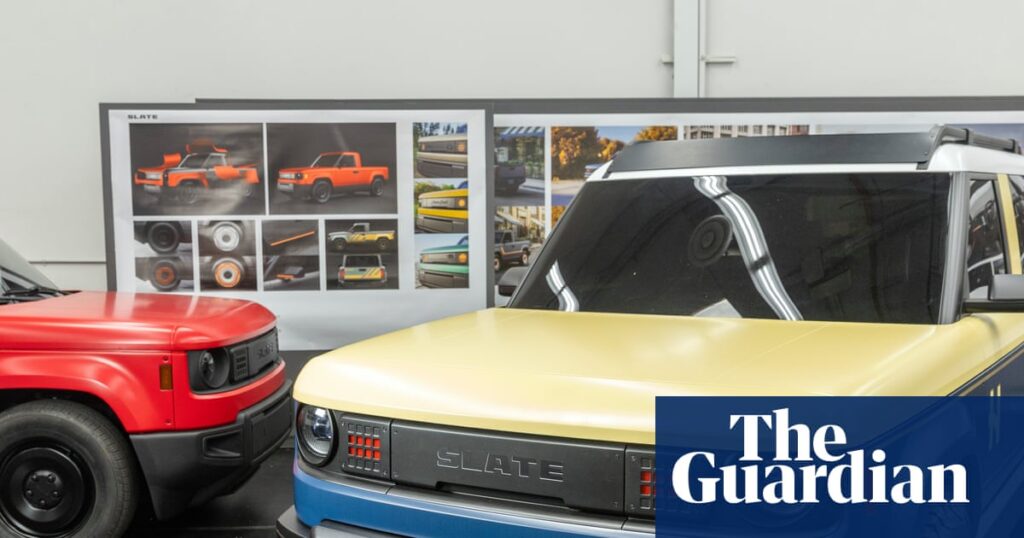
New Detroit-Based EV Startup Slate Auto Aims to Shake Up the Market
In a bold move within the electric vehicle (EV) sector, a new Detroit-based company, Slate Auto, has entered the market, offering a unique proposition to American consumers. Backed by Jeff Bezos, Slate Auto presents a pickup truck that stands out for its affordability, a rarity in the current US automobile landscape.
With a starting price of $24,950, this new entrant is positioned as one of the most cost-effective vehicles available in the US, nearly half the cost of the average new vehicle. However, despite its competitive pricing, Slate Auto faces challenges as it navigates the rapidly evolving global EV market, which is increasingly dominated by inexpensive Chinese cars that retail for as low as $10,000.
The influence of Chinese-manufactured cars is significant, with about 20% of new cars sold in the UK in December being Chinese-made, and they accounted for 12% of sales over the past year. In the European Union, these vehicles made up approximately 6.4% of sales, despite facing new tariffs. Notably, these Chinese vehicles are not available in the US market.
As the US automotive industry grapples with shifting political ideologies and consumer preferences, there is a distinct trend towards larger, feature-rich vehicles, aligning with domestic manufacturers’ production strategies.
Proponents of EV technology argue that the US is losing substantial ground to China in this crucial market sector. Dan Krassner, executive director of the American EVs Jobs Alliance, emphasized the importance of the US reclaiming its position. “We can’t hand the whole auto industry to Beijing,” Krassner stated. “EVs are the big manufacturing prize of the century, and America has to get back in the race.”
Slate Auto recently began accepting preorders, potentially filling a void in the domestic market. A significant decline in affordable vehicles is evident, with fewer than 5% of new cars sold for $25,000 or less last year, compared to nearly 21% in 2019, as per Edmunds data. During this period, the average new vehicle transaction rose by approximately $11,000, reaching $48,402.
Currently, Slate offers one of only eight US models available under $25,000. In contrast, China boasts over 200 EVs and hybrids within the same price bracket, according to industry analyst DCar.
The minimalist Slate truck, priced below $25,000, features basic amenities, including hand-crank windows, standard cruise control, and a smartphone mount instead of a navigation system. It offers an estimated range of 205 miles and is compact, reminiscent of 1980s Ford Rangers at just 14.5 feet in length.
Additional features, such as a stereo, fob, or conversion into a five-seat SUV, incur extra costs. Vinyl wraps are also available as an alternative to traditional paint, reducing Slate’s plant requirements for a paint shop.
Jessica Caldwell, executive director of Insights at Edmunds, compared Slate’s model to budget airlines, noting that while the base price is attractive, the cost of necessary add-ons can quickly escalate. She expressed skepticism about the approach’s appeal in the US market, saying, “I don’t think they’re going for the stripped-down version because the features, amenities, and technologies – those are part of why prices in the US are so inflated, because Americans wanted all the additions.”
In comparison, China’s BYD offers vehicles with advanced features, like driver’s assist, at a fraction of Slate’s cost. Their premium models, priced under $15,000, offer a range of 314 miles. BYD aims to become the world’s largest automaker within five years, already surpassing Tesla in EV production.
The cultural divide in car preferences is evident, with US consumers favoring larger, powerful vehicles, while emerging markets in China and smaller European cars embrace practicality and affordability. Despite these challenges, Krassner remains hopeful, citing the attractive price point and potential demand for more affordable EVs. “The price point is really attractive, and we hope Americans see that it matches their budgets and also shows automakers that there is hunger for cheaper electric vehicles,” he said.
Original Story at www.theguardian.com