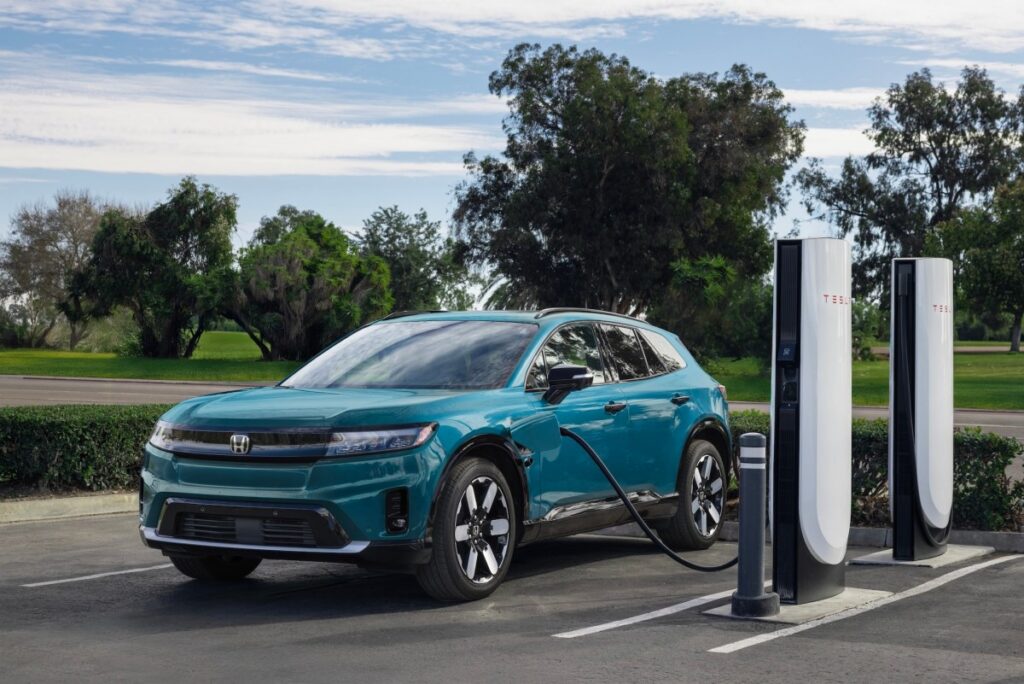
The electric vehicle (EV) landscape in the United States is undergoing a significant shift as several automakers withdraw their EV models from the market. The Honda Prologue is the latest casualty in this trend, marking Honda’s retreat from the all-electric vehicle segment in the U.S., a move that reflects a wider industry pullback in the face of various challenges.
This situation begs the question: which EVs have exited the U.S. market, and what’s driving this trend?
The cessation of the $7,500 federal tax credit has significantly impacted EV sales in the United States. However, the decline in available models also stems from tariffs, shifting consumer preferences, costs, corporate strategies, and regulatory pressures. According to data from Kelley Blue Book and Cox Automotive, the second quarter of 2026 saw 247,226 EVs sold, representing 5.8% of the total market. Despite an increase in sales from the first to the second quarter of 2026, sales remain below the same period last year, prior to the tax credit’s end in late 2025.
While the U.S. market still sees EV purchases and the introduction of new models like the Rivian R2, signs of recovery are emerging. The decline in fourth-quarter 2025 sales compared to 2024 was 36%, but by the second quarter of this year, the gap had narrowed to 20.5% compared to 2025. Nevertheless, many automakers are discontinuing their EV models, and TechCrunch will update its list of EVs exiting the U.S. market in 2026.
Afeela
The Afeela, originally launched as the Vision S by Sony, was a promising prototype at the 2020 Consumer Electronics Show. Honda joined Sony in 2022, forming a joint venture that unveiled an Afeela-branded prototype in 2023. Despite the significant marketing efforts, Afeela never saw production. By March 2026, the joint venture abandoned the Afeela EVs, following Honda’s decision to cancel three planned EVs for the U.S. market.
Honda (and Acura!)

Honda’s ambitious O Series, including a mid-sized SUV prototype, was unveiled at CES 2025, with plans for production in Ohio. Yet, by March 2026, Honda halted development of the Acura RDX, Honda O sedan, and SUV, citing U.S. tariffs and Chinese competition as reasons. Speculation about the Prologue’s discontinuation was confirmed in July 2026, ending production of the model that once sold respectably.
Hyundai

Hyundai has shown success in the U.S. EV market but adjusted its lineup due to economic changes. In March 2026, the company stopped U.S. sales of the Hyundai Ioniq 6, likely influenced by tariff considerations. While the Ioniq 5 and Ioniq 9 are assembled domestically, the Ioniq 6 was imported from South Korea. However, Hyundai will continue importing its premium N-model of the Ioniq 6.
Nissan
Nissan opted out of producing a 2026 model year for the all-electric Ariya SUV in the U.S. The Ariya, introduced in 2020, was Nissan’s first EV since the Leaf hatchback. Despite initial plans for U.S. sales, the model’s future in the American market remains uncertain.
Polestar

Swedish automaker Polestar, under China’s Geely, has been barred from the U.S. due to restrictions on Chinese-connected vehicle technology. Without authorization from the U.S. Department of Commerce, Polestar cannot import or sell new vehicles in the country. However, it will continue to support existing customers and sell remaining Polestar 3 and Polestar 4 stock. The Polestar 3 is assembled both in South Carolina and in China.
Conversely, Volvo Cars, a sibling company owned by Geely, received clearance to continue its U.S. operations.
Tesla Model S and Tesla Model X

In January, Tesla decided to cease production of its Model S sedan and Model X SUV, focusing instead on AI, autonomy, and robotics. Sales for these models had declined as consumers favored the more affordable Model 3 and Model Y. Production of the final Model S and X units concluded this spring, and the assembly lines were dismantled to accommodate Tesla’s new Optimus robots at its Fremont plant.
Volkswagen

Volkswagen has scaled back its U.S. electric vehicle lineup, including the ID.4 SUV and ID Buzz. In April, the company announced it would stop producing the ID.4 at its Tennessee plant, shifting focus to upcoming gas-powered models like the Atlas SUV. Current ID.4 inventory is expected to last into 2027. The ID Buzz, meanwhile, is on hiatus but set for a 2027 return. Volkswagen’s subsidiary MOIA America and Uber began testing autonomous ID Buzz microbuses in Los Angeles as part of a planned robotaxi service launching later in 2026.
Volvo

In March, Volvo announced it would withdraw its EX30 and EX30 Cross Country variants from the U.S. market. Production for these models will cease after the summer. Despite the EX30’s initial promise as an affordable EV, Volvo plans to continue selling the larger, all-electric EX60 and EX90 SUVs in the U.S.
When you purchase through links in our articles, we may earn a small commission. This doesn’t affect our editorial independence.
Original Story at techcrunch.com