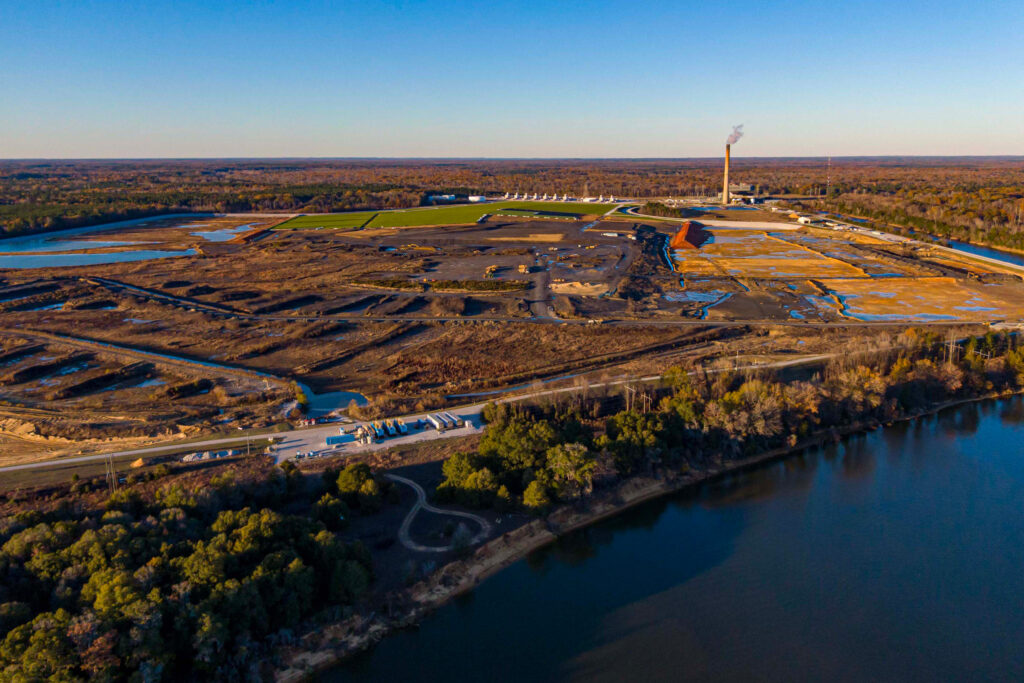
The Trump administration is taking steps to approve a contentious program in Alabama that may allow millions of tons of toxic coal ash to remain buried near the state’s rivers, despite much of it sitting in groundwater where it can leach into the environment.
On Monday, the Environmental Protection Agency (EPA) announced a proposal to approve Alabama’s coal ash permitting program, granting the state authority over the closure of coal ash ponds at major power plants. This is the same proposal the Biden administration rejected in 2024 for not meeting federal standards.
Alabama Power, operating six major coal ash ponds in the state, stated it is reviewing the EPA’s proposed approval. “We remain committed to complying with all state and federal environmental rules and regulations,” the company said.
The proposal would authorize the Alabama Department of Environmental Management (ADEM) to determine if utilities can leave millions of tons of coal ash—containing toxins like arsenic, lead, and mercury—buried near rivers, including the biodiverse Mobile-Tensaw Delta, often called “America’s Amazon.” Learn more about the region’s biodiversity.
The current proposal reverses a 2024 Biden-era EPA rule that rejected Alabama’s coal ash program for being “significantly less protective” than federal law demands, leading to the invalidation of state-issued closure permits.
The Southern Environmental Law Center criticized the Alabama program for being “identical” to the one rejected in 2024 under the Biden administration. “Alabamians celebrated when EPA denied the state’s attempt to leave toxic coal ash in water-filled pits,” SELC senior attorney Nick Torrey said.
EPA Administrator Lee Zeldin stated, “We trust local communities to make decisions that grow the economy and protect health and the environment.” Zeldin emphasized Alabama’s understanding of its resources, referring to coal combustion residuals (CCR), the solid waste from burning coal for electricity.
“Today’s proposal to approve Alabama’s CCR permit program empowers the state, marking a win for cooperative federalism,” Zeldin added.
ADEM expressed satisfaction with the EPA’s proposed approval. “The Department, with its professional staff, believes it is best suited to handle Alabama’s environmental issues, including CCR,” ADEM external affairs chief Lynn Battle stated.
For decades, utilities disposed of coal ash by flushing it into unlined ponds along rivers, where the ash remained in contact with groundwater, allowing contaminants to seep outside the facility. Environmental activists warn that leaving coal ash near rivers could lead to catastrophic events similar to the 2008 Tennessee Valley Authority’s Kingston Fossil Plant disaster.
Alabama’s coal ash ponds have been central to legal battles and community actions for over a decade. Following the 2015 EPA rules on ash pond management, Alabama utilities planned to close ponds by covering the ash rather than relocating it to lined landfills. However, the EPA’s 2024 finding disrupted these state permits, citing insufficient protection for health and the environment.
The EPA stated that previous permits were not included in ADEM’s latest application for the permitting program, meaning those ponds will need renewed approval, allowing public commentary during the permit review process.
Currently, over 117 million tons of coal ash are stored in unlined ponds along Alabama’s waterways. Alabama Power, TVA, and PowerSouth are the primary operators. Alabama Power has faced over $1.5 million in fines related to coal ash contamination.
Environmental group Mobile Baykeeper is suing Alabama Power over a 600-acre coal ash pond near the Mobile-Tensaw Delta. Additionally, Coosa Riverkeeper has sued over groundwater pollution from a pond in Gadsden, Alabama.
The EPA will accept written comments on its proposal to approve Alabama’s program until Sept. 14 and will host a virtual public hearing on Sept. 3, offering opportunities for public feedback.
Original Story at insideclimatenews.org