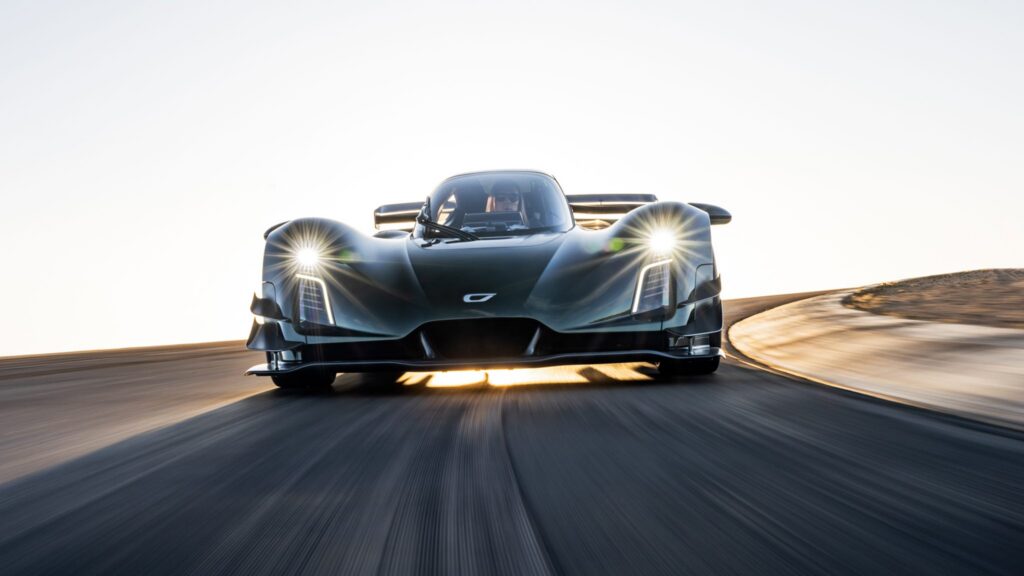
Unveiling the Czinger 21C: A Blend of Art and Engineering
As the sun dipped below the horizon at Chuckwalla Valley Raceway, the Czinger 21C emerged, shimmering like a masterpiece against the desert backdrop. With its striking presence, this vehicle promises not just aesthetics but an exhilarating performance, making it a remarkable piece of automotive engineering.
Upon arrival at the raceway, MotorTrend staff were given a comprehensive orientation to familiarize themselves with the Czinger 21C. This included a briefing and a brief street drive with Czinger’s test driver, Evan Jacobs, seated right behind in the tandem, fighter-jet-style seating configuration. Jacobs, who has been integral to the Czinger project, ensured the process was swift, thanks to the car’s minimalist design that forgoes superfluous controls. The most challenging part? Mastering the “butt pirouette” for a graceful entry and exit.
The unique seating arrangement offers a panoramic view reminiscent of prototype race cars, enhancing the driving experience. The 21C’s 2.9-liter twin-turbo V-8 engine roars to life, paired with a seven-speed single-clutch sequential Xtrac transmission. As the car glided out of the raceway, the central seating demanded a recalibration of lane positioning, quickly becoming intuitive after an initial adjustment.
At cruising speeds of 60 mph, engine noise is overtaken by the sound of air flow and tires, yet conversations with Jacobs remained clear. He highlighted that Czinger, alongside its parent company Divergent, plans to manufacture all brake components using proprietary 3D printing technology. During test stops, the braking system performed impeccably, with minimal ABS intervention. However, the brake pedal required more pressure than typical road cars for regular driving.
The gearbox, developed in collaboration with Xtrac, features a 3D-printed casing and Xtrac internals. Shifting, controlled via steering-wheel paddles, benefits from a 48-volt electric motor that ensures seamless transitions akin to a dual-clutch automatic transmission. Shifts were notably smooth in both manual and automatic modes.
The steering of the 21C is heavier, offering a tactile connection that many drivers prefer. Despite the crowned road, the car exhibited negligible tramlining. A Czinger engineer confirmed that the car was on a standard alignment suitable for both track and street use. Surprisingly, the car handled a tight U-turn effortlessly, blending prototype race car dynamics with the turning radius of a street vehicle.
During the familiarization drive, the engine revved comfortably, showcasing the car’s drivability. The electric component, powered by two 2.2-kWh batteries, delivers 500 horsepower to the front axle, complementing the 750-hp V-8 for a combined 1,250 hp. Jacobs advised, “When you’re on the track, try to keep the revs up—real power arrives above 6,500 rpm.” The engine can reach up to an impressive 11,000 rpm, underscoring its performance potential.
View more photos of the Czinger 21C.
Original Story at www.motortrend.com