Climate Change and Glacial Retreat: The Link to Catastrophic Events at Tracy Arm Fjord
As the world warms, the landscapes of cold regions are undergoing significant transformations. An event at Tracy Arm fjord, located around 45 miles south of Juneau, Alaska, underscores the potential for increased natural disasters due to these changes.
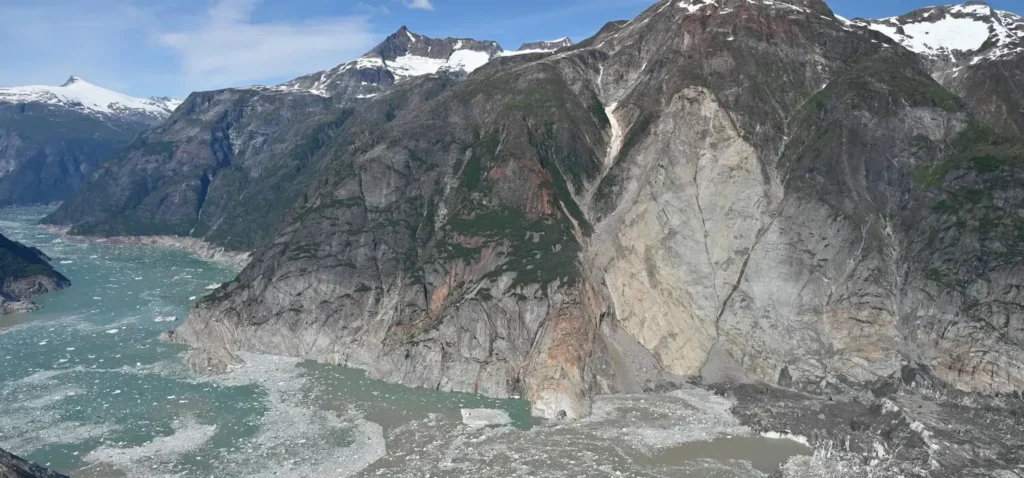
On August 10, 2025, a landslide comprising 2.3 billion cubic feet of rock cascaded into Tracy Arm fjord. The result was a “mega-tsunami” with a wave reaching 1,580 feet above sea level. Despite its magnitude, the event went largely unnoticed at the time, and fortunately, no injuries were reported.
A recent study published in Science provides insights into the event, highlighting the importance of monitoring and early warning systems in the face of climate-induced risks. According to Dan Shugar, a geomorphologist at the University of Calgary, “Normally, with these gigantic rock avalanches, they often give some sort of warning signs… In this case, that didn’t happen.”
The study reveals that the South Sawyer Glacier’s rapid retreat exposed the mountain rockface, contributing to its instability. This glacier retreat is likely linked to climate change, which reduces the ice pressure that stabilizes such rockfaces.
Intriguingly, the landslide appeared to occur without visible warning signs. However, underground data from earthquake sensors detected small tremors leading up to the event, similar to phenomena observed before avalanches on Alaska’s Iliamna Volcano.
In the hours before the landslide, these tremors increased in frequency, suggesting potential warning signals that could be leveraged in future monitoring efforts.
Need to know: How many tourists visit Tracy Arm?
During the summer, Tracy Arm and the neighboring Endicott Arm see more than 20 boats daily, including up to six large cruise ships. However, following last year’s tsunami, some cruise lines are opting to avoid Tracy Arm this year.
While the disaster occurred in the early morning, minimizing human impact, kayakers nearby reported the loss of gear, and a cruise boat further away noted a water surge. Researchers emphasize that the glacier’s retreat and preceding seismic signals might have warranted a timely warning to prevent potential harm.
Noah Finnegan, a geomorphologist at the University of California, suggests improving detection of such precursors is crucial: “The bar is, can we do better than missing most of these.”
With the ongoing effects of climate change, especially in Arctic regions, enhancing monitoring systems is becoming increasingly critical. As Aram Fathian, an Earth scientist, mentions, “These signals could be promising for developing early warning systems in similar conditions or areas.”
Original Story at www.smithsonianmag.com