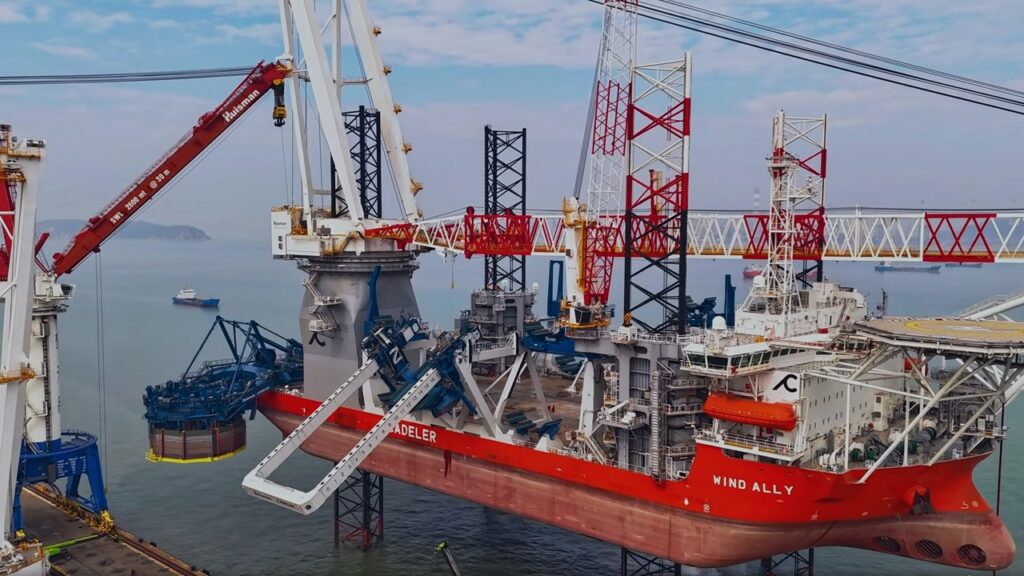
As offshore wind monopiles grow in size, the installation process becomes crucial for jack-up vessel design. A recent GustoMSC study reveals that loads during monopile lowering can approach or exceed those seen in extreme survival conditions.
With monopile diameters over 10 meters and weights above 2,000 tonnes, the installation dynamics are increasingly complex. The challenge extends beyond crane capacity to the interaction between the suspended monopile and the supporting jack-up.
From Suspended Cargo to Coupled System
During installation, a monopile is lifted, upended, guided into the gripper, and lowered through the splash zone into the seabed.
The most demanding condition arises during partial submersion, with the monopile fully suspended and laterally restrained by the gripper.
At this stage, the monopile acts as a hydrodynamically active structure. Its motions begin to interact dynamically with those of the jack-up due to its weight and flexibility.
For large-diameter monopiles, hydrodynamic loads can exceed those on jack-up legs, making the monopile a major source of horizontal loading.
What the Study Showed
GustoMSC analyzed the lowering of a large monopile from a modern four-legged jack-up vessel similar to the Cadeler A-Class.
The study examined monopiles between 10 and 12 meters in diameter, weighing up to 2,500 tonnes in 40 meters water depth. Various wave periods and directions were assessed.
Simulations included the flexibility of the jack-up, crane, and gripper, monopile dynamics, and hydrodynamic loading.
Results indicated the critical phase when the monopile was submerged by about 10 to 15 meters, exposed to wave action while fully suspended.
Under specific wave conditions, the motions of the monopile and jack-up reinforced each other, creating dynamic amplification effects.
Bending moments at the lower guide reached values up to 20% higher than those in 50-year North Sea conditions, despite moderate sea states.
The study highlighted the importance of wave direction, with certain headings generating higher loads by exciting motion around the gripper.
Installation Loads Can Govern Design
The findings suggest installation conditions can dictate the design of structural components.
Foundation reactions at heavily loaded legs approached the bearing capacity during critical partial submersion, with load combinations resulting from vertical crane loads and lateral hydrodynamic forces.
Simplified models may underestimate demand if the monopile is viewed only as a suspended weight. Hydrodynamic interaction effects can be overlooked.
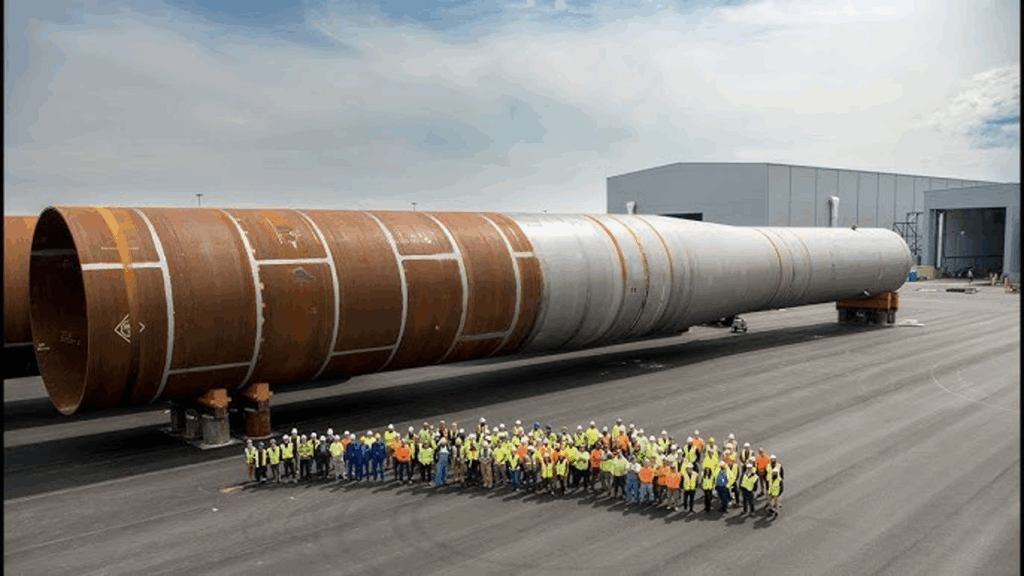
As monopiles increase in size, coupled dynamics grow in importance. Larger foundations attract greater hydrodynamic forces, altering the response of the vessel-pile system.
Future projects will require assessments considering multiple wave headings, variable submersion depths, hull flexibility, and combined loads.
Lowering a monopile through the splash zone, though brief, is becoming a demanding phase of the installation process.
For more info:
Engineering and Consultancy Services
Note: The opinions expressed do not necessarily reflect those of offshoreWIND.biz.
Original Story at www.offshorewind.biz