As the demand for electric vehicles and renewable energy systems continues to grow, the pressure on existing power grids intensifies. Utilities require innovative approaches to foresee and mitigate potential issues before they escalate. At the same time, researchers need secure environments to experiment with new technologies and resilience strategies.
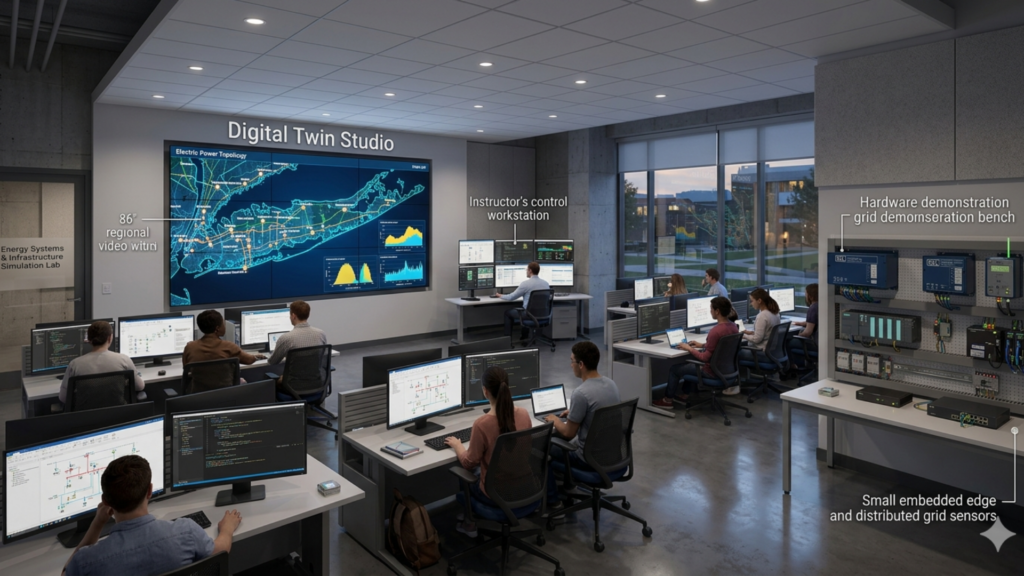
Stony Brook University is spearheading a solution with the creation of a Digital Twin Studio. This revolutionary platform will enable researchers, students, utilities, and public agencies to simulate electrical distribution systems. The studio will facilitate the study of grid responses to various challenges such as outages, extreme weather, cyberattacks, equipment failures, and evolving energy demands.
Under the leadership of the Center for Grid Innovation Development and Deployment (GrIDD) at the Advanced Energy Research and Technology Center (AERTC), the initiative is progressing towards implementation. An initial funding of approximately $550,000 has been secured, with an additional $300,000 expected for future development phases.
The studio aims to launch its minimum viable platform by December 2026, marking a significant milestone. This platform will evolve over time, integrating new equipment, datasets, applications, and partnerships.
“What excites me most about the Digital Twin Studio is that it will bring research, workforce development and industry engagement together in one place,” said Abdelrahim Brown of AERTC and GrIDD. “We are building something that students can learn from, researchers can use and partners can help shape as the platform grows.”
High-fidelity virtual models of power distribution networks will be developed, allowing users to test system performance before implementing changes to the physical grid. These models will incorporate data from various operational, environmental, and equipment sources.
Combining physics-based simulation, artificial intelligence, and data from geographic information systems, weather systems, and advanced meters, the platform enables near-real-time modeling. This integration allows researchers to connect physical equipment to a virtual environment, testing their performance under realistic grid conditions.
Building a More Resilient Grid
The initial phase of the studio will concentrate on vegetation risk analytics, outage and contingency forecasting, and asset-health monitoring.
The vegetation-management aspect will employ camera imagery, multispectral data, LiDAR, weather information, and AI to detect vegetation near electrical infrastructure and evaluate risks. Tools are being developed to classify vegetation and power lines, create 3D point clouds, identify tree species, and map high-risk areas. This information will aid utilities in prioritizing maintenance and preparing for natural hazards.
For outage and contingency forecasting, the studio will offer a controlled environment to test various power-flow scenarios and restoration strategies. This includes studying equipment failures, load growth due to electrification, and the impacts of extreme weather or cyber threats.
Asset-health monitoring will extend the capabilities to individual devices, using sensors and connected equipment to provide detailed data on energy use, air quality, and equipment performance. AI will help detect anomalies, predict maintenance requirements, and optimize operating schedules.
From Drone Imagery to High-Performance Computing
Major investments for the project include high-performance computing equipment, laboratory computers, networking infrastructure, sensors, data-acquisition tools, and backup power systems. A drone equipped with LiDAR, thermal imaging, and visual imaging capabilities will gather data to support vegetation-risk analysis and infrastructure monitoring.
Additional investments involve software, cloud services, platform development, and a student training laboratory at the Center of Excellence in Wireless and Information Technology (CEWIT), which is under construction.
Funding sources include university innovation funds and external support, with contributions from Sunrise Wind and Ørsted.
Supporting Students, Research, and Industry
The Digital Twin Studio will provide Stony Brook faculty and students with a shared infrastructure for research across disciplines such as electrical engineering, computer science, data analytics, and cybersecurity. Researchers can develop and test algorithms for various applications, including load forecasting and distributed energy coordination, without risking operational infrastructure.
A digital twin learning module is being developed for the CyberLearn workforce-development program, aimed at engaging its first group of students by Spring 2027. The studio will also facilitate sponsored research and collaborations with utilities, public agencies, industry partners, and other universities.
IotaComm is collaborating with CEWIT on smart-building technologies and will contribute data and capabilities to the studio. “Building on our work with a LoRaWAN® testbed at CEWIT and our related project with AERTC, this collaboration helps create a living-lab environment where smart building systems, energy research, environmental sensing, asset-health monitoring, and device-level modeling can come together,” stated Terrence DeFranco, Chairman and CEO of IotaComm, Inc.
The team is exploring opportunities to integrate data from Stony Brook’s utility infrastructure and deploy sensing devices on campus. By converging simulation, physical equipment, operational data, and interdisciplinary expertise, the Digital Twin Studio aims to advance grid technologies while equipping students for future contributions to the energy sector.
Original Story at sbmatters.stonybrook.edu