
In the ever-evolving landscape of electric vehicles (EVs), Rivian is garnering attention and interest from investors. While the sector faces challenges, recent developments suggest potential opportunities for growth.
The U.S. EV industry confronts hurdles, particularly with the current administration’s rollback of support, including new tariffs on imported automotive parts and the elimination of the $7,500 federal EV tax credit. These changes create a challenging climate for emerging companies like Rivian (RIVN 0.24%).
Yet, Rivian investors have reasons to be optimistic as they anticipate the launch of the R2 model next year.
Analyst’s Perspective
Baird analyst Ben Kallo has given Rivian a boost by upgrading its shares from hold to buy, raising the price target from $14 to $25. Currently, 30% of analysts recommend buying the stock, according to FactSet. What fuels this positive outlook?
Today’s Change
(-0.24%) $-0.05
Current Price
$21.13
“2026 is the year of R2,” Kallo informed investors. He believes that Rivian’s upcoming models can counter the overall decline in EV demand, marking Rivian as a potentially good investment. The new product cycle, featuring Rivian’s custom-designed microchips, is seen as enhancing the company’s brand and product appeal.
R2’s Impact
The anticipated launch of the R2 has investors on edge, especially given the reduced demand in the EV market post the federal tax credit withdrawal. Rivian’s CEO, RJ Scaringe, however, attributes this decline to a lack of variety in EV choices.

Image source: Rivian.
During the Fortune Brainstorm AI conference, Scaringe highlighted that Tesla remains dominant in the EV market, with limited competition offering consumers diverse options. He pointed out the disparity with over 300 gasoline-powered models compared to few compelling EVs, suggesting a lack of choice for consumers.
Changing market conditions and policy shifts have prompted automakers to make significant decisions. Ford Motor Company (F +0.53%) illustrates this shift by pivoting from high-end EVs to hybrids and extended-range vehicles, incurring $19.5 billion in write-offs. This pressure challenges Rivian to reduce costs further and improve margins, especially as the R2 is priced at the lower end of the high-end range. Rivian’s efforts to enhance gross margins are evident as the company progresses towards profitability.
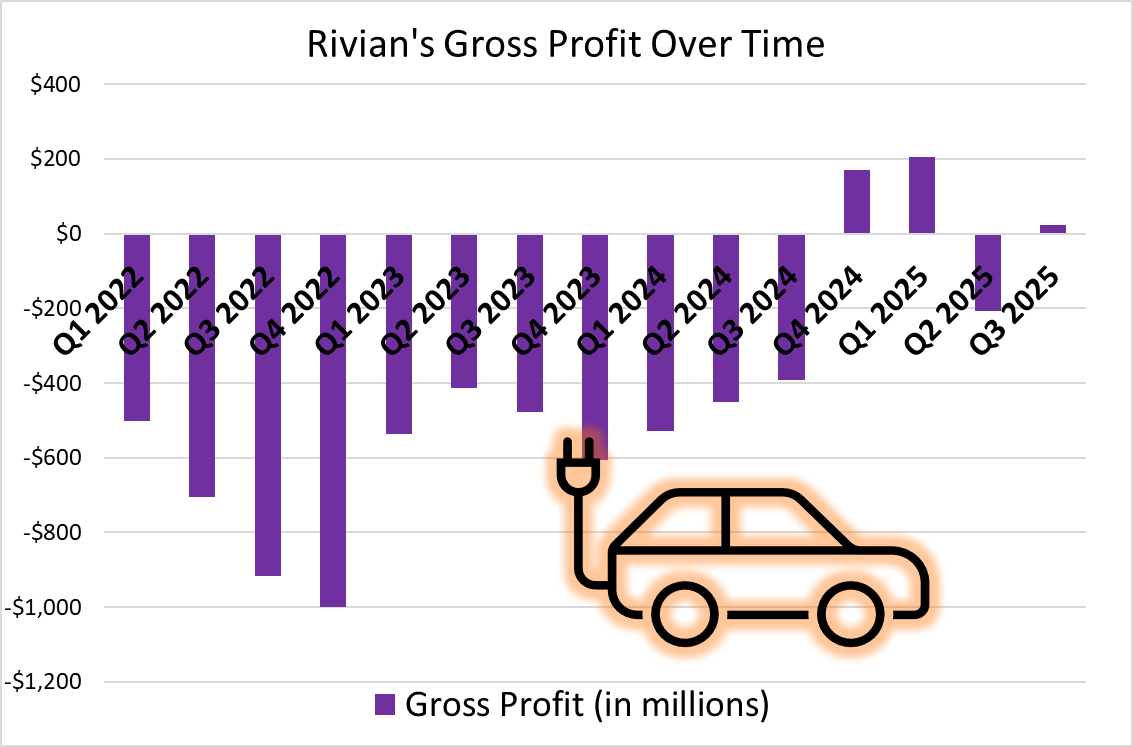
Data source: Rivian 10k SEC filings. Image source: Author.
Future Prospects
Rivian’s stock, trading around $20, has room to reach Kallo’s $25 target. The upcoming R2 could drive short-term optimism. Despite cost-cutting strides, Rivian faces challenges in scaling operations and navigating a competitive, demand-strapped market. While Rivian’s potential is promising, particularly with its custom microchip development, cautious investors might prefer to observe from the sidelines.
Original Story at www.fool.com