Climate Change and Its Impact on Phenology: A Global Perspective
As climate change continues to influence ecosystems globally, researchers are increasingly focusing on understanding the phenological responses of various species. Phenology, the study of cyclic and seasonal natural phenomena, especially in relation to climate and plant and animal life, is proving to be a critical area of research.
Species and Latitude Influence
Research by Parmesan (2007) highlights how species, latitudes, and methodologies significantly impact estimates of phenological responses to global warming. The study, published in Glob. Change Biol., emphasizes the need for a comprehensive understanding of these variables to predict and manage future changes effectively. Read more | Google Scholar
Phenological Divergence Between Plants and Animals
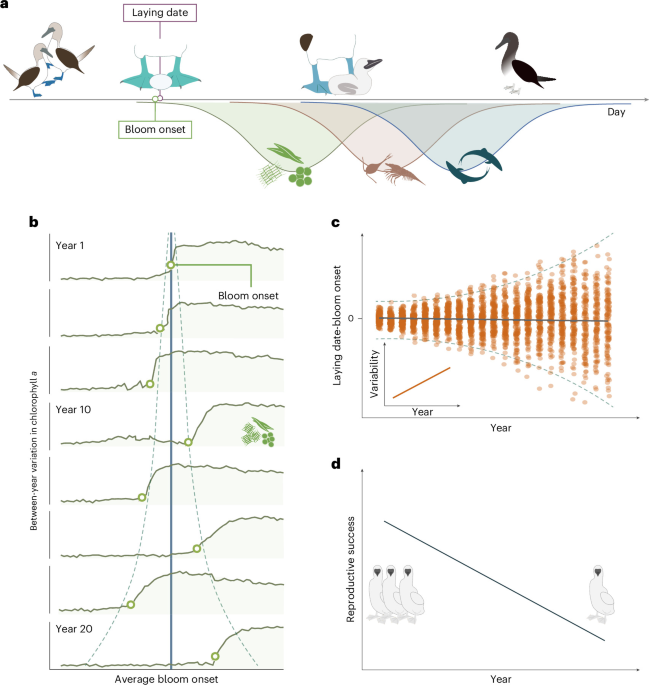
Lang et al. (2025) published in Nat. Ecol. Evol., explore the phenological divergence between plants and animals under the influence of climate change. The study provides a nuanced understanding of how these differences might affect ecosystems and biodiversity. Read more | Google Scholar
Seabirds and Ocean Temperature Insensitivity
Keogan et al. (2018) in Nat. Clim. Change, examined the global phenological insensitivity to shifting ocean temperatures among seabirds. The findings suggest that seabirds may not be as affected by changing ocean conditions as previously thought, raising questions about the adaptability of other marine species. Read more | Google Scholar
Oceanic Changes and Ecosystem Productivity
Sydeman et al. (2021) in Science, discusses hemispheric asymmetry in ocean changes and its impact on the productivity of ecosystem sentinels. This study sheds light on the varying effects of oceanic alterations across different hemispheres, which could influence conservation strategies. Read more | Google Scholar
Climate Change: A Call for a Phenological Yardstick
Visser and Both (2005) highlight the necessity for a standardized measure to assess phenological shifts due to climate change. Their work, featured in Proc. R. Soc. B, calls for a “yardstick” to better quantify these changes across different taxa. Read more | Google Scholar
Optimal Timing of Activities Amidst Environmental Changes
In Ecol. Lett., McNamara et al. (2011) explore the cues and optimal timing of activities under environmental changes. This study provides critical insights into how organisms might adjust their behaviors in response to climatic shifts. Read more | Google Scholar
El Niño-Southern Oscillation and Climate Change
Cai et al. (2021) in Nat. Rev. Earth Environ. investigate the changing nature of the El Niño-Southern Oscillation in a warming climate, offering predictions on future climate variability and its potential impacts. Read more | Google Scholar
Synthesis of Animal Phenological Responses
A global synthesis by Cohen et al. (2018) in Nat. Clim. Change compiles data on animal phenological responses to climate change, providing a comprehensive overview of how animals are adjusting their life cycles in response to environmental changes. Read more | Google Scholar
Review of Climate Variability and Vulnerability
Thornton et al. (2014) provide a review in Glob. Change Biol. on the variability and vulnerability of systems to climate change, emphasizing the challenges faced by ecosystems globally. Read more | Google Scholar
Extreme Weather Events Impact on Phenology
Li et al. (2025) in Nat. Clim. Change examine how extreme weather events distinctly affect plant and insect phenology, highlighting the importance of understanding these impacts on biodiversity. Read more | Google Scholar
Original Story at www.nature.com