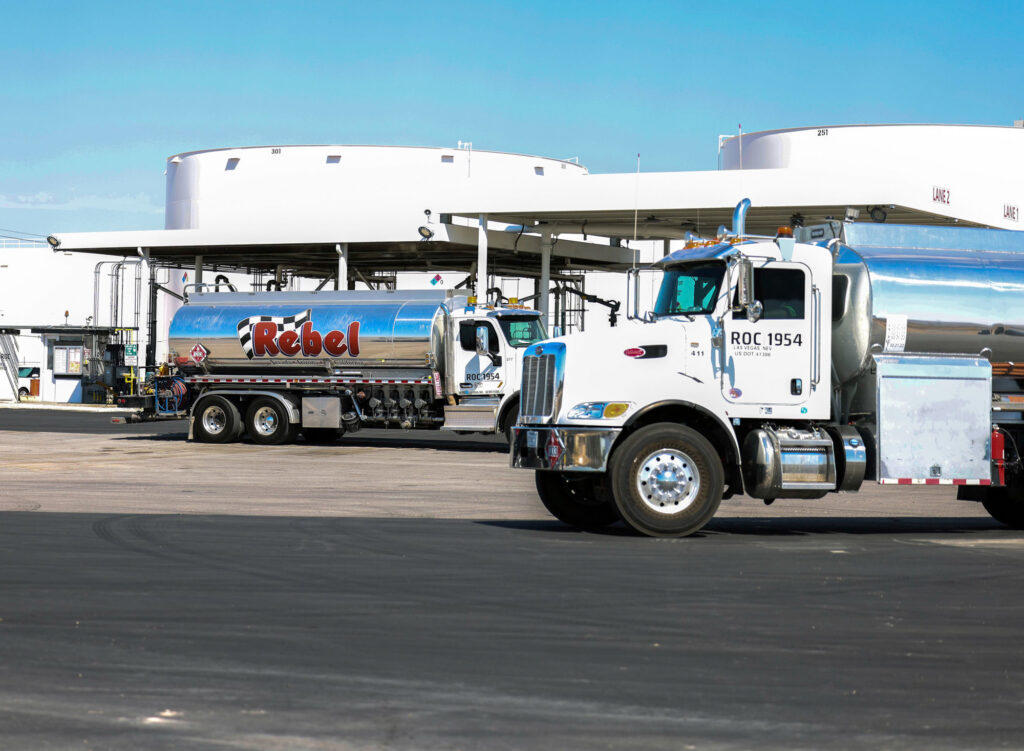
Nevada runs on fuel — billions of gallons of it every year — and right now, the infrastructure keeping that fuel flowing is surprisingly fragile. A single pipeline failure, a wildfire in California, or a refinery closure could leave the state with less than a week’s worth of gas on hand.
According to Nevada DMV data, 92 percent of Silver State drivers still rely on gasoline-powered vehicles. Those vehicles burned through 1.2 billion gallons of gasoline last year alone. Add diesel and jet fuel, and total fuel consumption in the state climbs to 2.5 billion gallons annually — all of it delivered through just three pipelines: two from California and one from Utah.
That narrow supply chain has real consequences. When any one of those lines goes offline — something that has already happened multiple times in recent years — Nevada has no backup options and only about one week of fuel stored in reserve. As the Office of Emergency Management/Homeland Security has noted, “a fuel disruption can quickly become a public safety issue, not just an inconvenience at the pump.”
A Committee Built to Find Answers
Recognizing the urgency, former Gov. Joe Lombardo (R) assembled a Fuel Resiliency Committee made up of industry leaders, state officials, and lawmakers. Their task: identify concrete ways to protect Nevada from future fuel supply failures.
The committee’s findings pointed to two primary goals — increase the state’s fuel storage capacity and reduce its heavy dependence on California’s pipeline network. Among the specific recommendations: doubling Nevada’s fuel reserves, supporting new pipeline projects, and building out infrastructure to receive fuel by rail.
Paul Enos, CEO of the Nevada Trucking Association and a committee member, made the stakes plain.
“Diesel fuel is the oxygen in the blood of the economy. We need it. If we don’t have it, food doesn’t get delivered. Medical supplies don’t get delivered.”
The committee’s report was finalized just days before the November election, which ended with Lombardo losing to Democratic Attorney General and Governor-elect Aaron Ford. A spokesperson for Ford did not respond to questions about whether his administration plans to act on the committee’s recommendations.
Northern Nevada’s Unique Vulnerability
The committee identified Northern Nevada as the most exposed region in the state. Only one of the three pipelines reaches that area, which includes the Fallon Naval Air Station. That single line originates in Northern California and is supplied by the region’s last two operating refineries.
California’s refining capacity has shrunk dramatically over the past four decades. About 75 percent of the state’s refineries have closed as California legislators have passed wave after wave of restrictions on the oil industry. The result is a supply chain with almost no redundancy feeding into Nevada from the west.
Building a new oil refinery inside Nevada is not a realistic short-term solution. The permitting process alone would take years, and Nevada has virtually no domestic oil reserves — meaning crude would still need to be imported through pipelines.
Southern Nevada faces its own version of the problem. The CalNev pipeline runs from Los Angeles to Las Vegas, serving Nellis and Edwards Air Force bases and Harry Reid International Airport along the way. In 2023, Gov. Lombardo declared a state of emergency when that pipeline was temporarily shut down due to California wildfires. The same pipeline was disrupted again by wildfires in a subsequent incident.
An Air Quality Problem That Could Change What Gas You Pump
Southern Nevada also faces a separate but related fuel challenge tied to air quality. The Las Vegas Valley has struggled to meet federal ozone standards set by the EPA in 2015. The region’s air quality classification has been downgraded twice — from “marginal” to “moderate” in 2023, and then to “serious” in 2025.
If the valley does not achieve compliance by next summer, it faces reclassification as “severe,” which would ban the sale of conventional gasoline. Drivers would then be required to use reformulated gasoline — a cleaner-burning but more expensive fuel produced only in specialized refineries. That fuel is already mandated across California, but not in Utah, which complicates Southern Nevada’s ability to use its Utah pipeline as an alternative source if the requirement takes effect.
Storage, Pipelines, and Rail: The Path Forward
The committee’s report identified fuel storage as the single highest-value investment Nevada could make — even more impactful than expanding pipeline capacity. The reasoning is straightforward: “When a pipeline goes down, deliveries fall to zero regardless of its size.” Nevada’s current storage is built to handle only six to eight days of peak pipeline deliveries.
One promising option already exists nearby. A specialized storage facility in west-central Utah — located just four miles from the pipeline running between Utah and Las Vegas — is capable of holding up to 840 million gallons of fuel in a way that keeps it from degrading over time. Currently, there is no connector between that facility and the Nevada pipeline, but building one could significantly expand the state’s access to reserves without requiring new tank construction.
The governor’s office has already asked the state attorney general’s office to examine whether Nevada has the legal authority to own strategic fuel reserves, including whether those reserves could be stored out of state.
On the pipeline front, the committee recommended supporting the Western Gateway Project, a proposed 1,300-mile pipeline stretching from Texas to Arizona and California, with a potential branch to Las Vegas. An expansion of the Utah-to-Las Vegas line was also recommended. However, neither of these projects would directly benefit Northern Nevada due to the geographic distance between the state’s urban centers.
Rail was identified as the second-most efficient method of fuel delivery after pipelines, though it requires additional lead time to arrange shipments. Trucking fuel in by tanker would be the least efficient option — it would take hundreds of tanker trips per day to meet Nevada’s needs.
Enos summed up the committee’s broader message:
“My hope is that whether it’s this governor or the next governor or the governor after that, there’s a realization that we still run on diesel and gasoline and we’re going to be doing it for the foreseeable future. And anything we can do to ensure that continuous supply is good for every citizen in this state.”