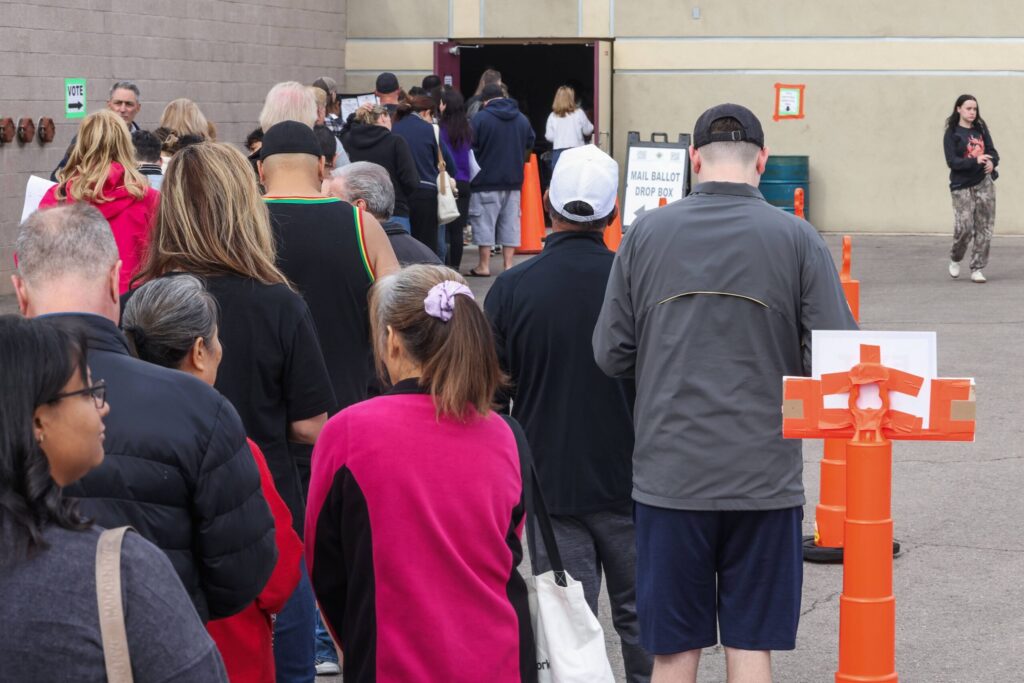
For most Americans, casting a ballot takes minutes. But in Las Vegas last week, hundreds of voters stood in line for hours — some until nearly midnight — just to exercise their most fundamental democratic right.
What unfolded in Nevada on election night raised serious questions about how election administration decisions can determine whether voters get to participate at all — and how long they’re willing to wait for the chance to do so.
Hours in the Cold to Cast a Ballot
Breanna Lareese Butler, a 36-year-old mother of three and full-time online student, finished her shift at United Healthcare and went straight to Brinley Middle School in Las Vegas. She expected to vote and go home. Instead, she waited three hours in temperatures cold enough to numb her feet.
She stayed anyway.
“It had to be done in order for us to vote and have our voices heard,”
Butler said.
Butler was far from alone. Brinley Middle School — the last polling location open anywhere in Nevada that night — did not cast its final ballot until just before midnight, a full five hours after polls officially closed at 7 p.m. According to a Nevada Independent analysis, that made this the latest final vote in any of the past six general elections in the state.
A Law That Holds Up Results Statewide
Nevada is one of only a handful of states that prohibits releasing any election results until the last person in line when polls close has finished voting. Similar laws exist in Hawaii, South Dakota, and Maryland. The practical result this cycle: Nevada became the last state in the entire country to release its initial election results — finishing after even Hawaii and Alaska.
Nevada Secretary of State Cisco Aguilar (D) said he wants to take a closer look at that law, particularly as the state prepares to host the early Democratic presidential primary in 2028, when national attention on Nevada’s results will be intense.
“We have to weigh what is the benefit of disenfranchising a voter versus having information out to the public,”
Aguilar said.
“It’s a policy discussion and a conversation that needs to be had.”
What Caused the Long Lines?
Clark County Registrar Lorena Portillo, who oversees the county’s elections, initially attributed the delays to voter “excitement” on election night — even though overall turnout was actually lower than in previous elections. The following day, she described the long lines as “unfortunate.”
“We listen all day at our polling sites and did not hear concerns about voters about long lines,”
she said at a press conference.
“It’s not unusual to have lines on Election Day.”
But election experts who study voter behavior see the situation differently. Trey Hood, a political science professor at the University of Georgia who focuses on election science, put the delays in blunt terms.
“This is the longest wait time I’ve heard of this cycle,”
Hood said.
Several factors appear to have contributed to the backlog. Clark County voters faced an unusually long ballot this year — 58 district court judge contests appeared on it, something that only happens every six years. Portillo acknowledged this at her press conference but noted that Clark County has had similarly long ballots before. In 2020, the last time all district court judges appeared on the ballot, results came in hours earlier — though pandemic-related factors affected that year’s turnout.
Ted Allen, a professor at the University of Massachusetts Amherst and a former election official, has studied how ballot length affects voter behavior and resource allocation.
“The places with the longest ballots usually have lower turnout than you expect,”
Allen said.
“For election systems, you should time it in advance, and then allocate resources so places with longer ballots should have more resources.”
Allen also warned about a silent cost of long lines: voters who give up and leave.
“Effectively a lot of people did give up and were disenfranchised and that’s not good,”
he said. His research indicates voters waiting in long lines leave at a rate of 2 to 4 percent per hour.
Real Voters, Real Consequences
Briseyda Jaimes, 21, nearly became one of those statistics. She brought her 14-month-old daughter to a Las Vegas City Hall polling site around 1 p.m. and waited more than an hour before she had to leave.
“I wasn’t expecting this,”
Jaimes told The Nevada Independent, gesturing toward the line she was halfway through.
“She’s getting fussy, it’s her naptime.”
But Jaimes came back later that day and cast her ballot — a fact confirmed by voting records. Her motivation was personal and deeply rooted.
“We come from immigrants, so we’re gonna vote for the people who couldn’t vote,”
she said.
“I want to put the example for my daughter.”
Officials Look for Solutions
County officials acknowledged that sites like Brinley Middle School — a newer polling location — come with less historical data to predict turnout and allocate resources accordingly.
“They do like that site, and we will be adjusting accordingly,”
Portillo told reporters.
A Clark County spokesperson added that the county cannot add voting machines
“if additional power sources are unavailable.”
Looking ahead, the county stated it
“will work to ensure that all available solutions to reduce the length of time it may take a voter to cast an in-person vote are explored, including seeking more community partnerships for new voting sites and forecasting potential voter volume.”
Secretary of State Aguilar echoed that spirit of collaboration while stressing the need for data-driven decision making.
“We have to collectively work together to figure out what those challenges were, why they existed and then figure out a solution to moving forward again,”
he said, adding that the state should also examine the funding it provides to county election offices.
“Making decisions off of data is critical.”
Aguilar noted that specific legislative fixes will depend on the leadership of relevant legislative committees and the priorities of Governor-elect Aaron Ford (D), but said he remains optimistic.
“I think we can address it,”
he said.
For voters like Butler and Jaimes, the willingness to endure hours-long waits reflects a deep commitment to civic participation. But as election experts and officials alike acknowledge, a functioning democracy should not require that level of sacrifice just to cast a ballot. Independent journalism covering these issues remains critical to ensuring voters and policymakers have the information they need to make elections work better for everyone in Southern Nevada and beyond.