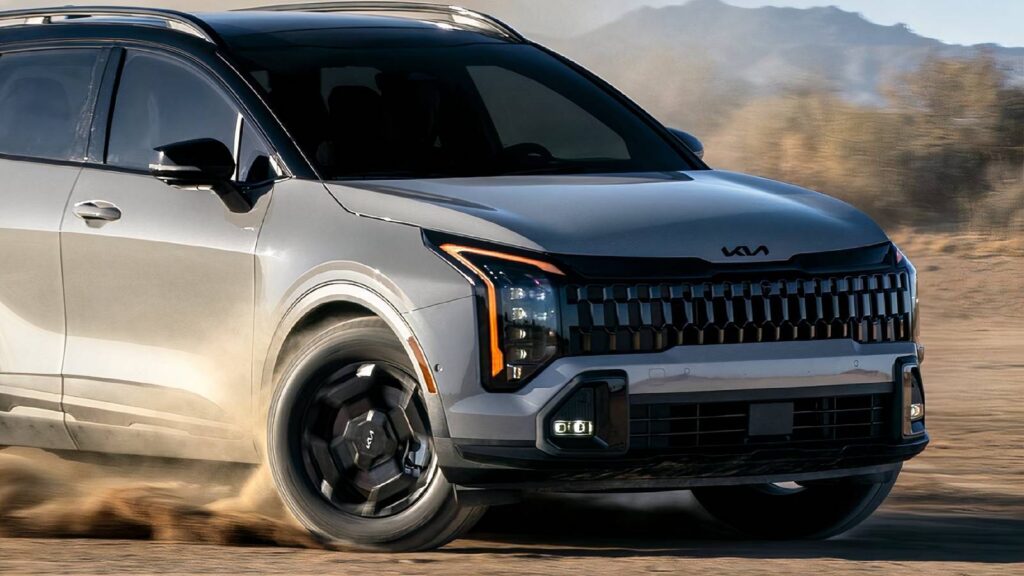
The automotive industry is seeing a shift with Kia’s introduction of the Sportage Hybrid, marking the company’s first hybrid electric vehicle manufactured at their cutting-edge facility in Georgia, USA. This move is not just about expanding production capabilities but also about navigating economic challenges and strategic positioning in the U.S. market.
Emerging from the Hyundai Motor Group Metaplant America (HMGMA) in Ellabell, Georgia, the Kia Sportage Hybrid is poised to take advantage of local production benefits. This facility, equipped to handle vehicles from Hyundai and Genesis as well, allows Kia to potentially sidestep import duties and tap into new American vehicle loan interest deductions, all while reinforcing its aspirations to optimize tariff strategies.
The Strategic Shift in Georgia
The Sportage Hybrid is a pivotal model for Kia, especially in the competitive U.S. compact SUV segment where hybrids are gaining traction as a practical solution amidst fluctuating gas prices. Production of the 2027 Kia Sportage Hybrid began on June 2, 2026, at HMGMA, joining the ranks of Hyundai’s Ioniq 5 and Ioniq 9.
Furthermore, Kia’s operations in Georgia are not new, with models like the Telluride, EV9, EV6, and Sorento already being manufactured at the West Point facility. Expanding production to include the Sportage Hybrid helps shield Kia from import duties, ensuring stability in a volatile market.
Kia’s Hybrid Strategy

The reduction of import duties on South Korean vehicles due to a trade agreement in November 2025 has not fully alleviated tariff pressures for Hyundai and Kia, with Kia reportedly losing over $2.3 billion in 2025 due to tariffs. By localizing the production of the Sportage Hybrid, Kia aims to fundamentally alter its tariff exposure, making the decision deeply strategic rather than just an addition to their U.S. assembly operations.
Though tariffs are a significant concern, manufacturers must also navigate parts sourcing, currency volatility, and supply chain issues. The final assembly location is crucial as it directly impacts transaction prices, especially in competitive segments like compact hybrid SUVs.
The Advantages of HMGMA’s Modern Facility

The HMGMA facility stands out with its advanced, fully connected, and flexible manufacturing systems, employing AI and data management to enhance production efficiency. It has the capacity to produce up to 500,000 vehicles annually, challenging other U.S. manufacturers.
One of the plant’s key advantages is its ability to adapt quickly to changes, a necessity given the unpredictable nature of the automotive market. The factory’s software-driven architecture could allow for rapid shifts between EV and hybrid production, providing a critical advantage in a fluctuating market.
As hybrid vehicles currently offer a pragmatic solution amidst fluctuating EV demand, the HMGMA’s ability to pivot swiftly could provide Kia with a significant edge against market and policy changes.
Sources: Kia, HMGMA, NHTSA, IRS.
Read the full article on CarBuzz
This article originally appeared on CarBuzz and is republished here with permission.
Original Story at www.military.com