Rising Waters Threaten America’s Historic Sites
As America commemorates its 250th anniversary, the nation faces a pressing challenge that endangers some of its most iconic historical sites. The relentless rise of sea levels and coastal erosion are altering the landscapes where pivotal moments in history unfolded, prompting urgent efforts to preserve these sites.
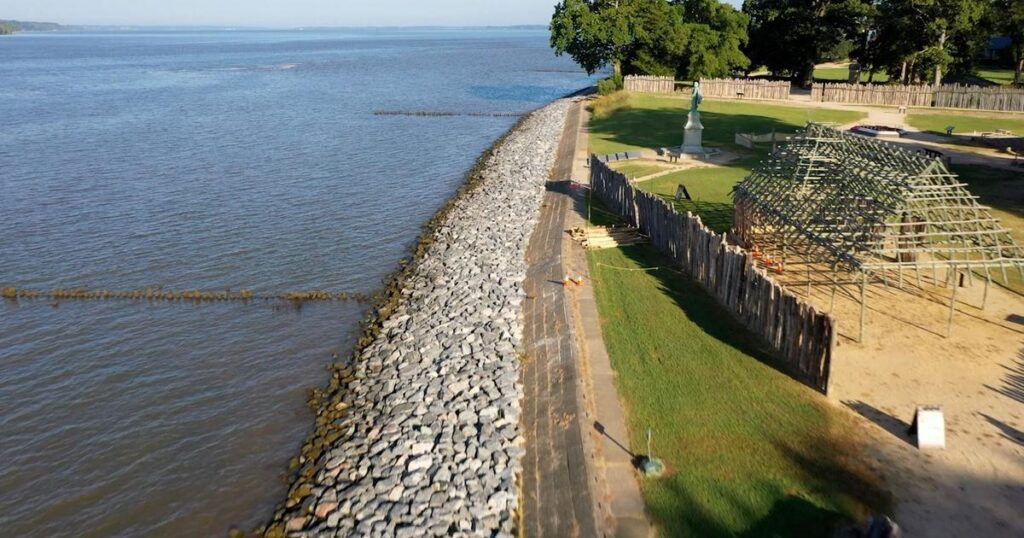
In Jamestown, Virginia, archaeologists are racing against time as they work to uncover remnants of America’s past before they succumb to the encroaching waters. Ben Tracy, reporting for Climate Central, explores this critical effort in Jamestown, the location of the first permanent English settlement in the United States, established in 1607.
Sean Romo, the director of archaeology for Jamestown Rediscovery, highlights the site’s significance: “It’s harder to have more of an impact than Jamestown.” Here, the seeds of American democracy were planted, Pocahontas married John Rolfe, and the first enslaved Africans arrived. The site represents both the ideals of democracy and the grave mistakes of slavery, embodying a complex history where diverse cultures converged.
Since the ruins of the original fort were discovered in 1994, archaeologists have uncovered five million artifacts, offering a glimpse into the lives of Jamestown’s early inhabitants. Modern technology, such as ground-penetrating radar, aids in mapping what remains hidden beneath the surface.
However, the threat of climate change looms large. Rising sea levels, which have increased by 1.6 feet over the past century, coupled with predictions of an additional three feet rise by 2075, pose a significant risk. The James River erodes the shoreline, while an expanding swamp frequently inundates excavation sites, turning the preservation of history into a race against nature.
Romo emphasizes the urgency: “We always have to be meticulous, but we do need to pick the pace up, because we are under severe threat from climate change.” Flooding is a constant concern, and the literal washing away of history underscores the gravity of the situation.
Rob Young, a geologist at Western Carolina University, points out that the issue extends beyond Jamestown. His team is assessing risks to 107 coastal national park sites, including the Statue of Liberty and Fort Sumter. “We can’t protect them all,” Young admits, highlighting the need for a national conversation on prioritizing preservation efforts.
The Atlantic Ocean has already claimed homes along North Carolina’s Outer Banks, leading to the relocation of the historic Cape Hatteras Lighthouse in 1999. While moving a lighthouse is feasible, the same cannot be said for more substantial structures like Fort Sumter.
As the nation grapples with these challenges, Romo continues his work in Jamestown, reinforcing defenses in hopes of preserving the site for future generations. He acknowledges the possibility of Jamestown Island being submerged within 50 years if no action is taken, emphasizing the urgency of acting now to safeguard this pivotal piece of American history.
For more insights, visit PBS NewsHour and Climate Central.
Original Story at www.pbs.org