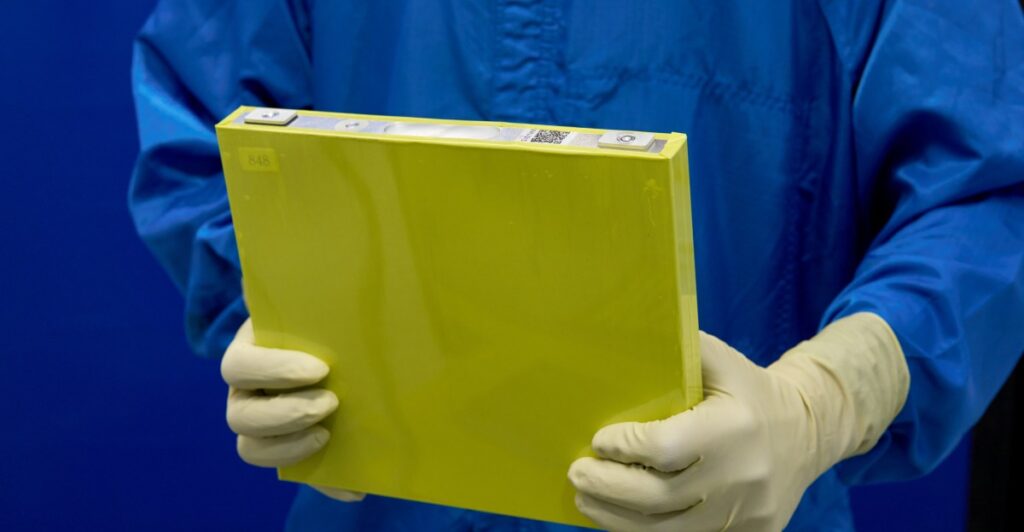
In the heart of General Motors’ (GM) bustling battery labs outside Detroit, a new chapter in electric vehicle (EV) innovation unfolds. Here, scientists and engineers are pushing lithium-ion cells to their limits, simulating extreme conditions from scorching desert heat to frigid arctic temperatures. The goal? To ensure the durability and efficiency of batteries that power GM’s latest models.
Inside GM’s Battery Testing
In an exclusive tour of GM’s secretive labs, The Verge observed researchers utilizing electron microscopes to study cell chemistries at the atomic level. Meanwhile, in another part of the facility, the Megashaker—a massive testing apparatus—puts GM’s 205-kilowatt-hour battery packs to the test. This includes the type used in models like the Cadillac Escalade IQ.
The 2,900-pound battery pack is suspended midair, mimicking its real-world connection to a vehicle. In an atmospherically controlled chamber, the battery endures simulations of everything from potholes to collisions. These rigorous tests allow GM to replicate a decade’s worth of battery usage—250,000 miles—in just six months.
But the real world presents its own challenges to EVs. High prices and policy changes, such as the rollback of pollution and fuel-economy rules, have dampened consumer enthusiasm. The Trump administration’s elimination of the $7,500 federal clean-car credits has further strained automakers, costing GM $1.6 billion in third-quarter earnings.
GM’s Strategic Response
Despite these setbacks, GM remains committed to advancing its EV technology. The company’s latest innovation, lithium manganese rich (LMR) batteries, promises to outperform current lithium iron phosphate (LFP) models. GM’s new batteries are projected to provide a third more driving range, potentially exceeding 400 miles on a full charge.
According to Andy Oury, a lead GM battery engineer, “This unlocks premium long-distance range at an affordable cost.” GM’s investment in these batteries is substantial, with $900 million allocated to new battery centers, adding to the $5 billion already spent on U.S. battery operations.
Kurt Kelty, GM’s vice president of battery, propulsion, and sustainability, emphasizes the significance of these advancements. “This a game-changer,” he says, drawing on his extensive experience in the battery industry. Unlike other promising technologies that never leave the lab, GM’s LMR batteries are ready for mass production.
Overcoming International Competition
Although some analysts doubt Detroit’s ability to compete globally, GM is confident in its competitive edge. LMR batteries are designed to exceed the performance of China’s LFP technology, while maintaining cost-effectiveness. By 2028, GM aims to offer its largest SUVs and pickups with more than 400 miles of EPA-rated range.
In addition to technological advancements, GM is working towards a more U.S.-based supply chain. This strategy contrasts with China’s rapid pace of market entry, which often sees new models in as little as two years. GM’s in-house operations could reduce battery development time by a full year, at a lower cost and higher quality.
At the Wallace Battery Cell Innovation Center, GM is vertically integrating its battery production, similar to China’s BYD. The center can produce up to 100 cells a day, with plans for a new development center to bridge the gap between lab research and full-scale production.
Future Prospects and Challenges
As GM pushes forward, the company is navigating the challenges of a changing market. With the elimination of federal credits, GM is subsidizing lease deals to maintain EV sales, despite the financial strain. Yet, the company remains optimistic about the future of EVs, focusing on reducing costs and improving affordability.
Kelty reflects on the industry’s trajectory, “You’ve got to be able to stand on your own. And that’s the way we’re looking at it here at GM.” The company believes that once EVs achieve price parity with internal combustion engine vehicles, the transition will be unstoppable.
Original Story at www.theverge.com