Emerging Trends in the Global Electric Vehicle Adhesives Market
The electric vehicle (EV) industry is witnessing rapid advancements, with the adhesives market playing a pivotal role in supporting this growth. As the automotive sector increasingly shifts towards electrification, the demand for innovative adhesive solutions is rising, revolutionizing how vehicles are assembled and enhancing their performance.
Market Projections and Regional Dominance
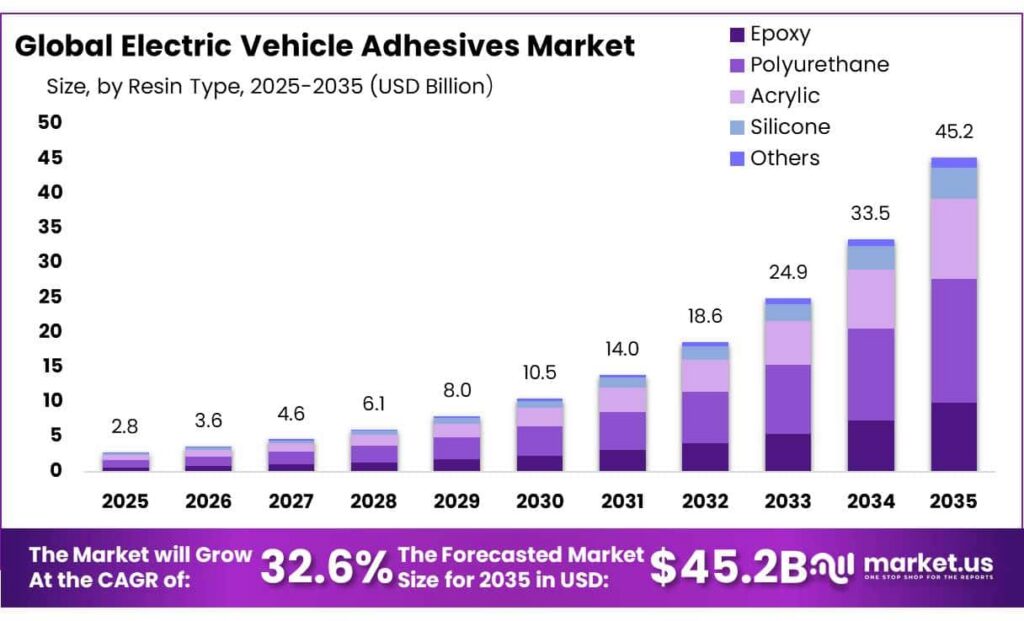
In 2025, the global electric vehicle adhesives market was valued at USD 2.8 billion. With an anticipated compound annual growth rate (CAGR) of 32.6% between 2026 and 2035, the market is projected to soar to approximately USD 45.2 billion by 2035. The Asia Pacific region emerged as a leader, holding a 48.2% market share, translating to USD 1.4 billion in revenue.
Technological Innovations in Adhesives
Adhesives are integral to various EV components, including battery packs, body structures, and thermal management systems. They are increasingly favored over traditional welding and mechanical fasteners. Epoxy, polyurethane, acrylic, silicone, and hybrid adhesives are prominent in bonding aluminum, steel, composites, and polymers. According to Sika, their thermal-conductive adhesive systems can achieve conductivity up to 2.0 W/m·K, facilitating efficient heat transfer within EV batteries.
Surging Electric Vehicle Production
The International Energy Agency reported that global electric-car sales surpassed 20 million units in 2025, marking a 20% increase from the previous year. Electric vehicles accounted for 25% of new car sales worldwide, with production volumes exceeding 22 million units. This surge in production has directly amplified the consumption of structural adhesives, battery sealants, and thermal-interface bonding materials.
Market Drivers and Challenges
Battery expansion remains a significant driver, with global EV battery deployment reaching 1.2 TWh in 2025, a 30% increase year-over-year. The IEA projects this to approach 3 TWh by 2030. However, the industry faces challenges such as price volatility in key materials like epoxies and isocyanates, impacting manufacturers’ margins.
Innovations and Opportunities
Chemical companies are responding with high-performance materials. In 2026, Henkel introduced Bergquist TGF 2030APS and Loctite TLB 9270APS, offering thermal conductivity and efficient integration into cell-to-pack designs. The U.S. Department of Energy’s funding initiatives also support this growth, providing USD 3 billion for battery manufacturing and recycling projects.
Segment Analysis
Resin Type: Polyurethane resins dominate, accounting for 39.6% of the market share, owing to their flexibility and durability in EV structures.
Technology: Reactive technology leads with a 32.5% market share, favored for its strong bonding performance in automotive applications.
Propulsion Type: Battery Electric Vehicles (BEVs) hold 70.3% of the market, driven by their extensive adhesive usage in battery pack assembly and thermal management systems.
Application: Powertrain applications dominate with 49.1% of the market share, highlighting the critical role of adhesives in electric drivetrains.
Vehicle Type: Passenger cars lead the market, representing 82.7% of adhesive usage, driven by the rapid electrification and high production volumes in this segment.
Key Market Players
Leading companies in the market include Henkel AG & Co. KGaA, Sika AG, 3M, Parker Hannifin, and others. These manufacturers are focusing on developing advanced adhesives for the unique demands of EVs, including structural bonding, thermal management, and high-voltage applications.
Original Story at market.us