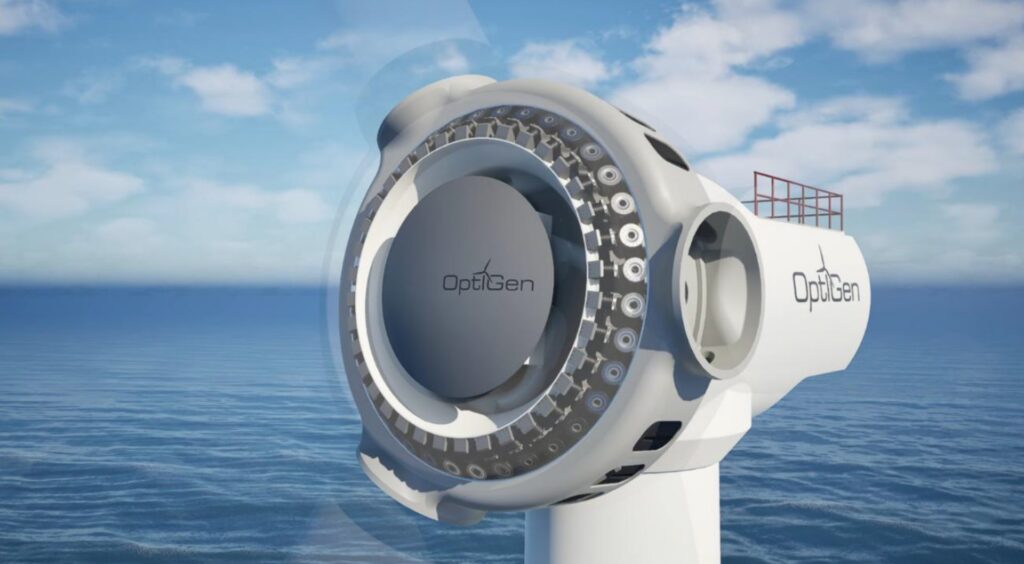
The European LIGHTWIND project has completed its initial test phase for a new drivetrain architecture designed for offshore wind turbines over 15 MW and is preparing for the next round of testing.
The LIGHTWIND consortium includes eight European entities: TNO in the Netherlands, IWES Fraunhofer in Germany, DIS/Creadis in Denmark, HCMR in Greece, MarinRes in Norway, and Euro-Funding, X1Wind, and OptiGen in Spain.
The project focuses on the OptiGen drivetrain concept, replacing traditional large main bearings with a wheel-and-rail system placed near the generator air gap.
This new drivetrain addresses challenges of increasing turbine power, such as larger dimensions, heavier components, and the complexity and cost of maintaining high-capacity offshore turbines.
The wheel-and-rail setup aims to simplify maintenance, allowing component monitoring and replacement within the turbine without dismantling the nacelle.
The first test campaign used the IEA Wind 15 MW reference turbine for a preliminary design. The team focused on critical components, particularly regarding fatigue, and analyzed operating conditions, loads on the wheels and rails, and suitable materials.
A test rig was developed to simulate operating conditions rapidly and evaluate system durability.
Dynamic behavior of the mechanical system was tested using a hexapod, Beat 1.1, developed by IDOM at Fraunhofer IWES in Hamburg, to assess the drivetrain architecture under tough conditions.
First-phase results were positive; the technical team is making improvements from the test data before the next phase.
The activities aim to advance the technology to Technology Readiness Level (TRL) 4, representing concept validation in relevant environments, pushing it closer to commercial use.
The LIGHTWIND partners will also design a 22 MW version of the OptiGen system, based on IEA Wind Task 55, and evaluate the potential for scaling up to 30 MW.
Original Story at offshorewind.biz