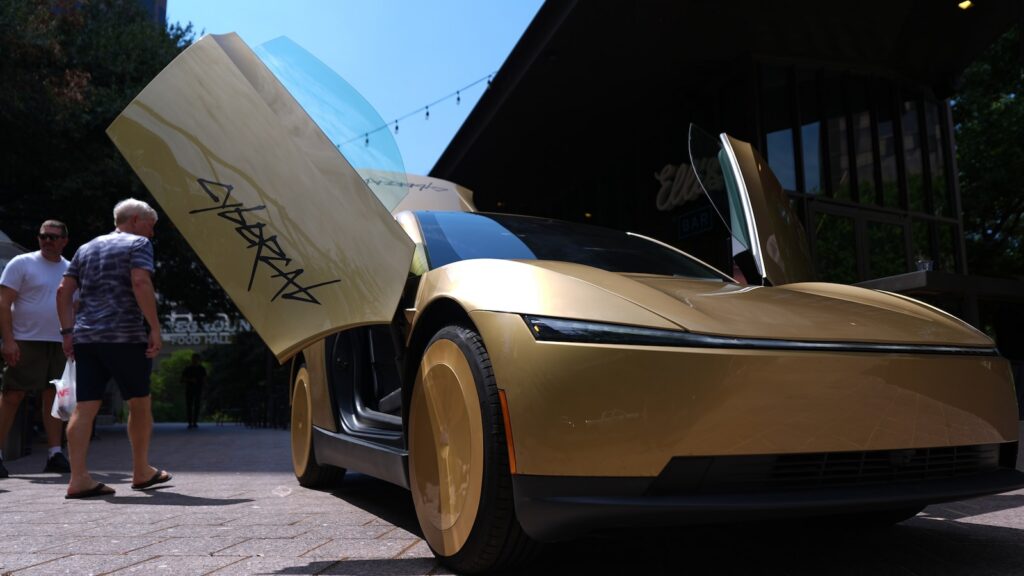
AUSTIN, TEXAS — In a bold move to revolutionize urban transportation, Elon Musk has introduced a fleet of autonomous Cybercabs in Austin. These driverless vehicles, devoid of steering wheels and brake pedals, mark a significant leap forward in Tesla’s quest to lead the self-driving car industry.
The launch of these gold-colored Teslas is a strategic effort by the company to expand its autonomous taxi services beyond Texas. Although Tesla’s stock has experienced fluctuations due to a decline in vehicle sales, the introduction of these futuristic cabs has spurred a 5% increase, signaling investor optimism about their potential success.
On social media platform X, Tesla teased, “No steering wheel, no pedals,” ahead of the launch. Elon Musk also shared a striking image of a Cybercab against the Austin skyline, describing it as “A Storm of Cybercabs.”
While an exclusive launch event was scheduled, the timeline for the broader deployment of the Cybercab service remains uncertain. However, Tesla is under pressure to accelerate its rollout to compete with industry leaders.
Tesla faces stiff competition from Waymo, which leads the market with a significantly larger fleet and more completed trips. Unlike Tesla, which relies solely on cameras, Waymo and Amazon’s Zoox use a combination of cameras, radar, and lidar technology for navigation and safety.
Despite technological advancements, public acceptance remains a hurdle. A Pew Research Center survey from February indicates that 70% of U.S. adults are uneasy about riding in driverless cars.
The past year has been challenging for Tesla, with its stock affected by Elon Musk’s political endorsements and participation in President Donald Trump’s cost-cutting initiatives, known as DOGE, leading to protests and boycotts from car buyers.
Tesla reported a decline in annual vehicle sales for the second year in a row, and its profits plummeted. Additionally, China’s BYD overtook Tesla as the leading electric vehicle manufacturer globally.
Since June of last year, Austin has hosted a Tesla “robotaxi” service, initially featuring vehicles with manual controls and safety drivers. This service has expanded to five additional cities in Texas and Florida and now includes over 200 “unsupervised” robotaxis operating without safety drivers, according to RobotaxiTracker. Waymo boasts more than 4,000 such vehicles across 14 cities.
While 16% of Americans expressed a willingness to ride in a driverless car, only 7% felt “extremely” or “very” comfortable, according to the Pew survey.
Skepticism about the safety of autonomous vehicles has grown, as noted in a 2025 Gallup poll, with more Americans favoring human-operated cars compared to 2018.
Challenges remain for Musk in convincing the public to embrace driverless technology. A January Pew poll indicated that nearly 60% of U.S. adults view him unfavorably.
Musk envisions deploying full self-driving software to hundreds of thousands of Teslas via a software update, allowing owners to transform their vehicles into taxis.
However, regulatory hurdles persist in both the U.S. and abroad. Tesla’s partial self-driving software lacks approval in most European Union countries, and U.S. regulators have launched multiple investigations into its safety.
One investigation examines the software’s involvement in several Tesla crashes under low-visibility conditions, including a fatal pedestrian accident. Another probe focuses on incidents where Teslas using partial self-driving software have run red lights or driven on the wrong side of the road, leading to collisions and injuries. A third investigation is assessing whether Tesla violated regulations by failing to report crashes promptly.
Original Story at abcnews.com