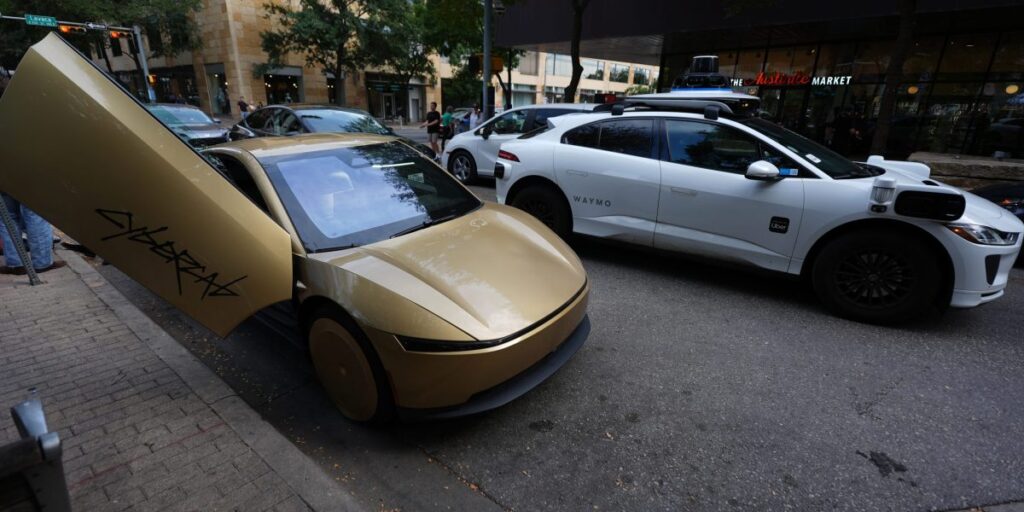
Tesla’s Bold Move: Driverless Cybercabs Hit Austin Streets
In a daring leap towards the future, Elon Musk has unleashed a fleet of autonomous Cybercabs on the streets of Austin, Texas. These self-driving Teslas, distinctively gold, lack traditional steering wheels and brake pedals, marking a significant step in Tesla’s quest to revolutionize urban transportation.
The launch of these futuristic taxis comes amid Tesla’s strategic efforts to expand into other cities, hoping to reverse the recent slump in vehicle sales. Encouragingly, the company saw a more than 5% increase in its stock value on Thursday, reflecting investor optimism about the potential uptake of these Cybercabs.
In anticipation of this rollout, Tesla teased the public with a post on X stating, “No steering wheel, no pedals,” followed by Musk’s own depiction of a giant Cybercab hovering over Austin’s skyline with the phrase, “A Storm of Cybercabs.” Although the official launch event was invitation-only, it marked a significant milestone for the company.
While the exact timeline for a broader release of the service remains vague, Tesla faces pressure to accelerate its deployment. The company lags behind Waymo in terms of the number of driverless taxis on the road and the volume of completed trips. Unlike Waymo and Amazon’s Zoox, which utilize radar and lidar in addition to cameras, Tesla relies solely on camera technology for navigation and obstacle avoidance.
Despite technological advancements, persuading the American public to embrace driverless rides remains a challenge. A February survey by Pew Research Center revealed that a substantial 70% of adults in the U.S. are either “not too” or “not at all” comfortable with the idea of riding in a driverless car.
Previously, Tesla’s reputation suffered due to Musk’s involvement in political matters, including supporting controversial figures and campaigns. This led to protests and boycotts by car buyers in several countries, contributing to a decline in sales and profits and allowing China’s BYD to overtake Tesla as the leading electric vehicle manufacturer.
Since June last year, Austin has hosted a Tesla “robotaxi” service with vehicles equipped with traditional controls for safety purposes. This service has expanded to five other cities in Texas and Florida, with more than 200 “unsupervised” taxis operating without safety drivers. However, they pale in comparison to Waymo’s fleet of over 4,000 vehicles in 14 cities.
The Pew survey also indicated that while 16% of U.S. adults might feel “somewhat” comfortable in a driverless car, only 7% expressed being “extremely” or “very” comfortable. A separate Gallup poll from 2025 showed increased skepticism about driverless car safety, with more Americans favoring human-operated vehicles compared to a 2018 survey.
Convincing the public of driverless cars’ safety could be an uphill battle for Musk, especially when a recent Pew poll showed nearly 60% of U.S. adults hold an unfavorable view of him.
Musk’s long-term vision includes deploying full self-driving software to hundreds of thousands of Teslas, transforming them into rentable taxis. However, Tesla faces regulatory hurdles both domestically and abroad. The company has yet to secure approval for its partial self-driving software in most of the European Union, and in the U.S., safety investigations are ongoing.
One investigation focuses on the software’s involvement in multiple crashes under low-visibility conditions, while another probes incidents where Teslas, using partial self-driving software, ran red lights or drove on the wrong side of the road, leading to accidents and injuries. A third investigation examines potential regulatory violations regarding Tesla’s crash reporting practices.
Original Story at fortune.com