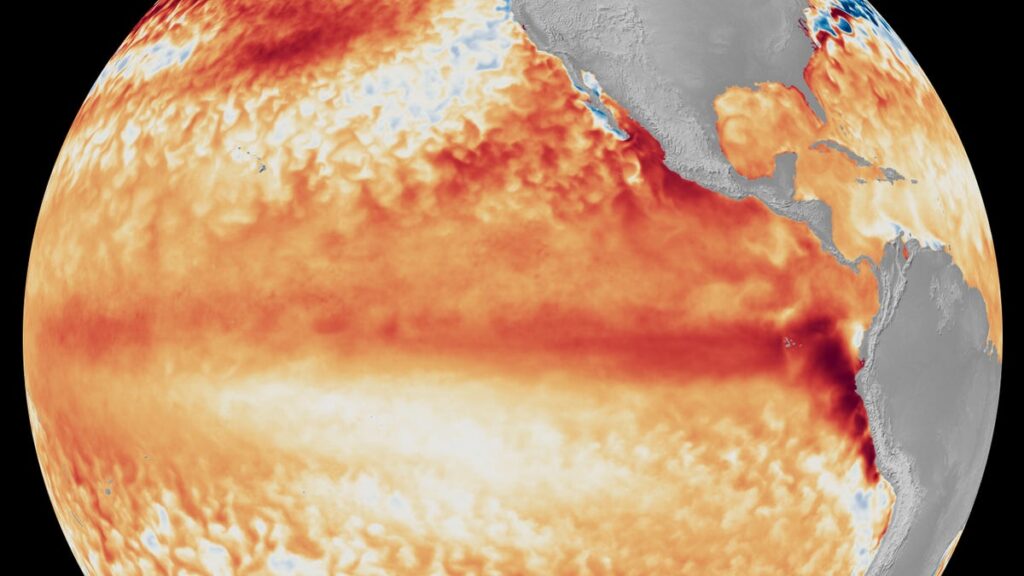
As winter approaches, Michigan residents might find themselves reaching for umbrellas instead of snow boots. The state is predicted to experience a milder winter season, characterized by rain and sleet, rather than the usual snowfall, due to an exceptionally strong El Niño event in the Pacific Ocean.
Julia Cole, chair of the University of Michigan Department of Earth and Environmental Sciences, notes that this El Niño is currently exhibiting record-setting strength. “What we expect to see in 2027 is a big release of heat from the Pacific that is going to drive global temperatures significantly higher,” Cole explained. “Odds are strong that we are going to see the hottest year on record in 2027 as a consequence because of this.”
El Niño typically alters weather patterns globally, causing wetter conditions in usually arid regions such as the southwestern U.S., and drier conditions in typically rainy areas like Indonesia. For Michigan, the phenomenon could mean warmer winter temperatures, with increased chances of rain and ice storms, according to Daria Kluver, a professor of earth and atmospheric science at Central Michigan University.
Reflecting on past El Niño events, Cole mentioned that Michigan has experienced winter temperature increases of 4-5 degrees Fahrenheit. “That’s kind of big when you think about us hovering around the freezing line a lot,” she said. This temperature shift could result in less snow for winter sports enthusiasts, such as cross-country skiers, who rely on thick snow layers for their activities.
Super El Niño Could Be World’s Strongest
El Niño, a natural climate phenomenon, occurs when Pacific trade winds weaken, allowing warm water to move eastward towards South America. This shift impacts global precipitation and temperature patterns. In the U.S., El Niño often redirects storms to the typically dry southwest region.
Cole highlighted that the current El Niño might become the strongest on record. “The predictions are pointing in that direction, that it’s going to be either the strongest or possibly the second strongest,” she said. This implies that the weather impacts could be more pronounced beyond the Pacific region.
El Niños usually reach their peak in December, according to Kluver. “This is potentially a record-breaking one. That’s what our models are indicating,” she said. “For us in Michigan, we know the pattern to expect. A warmer winter and less snow. You might like that or not.”
Climate Change Fuels El Niños
Research has shown that El Niños have intensified since the industrial revolution, linked to the increase in fossil fuel usage. A study led by Cole and her colleagues, published in the journal Science, reveals that El Niños have become stronger since the 1980s. The findings were based on core samples from corals in the Galápagos Islands, which have been affected by El Niños for centuries.
These corals provide insights into historical ocean temperatures and El Niño strengths, dating back 900 years. “That range was fairly low and stable across what we would call the pre-industrial area, before 1850, and then it starts to increase, and then it gets really big since about 1980,” Cole stated.
Cole asserts that human-caused global warming is amplifying El Niños and their severe weather effects. “This is one of those surprise, not-surprise things,” she remarked. “We know how to turn down the temperature of the planet. We know how to use renewable energy. Renewable energy is cheaper than fossil fuel energy. We know how to solve this problem.”
For more information on polar vortex effects, see what’s known as a “polar vortex.”
Original Story at www.detroitnews.com