Transforming Glacial Landscapes into Urban Art Installations
Imagine walking through a bustling city and encountering an installation that brings the distant phenomenon of glaciers right to your doorstep. This is the essence of the Glacier Project, a collaborative effort between Dayuan Design and N.O.C., an ocean conservation nonprofit. The project seeks to bridge the gap between remote environmental conditions and urban life, transforming climate change into a tangible, sensory experience within the heart of Shanghai.
Glacier Project is not just another exhibit filled with data or visuals; it’s a physical manifestation of the intricate connections between glaciers, oceans, and urban environments. The project is themed “Resonance of the Extremes,” and it unfolds through various scales, starting with the outdoor installation “Parallel Projections – Glacier Project.” It continues indoors with film, sound, artifacts, and a captivating tabletop display called “Flowing Glacier.” These elements collectively weave the narrative from the urban landscape into the exhibition space, ultimately integrating it into daily life.
Nine Geometric Forms Depict Iceberg Structures
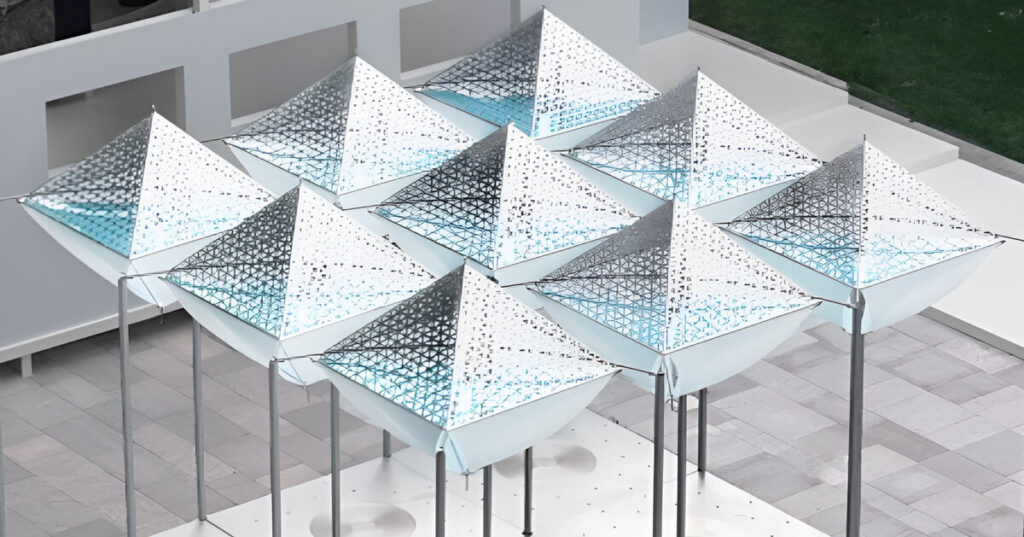
In the plaza, Dayuan Design Studio presents nine suspended geometric forms that mimic a fragmented glacier landscape. These forms symbolize both the visible and hidden parts of an iceberg, emphasizing the interconnectedness of polar environments. As visitors navigate through the installation, they can engage with components that trigger changes in the geometric structures above, illustrating a direct connection between human interaction and environmental change.
Aerial views of Glacier Project by day | all images by © XUEQING
Harnessing Nature’s Elements: Rain, Light, and Reflection
With sustainability at its core, the installation is crafted from recycled materials like metal and waterproof fabric, designed for easy disassembly and reuse. The use of triangular perforations in the metal mesh not only references glacial melting but also facilitates light transmission, transforming the forms from solid to fragile. The interplay of daylight, air movement, and visitor activity continually alters the shadows and reflections, making the installation a dynamic experience.
Weather elements such as rainwater are integrated into the installation. Rain falls naturally onto metal surfaces, creating a soundscape that blends with the visual reflections, further connecting the installation to natural cycles. Visitors can walk through this urban ice field, experiencing the lightness and fragility of glacial ice.

Suspended geometric ice forms create an urban ice field that visitors can walk through
Miniature Glaciers: A Tabletop Experience
The Flowing Glacier brings the larger installation’s essence into a smaller, tabletop format. Using traditional Chinese glassmaking techniques, this object allows smoke to flow through a translucent form, symbolizing the passage of time and the retreat of glaciers. This small-scale installation invites repeated observation and reflects on environmental changes through traditional craft.

Visitor interaction with the glacier installation, by day and at night
An Immersive Narrative on Climate Change and Glaciers
The exhibition, designed by Dayuan Design with N.O.C., translates scientific research into an experiential journey. Visitors begin outdoors and move through a sequence of spaces featuring film, artifacts, and sound, all organized into four thematic chapters: Encounter, Remains, Listening, and Resonance. These sections guide visitors from observation to sensory engagement, encouraging reflection on their environmental impact.
This comprehensive project redefines sustainability by integrating it into design, material choices, structural systems, and cultural preservation. Through its installations, Glacier Project transforms public perception, fostering lasting awareness by linking individual actions to broader environmental processes.
Original Story at www.designboom.com