
Citroën Revisits the Past with a Modern Twist: The 2 CV Concept as an Electric Vehicle
Citroën has taken a leap into the future by borrowing from its storied past. At the 2026 Paris Motor Show, the French automaker unveiled the Citroën 2 CV Concept, a modern homage to its 90-year-old design, transformed into a minimalist, affordable electric vehicle (EV). This new iteration aims to disrupt the current trend of bulky, feature-laden crossovers, targeting a 2028 launch at a starting price of €15,000 (approximately US$16,400).
Time 2 meet again.
The 2 CV Concept car is positioned between the compact Ami quadricycle and the e-C3 supermini. Citroën boasts that this European-built concept is nearing production readiness. Emulating its predecessor, the new 2 CV reveals significant cost-efficiency, featuring a design that echoes the single headlamp and fold-down windows of the original model.
Remarkably, the 2 CV Concept maintains a weight under a metric ton (2,204 lb), making it substantially lighter than Citroën’s own e-C3 or Honda’s e city car. This featherweight design allows for a smaller battery requirement, enhancing its efficiency.
The vehicle’s dimensions are compact, measuring just 3.76 meters (148 inches) in length. Design lead Antoine Gaillot-Drevon mentions that the use of flat steel panels and glass significantly reduces costs. The car’s bumpers are designed to be easily removable, facilitating inexpensive repairs after minor accidents. The rear tailgate’s black finish is achieved by direct molding, eliminating the need for paint.
Citroën/Stellantis
The concept car is a vibrant orange-red, featuring retro-inspired elements like high flared wheel arches, rounded LED headlight pods, and a manual roll-back fabric sunroof. These details pay homage to the original 2CV’s design ethos of “four wheels under an umbrella.”
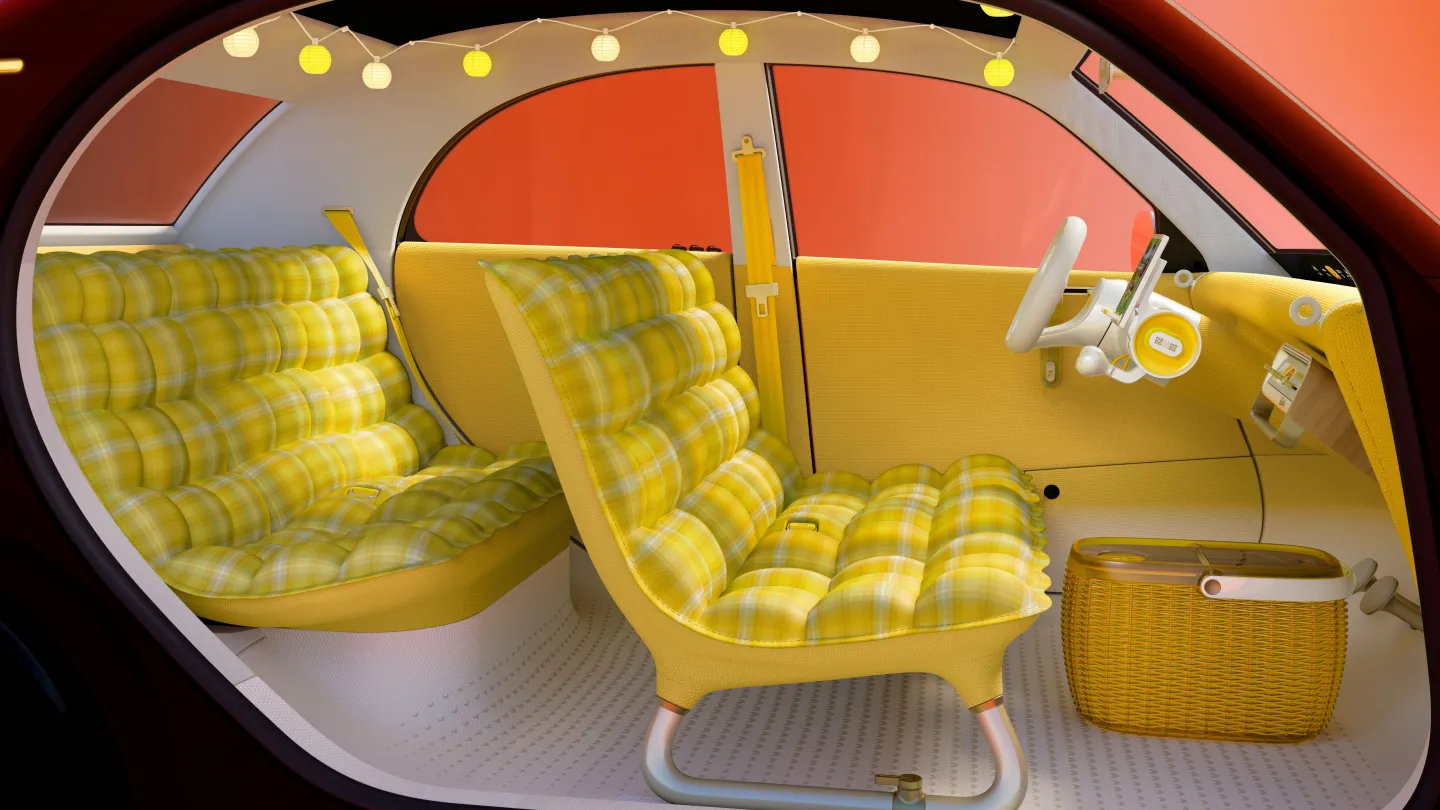
Inside the car, simplicity reigns. There is no traditional dashboard; instead, the steering wheel and instrument cluster are mounted on the steering column. The cabin includes an 8-inch touchscreen, plaid upholstery, and functional features like fabric door-pull straps and a removable 3D-printed storage basket. The radio/speaker unit doubles as a Bluetooth speaker, and tubular-frame seats can be removed for outdoor activities.
Citroën/Stellantis
The original 2CV was a marvel of engineering, balancing limited material availability with exceptional space efficiency. Citroën has furthered this legacy through advanced computer-aided design (CAD), optimizing the 2 CV Concept’s structural geometry for maximum interior volume and minimal weight. Notably, the design team chose to maintain the car’s iconic high, curved roofline, prioritizing aesthetic value over computational efficiency.
Despite its innovative design, the 2 CV is unlikely to make its way to the United States. Compliance with U.S. regulations would necessitate additional structural steel and driver-assistance systems, negating its lightweight and cost-effective advantages. Its modest battery pack, similar to the e-C3’s 30-kWh lithium-iron-phosphate chemistry, limits its highway range to under 100 miles, further constraining its appeal in the U.S. market.
Nevertheless, the 2 CV Concept challenges the pervasive “SUV creep” in North America, offering an intriguing micro-mobility solution akin to other compact electric vehicles like the roofless bubble car. It could find a niche as a distinctive city car in places like gated communities, coastal resorts, or urban centers with short daily commutes. Citroën hopes its retro-chic design will capture consumer interest despite its minimalist features.

Citroën/Stellantis
Even if the 2 CV never graces American roads, it provides valuable insight into the global automotive landscape. The Western market is preparing for a wave of cost-effective, competitive Chinese electric vehicles, and the 2 CV stands as a testament to the unique European charm that other global competitors cannot easily replicate. As Stellantis experiments with this blend of heritage design and minimalist engineering, American automakers will be keenly observing, especially those struggling to produce an affordable entry-level EV.
Source: Stellantis
Original Story at newatlas.com