
Rising Global Temperatures Expose Young Children to Increased Heat Stress
In a world where climate change is becoming more apparent, over 40% of children under ten are already experiencing at least 20 extra days of heat stress annually. This alarming statistic is the result of a recent study published in Science Advances, which examines the demographic exposure to increased hot and humid days through climate models.
Research indicates that children up to nine years old face more additional heat-stress days due to climate change than any other age group. The regions most affected are South Asia and West Africa, where the rapidly growing youthful population experiences the highest levels of humid heat exposure.
Understanding Humid Heat
The deadly potential of high temperatures cannot be overstated. Heatwaves in Europe in 2026, for instance, have been linked to tens of thousands of excess deaths. Previous studies have established that children born in the 21st century will face more extreme weather events than their predecessors. A related study highlights that over half of the children born in 2020 will encounter an unprecedented lifetime exposure to heatwaves, even if global warming is limited to 1.5C.
The latest findings from the research team suggest that children are already more exposed to dangerous levels of humid heat than adults due to human-induced climate change. The combination of high temperatures and humidity can particularly impair the body’s ability to cool itself through sweating.
The study employs the wet-bulb globe temperature to measure heat stress, defining a “heat-stress day” as a day with temperatures exceeding 28C. Climate models simulate current global temperature patterns, revealing that low-latitude countries record the most extra heat-stress days compared to pre-industrial conditions.
In Côte d’Ivoire, for example, residents face 112 heat-stress days annually, with about half attributed to climate change. Meanwhile, Germany averages only 0.1 heat-stress days per year, largely due to human-caused warming.
Inequality in Heat Stress Exposure
Children, seniors, and those with medical conditions are most vulnerable to extreme heat due to their bodies’ reduced ability to regulate temperature. Using demographic data, the researchers found that 583 million children under ten experience at least 20 extra heat days annually. This contrasts with 190 million individuals aged 60-69, comprising 30% of this older cohort.
Two primary factors contribute to the higher exposure among children. First, the global population under ten is larger than the older age groups, with 1.3 billion children compared to 0.6 billion aged 60-69. Second, Africa and Asia’s rapidly growing populations tend to have more young children, whereas northern hemisphere countries, which are typically cooler, have older populations.
Future Projections in a Warming World
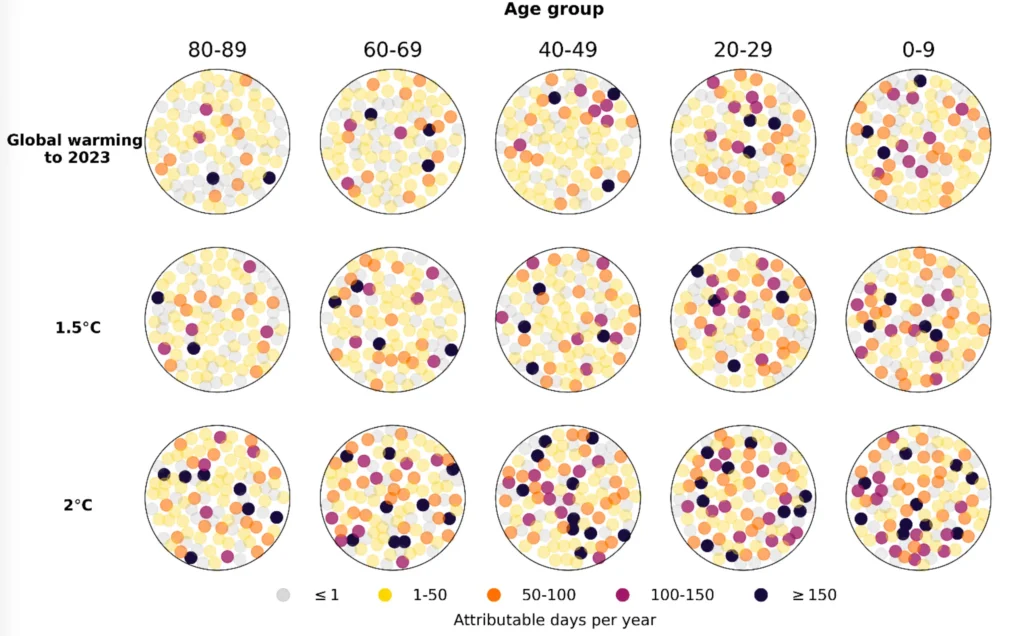
Analyzing future climate scenarios, the study projects that in a 1.5C and 2C warmer world, the percentage of children under ten facing 100 or more extra heat-stress days rises to 13% and 23%, respectively. This is compared to the current 11%. For those aged 60-69, this exposure rises from 6% to 9% and 17% in the respective warming scenarios.
Addressing Vulnerability
Dr. Qinqin Kong from Stanford University praises the study’s methodology, noting its importance in climate justice discussions. However, he points out that the elderly might also be significantly vulnerable due to social factors, such as living alone or having limited mobility, which complicates their access to cooling measures during heat events.
Overall, the study underscores the need for further research linking climate and health sciences to better understand the impacts on children’s health and education. Rosa Pietroiusti emphasizes the importance of such studies to highlight climate justice issues, particularly as children in developing countries bear the brunt of increased heat-stress days despite contributing the least to global emissions.
Original Story at www.carbonbrief.org