The landscape of electric vehicle (EV) adoption in California is a complex interplay between state ambitions and federal policies. While California is pushing for more electric cars and charging stations as part of its ambitious climate goals, federal actions are creating hurdles that could slow progress.
California aims to achieve carbon neutrality by 2045 and reduce the number of gas-powered vehicles on its roads. Transportation is a significant contributor to the state’s greenhouse gas emissions, making the transition to EVs crucial.
This story is part of a series of occasional articles on the state of the energy transition in California amid opposition from the Trump administration.
Recent federal measures have challenged California’s authority to regulate emissions, including the elimination of a federal tax credit for EV buyers and the revocation of California’s power to set stricter vehicle emission standards. The Trump administration’s actions are aimed at promoting a fossil fuel future.
Electric Vehicle Sales
Following the end of the $7,500 federal rebate, national EV sales plummeted and have not yet bounced back. Automakers like Ford and Honda have adjusted their strategies, scaling back on EV models due to federal pressures. Volkswagen has also shifted focus from its electric ID.4 SUV to gasoline-powered models.
“What the Trump administration did is put things on its head,” said Gil Tal, director of the Electric Vehicle Research Center at UC Davis. “They did a U-turn.”

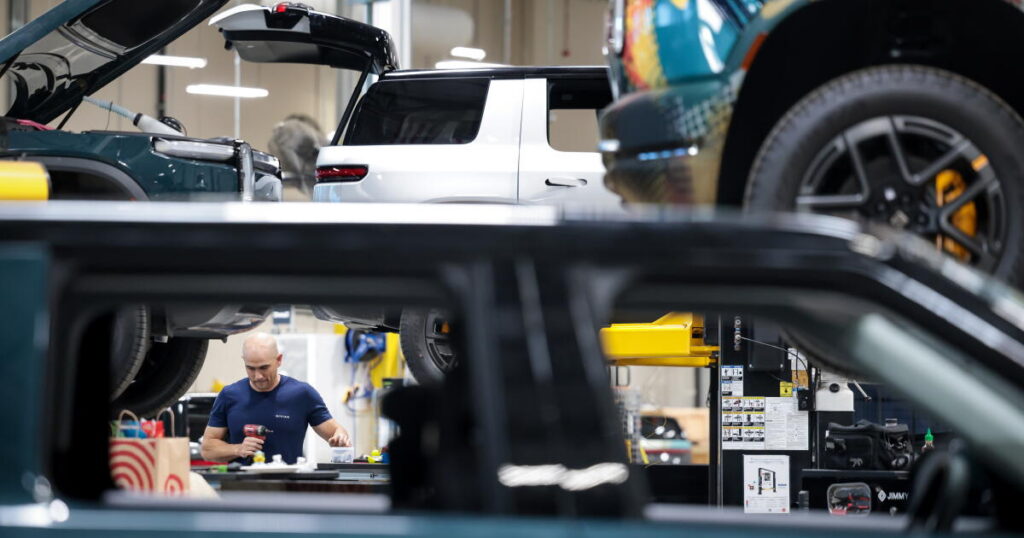
The headquarters of automaker Rivian in Irvine. Unlike Tesla, which moved its headquarters to Texas, Rivian remains committed to California.
(Christina House / Los Angeles Times)
Despite these challenges, Californians continue to embrace EVs, with zero-emission vehicles making up 19% of new car sales in the state this year. This is significant compared to the national average, although it represents a decline from previous years.
A Growing Network of Chargers
California’s network of EV chargers is expanding, boasting more EV chargers than gasoline nozzles. This infrastructure growth supports the state’s EV adoption, despite the Trump administration’s temporary freeze on new funding for public chargers, which was later deemed unlawful by a federal judge.

An EV charging station in the Arts District of Los Angeles on Aug. 13, 2026.
(Allen J. Schaben / Los Angeles Times)
California added the most public fast-charging stations in the country this year, maintaining a high utilization rate. This is driven by EV drivers without home charging options and the increasing popularity of ride-hailing services with electric vehicles.
Building EVs in California
While Tesla shifted its headquarters to Texas, Rivian remains a steadfast presence in California, recently launching the R2 midsize electric SUV. The company continues to see strong demand, with its R1S SUV ranking highly in sales.


1.
Inside the prototype build facility at Rivian in Irvine on June 24, 2026.
2.
Soaring gasoline prices in 2026 have pushed more consumers to consider EVs, according to a Rivian executive.
3.
Software engineers Krishna Venga, left, and Akshdeep Maan test a vehicle at Rivian on June 24, 2026.
(Christina House / Los Angeles Times)
The fluctuating policies at the federal level create unpredictability for automakers, affecting long-term planning and supply chains. Brian Gase, Rivian’s VP of engineering quality, emphasized the need for consistency in policy to support growth in the EV sector.
California continues to push its EV agenda, but the challenges presented by federal policies remain a significant concern. As California Air Resources Board spokesperson Lindsay Buckley noted, these interferences could impact the state’s ability to meet air quality standards and protect public health.
Original Story at www.latimes.com