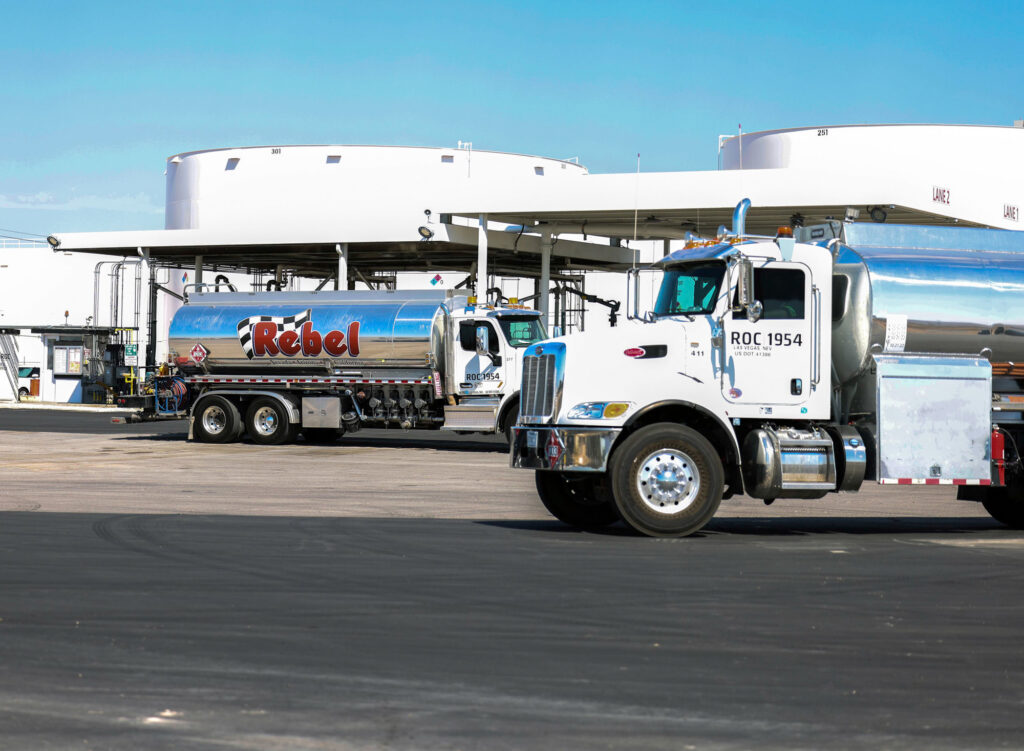
Nevada’s fuel supply hangs by a thread — literally. Just three pipelines carry all the gasoline, diesel, and jet fuel the state needs, and if even one of them fails, the state has only about a week’s worth of reserves to fall back on.
That vulnerability has prompted serious concern among state officials and industry leaders, especially as pipeline shutdowns have already happened in recent years due to wildfires and other disruptions. A Fuel Resiliency Committee convened by Republican Governor Joe Lombardo last year brought together industry experts, state officials, and legislators to study the problem — and their findings paint a stark picture of how exposed Nevada really is.
According to state data, Nevada drivers consumed 1.2 billion gallons of gasoline last year alone. Combined with diesel and aviation fuel, total fuel consumption across the state reached 2.5 billion gallons. Despite growing interest in electric vehicles, 92 percent of Nevada drivers still rely on gas-powered cars and trucks.
All of that fuel flows into Nevada through just three pipelines — two from California and one from Utah. There is no backup system. If a supplying refinery shuts down or a pipeline goes offline, Nevada has no alternative source to draw from.
Northern Nevada: The Most Vulnerable Region
The committee identified northern Nevada as the area most at risk. Only one of the three pipelines reaches that part of the state, and in 2019 it was shut down entirely due to California wildfires. The refineries that feed that pipeline have been closing steadily over the past several decades, adding another layer of risk.
Building a new oil refinery inside Nevada is not a near-term option. The permitting process alone would take years, and Nevada has virtually no domestic oil reserves — meaning crude would still have to arrive via existing or new pipelines regardless.
Southern Nevada faces its own set of challenges. The CalNev pipeline, which runs from Los Angeles to Las Vegas, also supplies Nellis Air Force Base, Edwards Air Force Base, and Harry Reid International Airport. Governor Lombardo declared a state of emergency in 2023 when that line was temporarily shut down. It was later closed again due to wildfires.
Air Quality Regulations Could Add More Pressure
Las Vegas faces an additional complication: federal air quality rules. The Las Vegas Valley is currently out of compliance with Clean Air Act ozone standards tightened by the Environmental Protection Agency in 2015. If the region fails to meet federal benchmarks by next summer, it will be reclassified as a “serious” nonattainment area — a designation that would ban the use of conventional gasoline.
Under that scenario, the region would be required to switch to reformulated gasoline — a cleaner-burning but more expensive fuel that can only be produced at specialized refineries, further limiting Nevada’s supply options.
What the Committee Recommends
The committee’s report called for doubling Nevada’s fuel storage capacity, investing in new pipeline infrastructure, and expanding the state’s ability to receive fuel by rail. Trucking fuel in was identified as the least efficient alternative — it would take hundreds of tanker trips per day just to meet the state’s basic needs.
One promising possibility involves a specialized fuel storage facility in west-central Utah, located just four miles from the pipeline that connects Utah to Las Vegas. That facility can preserve gasoline for years without degradation — a key advantage, since fuel stored too long can deteriorate. A short connection between that facility and the existing pipeline could give Nevada meaningful backup capacity without requiring entirely new storage tanks or a full pipeline build.
Lombardo’s office also asked the state attorney general to review how much legal authority Nevada has to maintain strategic fuel reserves, including whether those reserves could be stored out of state.
Paul Enos, executive director of the Nevada Trucking Association and a committee member, emphasized the economic stakes involved.
“Diesel is the oxygen in the blood of the economy. We need it. If we don’t have it, food doesn’t arrive. Medical supplies don’t arrive.”
The committee’s report was finalized just days before the November election, in which Lombardo was defeated by Democratic Attorney General and Governor-elect Aaron Ford. A spokesperson for Ford did not respond to questions about whether his administration plans to act on the committee’s recommendations.
Enos expressed hope that the issue would remain a priority regardless of who holds the governorship.
“My hope is that whether it’s this governor or the next one or the one after that, there’s an awakening that we’re still running on diesel and gasoline and we’re going to continue to do so for the foreseeable future. And any steps we can take to ensure a continuous supply benefits every citizen in this state.”
This report is based on original English-language reporting published by The Nevada Independent. Additional coverage is available in the publication’s En Español and Medio Ambiente sections. Support independent journalism in Nevada by learning more about membership.