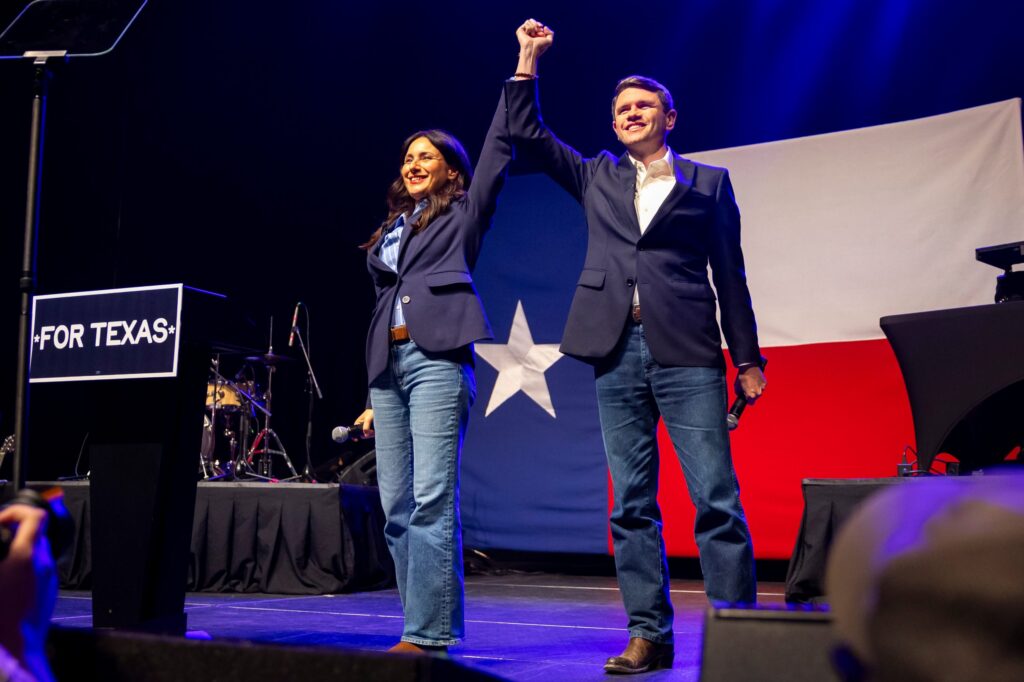
Texas has long been considered reliably Republican territory, but the 2026 election delivered results that are prompting a serious reassessment of the state’s political map. Voters across all 171 rural counties — including communities along the U.S.-Mexico border that had been trending Republican for years — cast ballots in ways that shifted the balance of power in one of America’s largest states.
Democrat Gina Hinojosa defeated incumbent Republican Governor Greg Abbott, and Democrat James Talarico won the U.S. Senate seat held by Republican Ken Paxton. These outcomes represent the first major statewide Democratic victories in Texas in decades — and the voting data behind them tells a story about how voters across the state’s vast rural and border regions participated in this election.
A Statewide Shift in Every Rural County
Election results show that every one of Texas’ 171 rural counties moved toward Democrats in both the gubernatorial and U.S. Senate races compared to previous elections. The gubernatorial contest shifted rural Texas more than eight percentage points toward Democrats compared with 2022, while the Senate race moved rural Texas 7.5 points more Democratic compared with the presidential election cycle of 2024.
It’s worth noting that comparing a 2026 midterm to a 2024 presidential race isn’t a perfect apples-to-apples analysis — presidential elections typically draw higher turnout and are shaped by national dynamics that differ from midterms. Even so, the fact that every single rural county shifted in the same direction suggests something more than a statistical anomaly. It points to a meaningful change in how rural Texans are engaging with their ballot choices.
Voter turnout also increased across the state. According to the Texas Tribune, rural turnout rose from 40.37% to 41.55% between 2022 and 2026, while metro turnout climbed from 46.66% to 50.52%. The state’s 16 border counties saw an especially notable jump — more than 8 percentage points — signaling that more eligible voters in those communities chose to participate in this election than in prior cycles.
Preliminary figures also suggest that rural voters made up a slightly smaller share of the overall electorate in 2026 — approximately 10.5% compared with 11.3% in 2022 — even as their raw turnout numbers increased.
Border Counties That Once Trended Republican Swung Sharply
Some of the most striking results came from counties that had recently moved toward Republicans, particularly among Hispanic voters along the Rio Grande Valley. The swings in these communities were dramatic enough to draw national attention to how voters in these areas exercised their right to vote.
Brewster County — home to Big Bend National Park and the site of national controversy over border wall construction — illustrates the scale of the shift. In 2022, Governor Abbott carried the county by nearly nine points. In 2024, President Trump won it by 13 points and Senator Ted Cruz won it by more than 10 points. This election, Hinojosa won Brewster County by eight points, while Talarico won it by more than 10 — a reversal of more than 20 points from 2024’s presidential results.
The shift in Starr County, a majority-Hispanic county in the Rio Grande Valley, was even more dramatic. Trump had carried Starr County by 16 points in 2024 and Cruz won it by two. In 2026, Hinojosa won the county by nearly 50 points and Talarico prevailed by nearly 55 — an extraordinary turnaround in a region Republicans had been counting on to deliver margins among Hispanic voters.
In Maverick County, situated between Starr and Brewster counties, Cruz carried the county by three points in 2024. This year, Talarico won it by 45 points, while the gubernatorial race moved more than 11 percentage points toward Democrats compared to the prior cycle.
Congressional Races Reflected the Same Pattern
The Democratic shift extended beyond statewide races to congressional contests, where Republicans’ mid-decade redistricting strategy did not produce the gains party leaders had expected. Democrats held several targeted South Texas seats and flipped two key districts.
In the 15th Congressional District, which covers much of the Rio Grande Valley, Democrat Bobby Pulido defeated Republican incumbent Monica De La Cruz, reclaiming the seat for Democrats. Republicans had redrawn the state’s congressional map with the aim of strengthening their position in South Texas. The district ultimately shifted 42 percentage points toward Democrats compared with 2024, with rural counties also moving in that direction. In DeWitt County, for example, the margin shifted 10 percentage points toward Democrats.
In the 23rd Congressional District — a sprawling district stretching from the San Antonio area across much of rural West Texas toward El Paso — Democrat Katy Padilla Stout defeated Republican Brandon Herrera. The 23rd had voted for Trump by a margin of 15 points in 2024 and was previously represented by Republican Tony Gonzales. The district shifted approximately 23 percentage points toward Democrats compared to the previous election. Even in rural counties where Herrera maintained an advantage, his margins were significantly narrower than Republicans had seen in past cycles. In Uvalde County, Herrera won by nine points, but the county’s overall margin shifted 25 percentage points toward Democrats compared with 2024.
What These Results Mean for Voters and Democratic Participation
The 2026 Texas results offer a window into how increased voter participation and shifting voter preferences can reshape outcomes even in states considered politically dominant by one party. Higher turnout — particularly among border county residents and rural voters — translated directly into competitive and in some cases decisive results in races that had not been genuinely contested for years.
The data also raises important questions about how redistricting efforts affect voter representation. When congressional district lines are redrawn to favor one party, the resulting maps are tested by the actual choices voters make at the ballot box. In Texas in 2026, those choices did not align with what Republican mapmakers had anticipated — and voters in both redrawn districts sent Democratic representatives to Congress.
Beyond congressional contests, Democrats made gains across the state ballot in state legislative and judicial races, as well as other statewide offices — suggesting that the shift reflected broad voter engagement rather than isolated outcomes in a handful of high-profile contests.