Election Day in Clark County, Nevada turned into a marathon for thousands of voters — some standing in line for more than four hours after polls officially closed. How a county manages that kind of turnout, and what it means for public trust in the democratic process, is a story every American voter should understand.
Lorena Portilla, Clark County’s registrar of voters, pointed to genuine enthusiasm as the driving force behind the long lines. Roughly 677,000 ballots were cast in the county — a figure that outpaced comparable turnout from the 2022 midterms, which also featured a governor’s race.
“A lot of excitement for voters to go in person and vote,”
Portilla told reporters.
But excitement alone didn’t explain the delays. In a follow-up statement, Portilla noted that Clark County’s ballot was unusually complex this cycle — two cards covering 142 contests and 254 candidates.
“The two card ballot this year with 142 contests and 254 candidates was unique to Clark County and contributed to the time it took for a person to make their choices at election sites,”
Portilla said. She added that several large polling locations had no lines at all, and encouraged voters to use early voting and mail ballots in future elections to avoid Election Day waits.
“We strongly encourage the public to take advantage of early voting and mail ballots as alternatives to in-person Election Day wait times,”
she said.
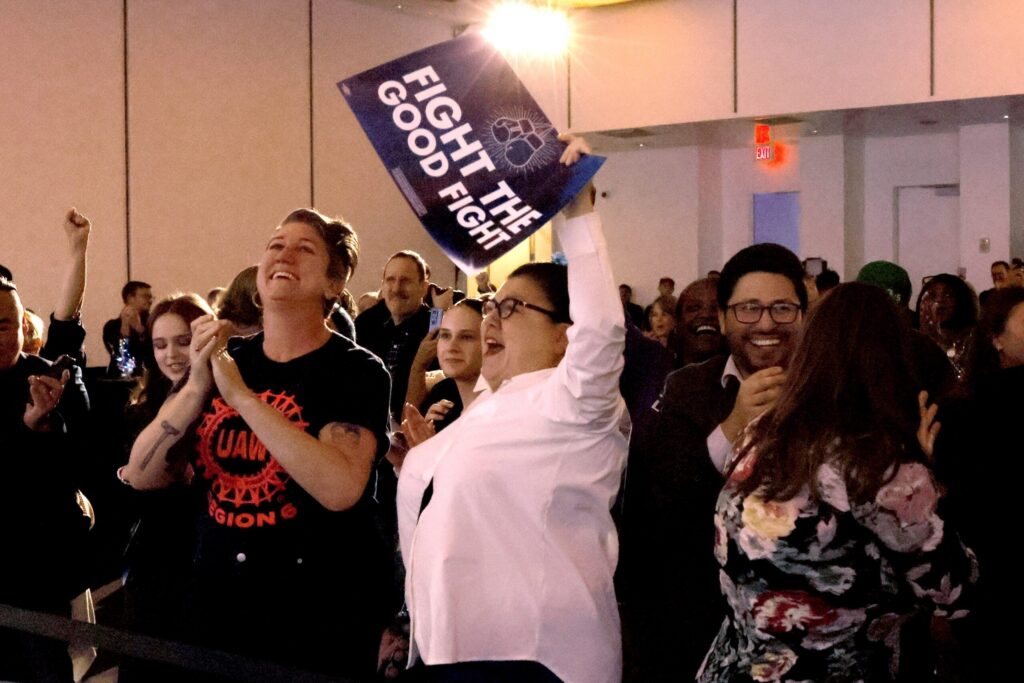
The long lines underscore a recurring tension in election administration: how to accommodate surging in-person turnout while ensuring every eligible voter who shows up can cast a ballot. For many voters, standing in line for four-plus hours after polls close is exactly that — standing until they get their vote counted. That persistence, and the system’s ability to accommodate it, is central to public confidence in elections.
Results Reflect Strong Democratic Performance Across Southern Nevada
When the first results dropped around midnight, Democrats had swept several key races in Clark County, including nonpartisan contests. Among the most closely watched was the progressive Democrat Minja Yan‘s victory in the Clark County District F commission race. Yan defeated Assemblywoman Heidi Kasama (R-Las Vegas) and former state senator Becky Harris, a nonpartisan candidate — winning by at least 14 percentage points by Wednesday afternoon.
What made Yan’s win particularly striking was the financial disparity. Yan declined corporate donations throughout the race and raised approximately $133,500 total, spending around $110,200. By the end of the cycle, she had just $5,399 left in her campaign account. Her opponents, by contrast, spent far more: Harris raised over $410,000 and spent more than $450,000, while Kasama raised roughly $330,500 and spent around $557,000.
When asked about her slim remaining balance, Yan was candid.
“We didn’t have a lot of funding or political resources when we started,”
Yan told The Nevada Independent.
“But we had a lot of community support and community resources.”
Yan’s platform centered on light rail development, affordable housing, and protecting the region’s land and water resources. She credited her policy vision — not just national political trends — as the core of her success.
“I think the national trends definitely impacted my race,”
Yan said.
“But I believe that at the core, the main reason why my campaign was successful was that we had a vision. We were able to communicate our policy plan to voters and we are able to build a big coalition.”
Harris, for her part, attributed her loss largely to the broader political environment.
“We got caught up in the middle of Trump’s war in Iran and disenchantment with national policy,”
she said.
“This is an example of larger federal politics and policies impacting local races.”
Yan acknowledged that her work is just beginning.
“I will not be able to accomplish these policies and visions alone,”
she said, noting her immediate priority was assembling a District F team.
North Las Vegas and Henderson Races Round Out the Picture
In North Las Vegas, Assemblywoman Daniele Monroe-Moreno (D-North Las Vegas), who also chairs the Nevada Democratic Party, won the nonpartisan race for mayor against Councilmember Scott Black. Though the race was nonpartisan, Black had previously been registered as a Republican before switching his affiliation. He was endorsed by the Vegas Chamber and several law enforcement groups, and he significantly outraised Monroe-Moreno — spending $1 million over the course of the cycle compared to Monroe-Moreno’s roughly $500,000. She raised roughly $467,000 while Black raised around $635,500.
Speaking at a victory rally, Monroe-Moreno drew a distinction between party representation and public service.
“When Democrats get elected, we aren’t elected to represent a party,”
she told supporters.
“We are elected to represent the people.”
Monroe-Moreno said she felt her race stood apart from national trends, though she credited Democratic organizing nationwide. Her term as state party chair ends in March 2027, and she said she would not seek re-election to that position. Black did not respond to media requests, though Monroe-Moreno confirmed he called her and that the two planned to meet for lunch.
Also in North Las Vegas, Esmeralda Villeda — a real estate professional serving on the city’s Planning Commission — won the Ward 1 city council race against Sherry Strothers.
In Henderson, incumbent Mayor Michelle Romero won re-election by more than 20 percentage points against former police chief Hollie Chadwick, whom Romero had fired in early 2025 after less than two years on the job. The dispute had featured prominently in campaign attack ads.
“I’m very pleased with the result; it came in just about where we thought it would,”
Romero told The Nevada Independent.
The fundraising gap in Henderson was similarly lopsided: Romero had roughly $287,600 on hand in the final stretch while Chadwick had just about $7,000.
In Henderson’s Ward 3 race, Jennifer Atlas — a government relations director for the American Cancer Society Cancer Action Network — defeated incumbent Councilmember Carrie Cox. Atlas, a registered Democrat, will now be the only Democrat on the Henderson City Council.
“I campaigned on fighting to lower costs, increase access to quality healthcare and keep our community safe,”
Atlas said in a text message, calling the win a moment she was
“humbled”
and
“grateful”
for.
When asked about Atlas, Romero expressed optimism about the incoming council member.
“She will bring a new energy and I’m excited to work with her,”
Romero said.
One Race Too Close to Call — and What Nevada Law Says About Recounts
Not every race produced a clear winner by Wednesday. In Las Vegas’ Ward 2 city council race, attorney Shannon Nordstrom led firefighter Luke McCarthy by just 144 votes, with tens of thousands of mail ballots still to be counted.
Voters in close races should understand what protections exist. Unlike some states that automatically trigger a recount when results fall within 0.5 percent of each other, Nevada has no automatic recount threshold. Candidates do, however, retain the right to request a recount within three days of the election. Neither Nordstrom nor McCarthy responded to requests for comment before publication.
The Ward 2 outcome is a reminder that in a healthy democracy, every ballot — including those arriving by mail — matters, and the counting process must be allowed to run its full course before results are finalized.