Imagine looking up to the sky and seeing a world of opportunity and innovation. For Bill Gates, this was his reality growing up in Seattle, a city deeply connected to aviation through Boeing. Now, as he considers the impact of aviation on climate change, the skies tell a different story.
“When I was growing up in Seattle, planes were everywhere,” Bill Gates recalls, highlighting Boeing’s significant presence in the area. “Boeing was the biggest employer in the area, and it felt like almost every adult I knew had some connection to the company,” he adds, pointing to the widespread involvement of his neighbors, family friends, and teachers in the aviation industry.
This is what Bill Gates wrote about planes and climate
Today, airplanes are not just marvels of engineering; they are also substantial contributors to climate change. Gates notes that aviation is challenging to decarbonize because keeping a massive aircraft airborne without increasing weight or compromising safety is a complex task. While electric and hybrid aircraft are being developed for shorter flights, longer journeys require Sustainable Aviation Fuel (SAF) to reduce emissions.
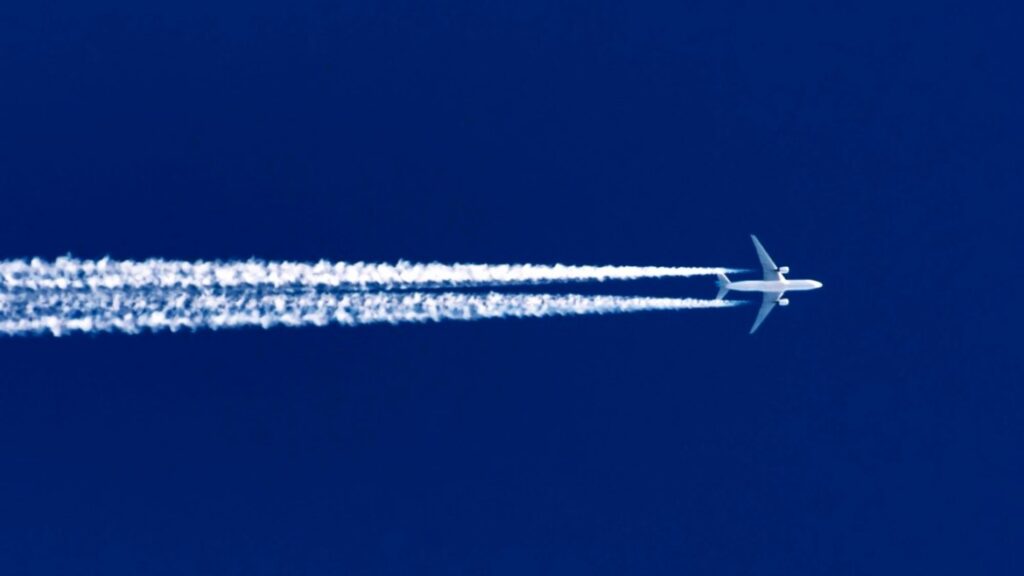
Beyond jet fuel, airplanes influence climate through contrails. These condensation trails, often mistaken for “chemtrails,” are essentially clouds formed by planes, which significantly contribute to global warming. Gates states, “If we got rid of some contrails, we could eliminate up to two percent of all global warming.”
Contrails form when planes fly through air pockets with specific temperatures and humidity, causing water to condense around soot particles from the engines, turning into ice crystals. While many contrails dissipate quickly, some linger and transform into cirrus clouds, trapping heat similarly to natural cirrus clouds. During nighttime, these clouds prevent heat from escaping, thus contributing to warming.
Persistent contrails account for about half of the temperature rise due to aviation. Eliminating them could be a cost-effective climate intervention, costing less than ten dollars per ton of emissions avoided, compared to the higher costs associated with SAF.
Preventing contrail formation involves rerouting flights, a practice already used to avoid turbulence and bad weather. Adjusting flight paths slightly can prevent planes from flying through contrail-forming conditions, impacting only about five percent of flights globally. The additional fuel burned from these changes is minimal, especially as cleaner fuels like SAF become more prevalent.
Gates is actively involved in initiatives like Contrails.org, which develops tools to help airlines plan routes that avoid contrail formation. Collaborations with American Airlines and Google Research have already tested contrail avoidance techniques, and upcoming studies like Operation Blue Skies will further explore these strategies.
Despite his own use of private planes, Gates emphasizes his commitment to minimizing environmental impact by utilizing SAF and ensuring his flights avoid creating warming contrails. The challenge lies in incentivizing airlines to adopt these practices, as the economic benefits of avoiding contrails are not immediately apparent.
Nonetheless, Gates remains hopeful that contrail avoidance will become integrated into air traffic modernization efforts worldwide. As he reflects on the potential to significantly reduce global warming at a modest cost, Gates underscores the urgency of making such progress while waiting for broader innovations to reach their full potential.
Original Story at tanzaniatimes.net