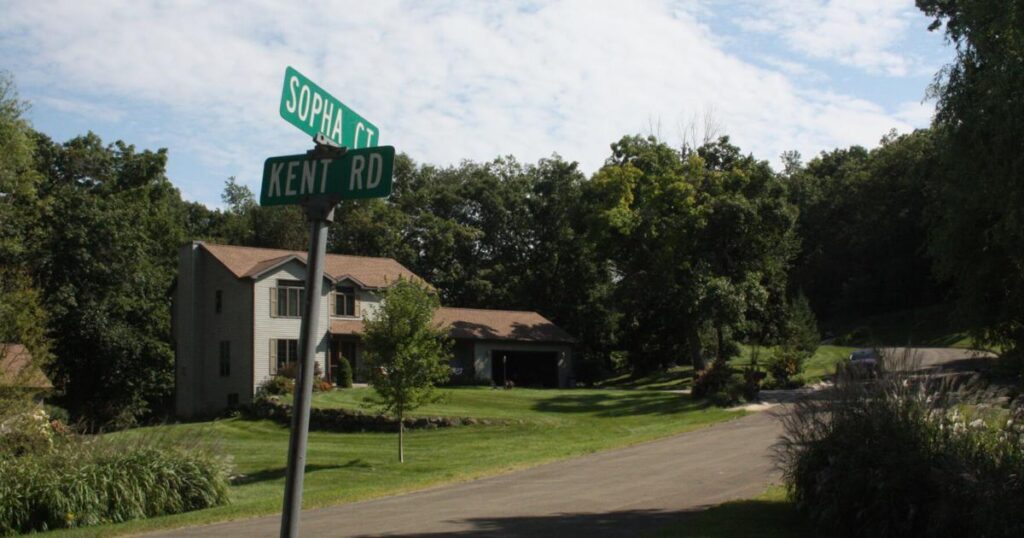
The Village of Poynette is grappling with persistent drainage issues in the Sopha Court area, as officials try to piece together the origins of the problem amid missing historical documents. The village is now exploring potential solutions to mitigate the stormwater challenges.
During a Village Committee of the Whole meeting on August 24, Village Administrator Craig Malin presented a detailed memo addressing the issue. Malin explained to the board that stormwater flows primarily down the east side of Sopha Court. Unlike the west side, which has a curb and gutter, the east side lacks these features at the top of the road, though they are present further down.
Kory Anderson, Vice President and Project Manager at General Engineering, confirmed the challenging topography, noting that water descends a steep embankment toward homes below. The village incorporated Sopha Court around 1994, but meeting minutes from that time were lost due to water damage. A surviving document from June 13, 1994, is a letter from Jerry Foellmi to the Poynette Village Board, recommending the street’s acceptance:
“As you may recall, the agreement (noted in my May 20, 1993 letter to the Village) stipulated that Mr. Sopha was to construct an acceptable roadway with cul-de-sac, gravel, shoulders, necessary curb & gutter, acceptable side slopes, ground cover, and erosion control protection measures in order for the Village to accept the dedication of the street. After the dedication acceptance, a one year warranty period would go into effect, during which time if problems arose with such things as (erosion problems, inadequate vegetive cover, pavement or curb problems) Mr. Sopha would be responsible for making necessary repairs and bringing the street into an acceptable condition.”
Malin suggested focusing on current conditions and challenges rather than speculating on past agreements. He highlighted two significant changes: the increased severity of storm events due to climate change and the existence of the village’s stormwater utility, established in 2006 and funded by a special charge on water bills based on local conditions.
In 2012, the village published a comprehensive Stormwater Master Plan, but Sopha Court was not specifically identified as an area of concern. When questioned about this by Village Board President Diana Kaschinske, Anderson explained that little had been done regarding stormwater management in that area before the Point Garden development. He also noted that the list of areas of concern was not exhaustive, and some projects mentioned had already been addressed.
With these historical and current considerations in mind, Malin suggested the board consider whether a stormwater management project on Sopha Court could serve a public purpose, benefitting more than just one residence, and therefore be eligible for funding by the stormwater utility.
Anderson, who had already conducted a preliminary exploration of the area with Director of Public Works Scott Gorman, expressed confidence in a potential solution. “I’m pretty confident that curb and gutter on the east side of Sopha Court would be the most effective, and that would basically collect the water and take it down Sopha Court to connect with existing curb and gutter on that side of the street,” Anderson stated. He added that the ample landscaping between properties provides sufficient space to manage water flow effectively.
Anderson mentioned the possibility of fast-tracking the project to begin within the year, contingent on board approval, or scheduling it for 2027 if necessary.
Original Story at www.hngnews.com