Unveiling the Future: Genesis GV90 and the Shift to Electric Luxury
In the heart of San Bruno, just a stone’s throw from San Francisco International Airport, a new chapter in automotive luxury unfolds. Genesis of San Bruno, a newly opened dealership, recently showcased the striking “concept” convertible from the G90 Trilogy to a captivated audience of international auto journalists. This event marked an in-depth exploration of Hyundai’s burgeoning luxury brand’s forthcoming flagship model.
The Genesis Gran Convertible, with its stunning design, arguably outshines the GV90 in embodying the luxury brand’s flagship aesthetic. However, the 2028 Genesis GV90, slated for a U.S. debut in early 2027, is positioned as the brand’s next big step. Meanwhile, a G90 coupe and convertible inspired by the Trilogy may take an additional year or two to reach the market.
For those unfamiliar with Genesis’s naming conventions, “GV” signifies a sport/utility vehicle, distinguishing it from the G90 Trilogy concept cars, which suggest successors to the current G90 sedan. These concept cars harness the power of a modified version of the existing G90’s twin-turbo V6, enhanced by a 48-volt e-charger.
The Trilogy may not define Genesis’s future, as the GV90 showcases the brand’s innovative eMP platform, assembled in a dedicated facility in Ulsan, South Korea. This platform features a high-capacity 123.5 kilowatt-hour battery with thermal runaway fire protection, powering the front motor with 322 horsepower and 258 lb-ft of torque, while the rear motor delivers 355 horsepower and 332 lb-ft of torque, resulting in a combined output of 657 horsepower and 590 lb-ft. A dual electronic limited-slip differential, multi-chamber air suspension, and dual-valve shock absorbers ensure optimal performance.
While the GV90 was developed as a battery-electric vehicle, Luc Donkerwolke, the chief creative officer, notes that this “does not exclude” the possibility of an extended-range version in the future. Despite impressive towing capabilities of 7,500 pounds, Genesis acknowledges that towing a trailer could significantly reduce the vehicle’s 316-mile range. A rapid charge from zero to 80 percent is achievable in just 22 minutes.
The Cadillac Vistiq, boasting 615 horsepower and 650 lb-ft of torque with a 300-305-mile range, emerges as a potential rival to the GV90, although Genesis refrains from engaging in direct competitor comparisons.
“From a pure technical point of view, electricity is the future.” —Luc Donkerwolke
Despite changes in federal EV tax credits under the Trump administration, Genesis remains committed to its strategy, confident that the GV90’s anticipated pricing will surpass the expired tax credit threshold. The brand’s expansion into over 40 markets globally has helped offset declining U.S. EV sales, as demand surges in regions affected by geopolitical events like Iran’s closure of the Gulf of Hormuz.
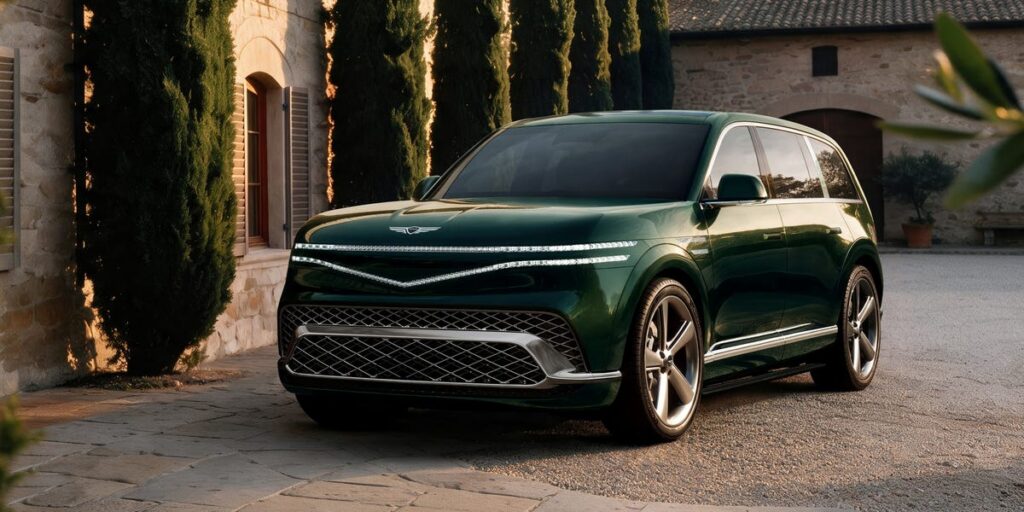
As Genesis’s flagship model, the GV90 introduces a new design language that may influence future EVs from the brand, possibly including a new G90 in the coming generations. The SUV’s distinctive styling features a costly thin, flush V-shaped LED headlight ring, which Donkerwolke suggests might have cost him his job at another automaker. Below, a grille-like diamond-pattern chrome lower fascia offers a modern take on 1950s American car design, while double-strip horizontal tail lamps evoke the 1965 Buick Electra 225.
A thin, flush V-shaped LED headlight ring is the costliest design element on the SUV that Donkerwolke says likely would have cost him his job at any other automaker.
The GV90’s interior rivals the finest from Germany and England, featuring premium leather, wool cashmere, and a selection of seven color combinations, complemented by stone and wood trim. The power front seats can rotate 180 degrees to face the second-row first-class airliner seats, and a 23.6-inch organic LED center screen expands to 24.6 inches for video viewing. However, Genesis emphasizes that the SUV cannot be driven with the seats and screen in this configuration.
The “base” Genesis GV90, with its traditional swing-out doors, positions itself against competitors like the Cadillac Vistiq and the 2028 Land Rover Range Rover EV. Meanwhile, the GV90 Neolun, featuring independently opening ’60s Lincoln Continental-style coach doors, aims to compete with the high-end Mercedes-Maybach EQS.
Neolun’s coach doors incorporate a hidden b-pillar, which enhances accessibility by removing the pillar between the front and rear seats. According to Dae Hee Lee, head of the Genesis body design group, the use of aluminum instead of steel in the doors ensures structural rigidity surpassing that of traditional B-pillars. The SUV’s structure comprises 72 percent aluminum, resulting in body rigidity that’s 12 percent greater than its competitors, Lee adds.
The GV90 Neolun’s “executive suite” interior features a wood veneer floor with under-floor heating, airliner-style tray tables, a mini-fridge, and top-tier massaging seats. The First Edition launch model includes a “comfort partition” for added quietness, while other models offer a third row, although headroom is limited due to the world’s first rollover airbag integrated into the headliner.
The GV90’s extensive list of luxury features includes remote start parking assist, Bang & Olafsen Premier 3D sound with 25 speakers, ambient lighting, heated windshield, and Geo AI voice command controls. A unique retro feature is the column shifter that swivels when the vehicle starts, accompanied by a crystal sphere controller on the front console.
Original Story at www.autoweek.com