Tracking Bird Movements: How Climate Watch Volunteers Are Mapping Avian Adaptations
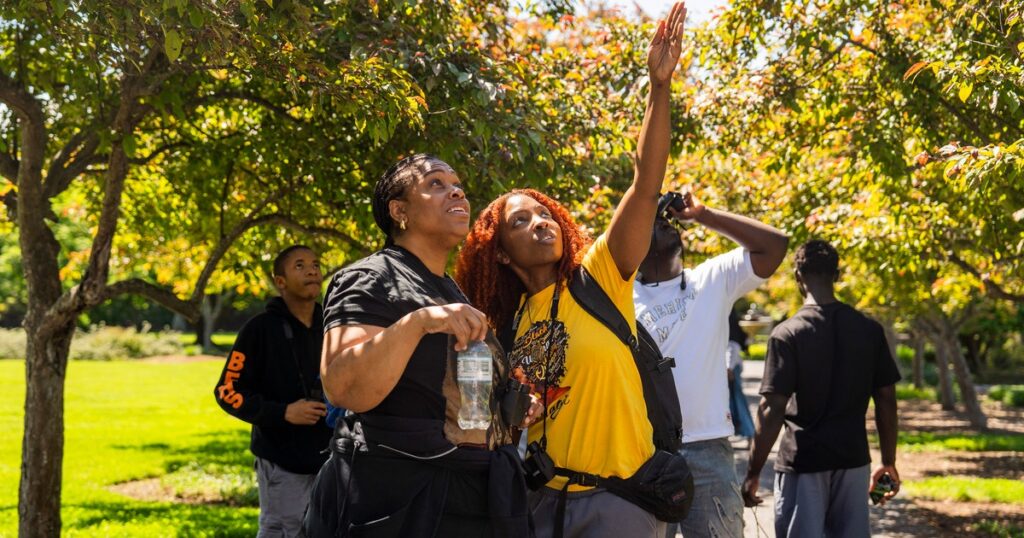
As the February morning chill lingered, Aiyana Uter lifted her binoculars, scanning the trees for bluebirds while joining her peers from Claflin University’s Audubon campus chapter. This dedicated group methodically traversed Orangeburg, South Carolina, pausing for five minutes at each selected location to log sightings of Eastern Bluebirds and other bird species.
Uter’s group is part of a larger community effort under Audubon’s Climate Watch, a citizen science initiative that began in 2016. Initially involving 75 participants in four states, this program has expanded significantly. Now, over 1,000 volunteers annually track 12 bird species, including nuthatches, goldfinches, and towhees, documenting their movements in response to climate shifts.
Audubon initiated this project to verify their climate change predictions. Their 2019 report, Survival by Degrees, identified 389 bird species at risk due to climate threats, mapping potential habitat changes under different global warming scenarios. Climate Watch volunteers provide crucial data, confirming whether birds are moving as predicted or vacating traditional habitats.
“Nobody has really done, at this scale, what we’re doing,” shares Brooke Bateman, Audubon’s senior director of climate and community science. The program relies on volunteers to report both sightings and absences of target species, offering invaluable insights into bird movements across the nation.
In 2020, a study confirmed that bird observations aligned with climate predictions, noting species like the Brown-headed Nuthatches moving northwest beyond their usual southeastern pine forest habitats. Audubon is now developing a comprehensive analysis covering data from the entire decade. “We’re seeing even stronger validation of our climate projections than we did from the first paper,” notes Sarah Saunders, Audubon’s senior manager of quantitative science. “And we’re identifying which species are keeping pace with climate change and which are lagging behind.”
Recent observations reveal varied responses among species. For instance, while Western Bluebirds are relocating northward, Eastern Bluebirds are slower to adapt, potentially leaving them vulnerable to climate change. Nuthatches also show reluctance to breed in new areas, suggesting that factors beyond climate may influence habitat suitability.
The project contributes to broader research examining species movements on a warming planet. Ben Winger, an evolutionary biologist at the University of Michigan, highlights that while many North American birds are shifting their ranges northward, these adjustments may not suffice against rising temperatures.
Information from Climate Watch aids conservation efforts, pinpointing species and habitats requiring urgent attention. Local communities can participate by installing nest boxes to support bluebird populations. Winger emphasizes that birds offer a lens through which people can understand climate change’s impact on local landscapes, and initiatives like Climate Watch empower individuals to contribute scientifically.
Carrie Wild, involved with Climate Watch through the Amos Butler Audubon Society in Indiana, expresses her enthusiasm: “I had the best time because it felt like I was a part of something bigger.” Her encounters with birds inspire her work as a professional artist, capturing the essence of birds like the Golden-crowned Kinglet in her paintings, which often support conservation efforts.
Similarly, Aiyana Uter emphasizes the importance of youth engagement in conservation, noting that activities like participating in Climate Watch and local birdwatching are accessible ways to contribute to nature preservation without significant financial investment.
Original Story at www.audubon.org