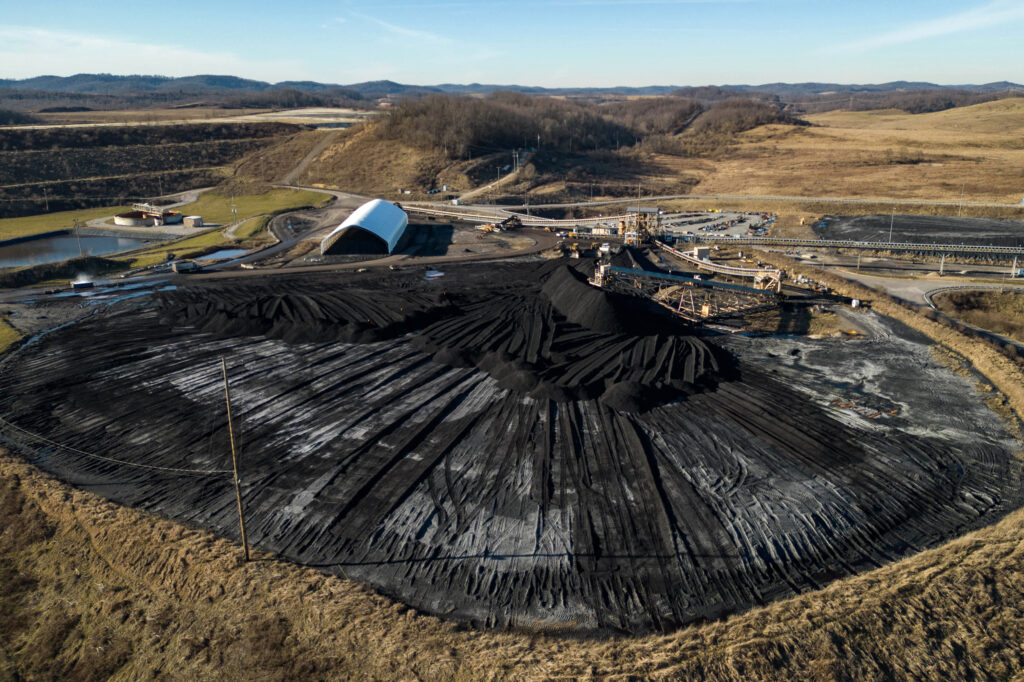
Energy officials announced on Thursday a $425 million investment to extend the life of 12 coal plants across several states, including $50 million from the U.S. Department of Energy (DOE) for the Mitchell Plant in Moundsville, West Virginia. This move is part of a larger effort to modernize existing facilities.
Quenton King, government affairs specialist for Appalachian Voices, expressed frustration, saying, “Coal is not dead in West Virginia…we’re just maintaining the coal systems.” He noted that while new solar panels are not being constructed, coal plants continue to receive significant reinvestment, affecting health and economic conditions.
Beyond West Virginia, the DOE funding also supports coal plants in Arkansas, Arizona, Kentucky, North Carolina, North Dakota, Oklahoma, Tennessee, and Wisconsin. An additional $350 million will be invested in new coal power plants in Anchorage, Alaska, and Mount Storm, West Virginia, and for upgrades in Guayama, Puerto Rico, and Cumberland, Maryland.
The announcements coincide with EPA rollbacks of coal ash regulations and a federal shift away from renewable energy investments like solar and offshore wind.
Energy Secretary Chris Wright emphasized the strategic importance of these projects, including a $75 million allocation for a coal export terminal in Oakland, California, which has faced local opposition. “By investing in coal generation and export infrastructure, we are reinforcing energy security and strategic supply chains,” Wright stated.
Michael Lenoff of Earthjustice criticized the use of the Defense Production Act for funding, arguing it contradicts efforts to promote modern technologies like solar and wind energy.
“Coal Should Be at the Bottom of Your List”
Earlier this year, the Trump administration ordered coal plants to remain operational to meet rising energy demands. Michelle Bloodworth from America’s Power stated that coal plants provide essential baseload power, enhancing resilience.
Coal has long been on the decline due to its environmental impact. In 1990, it generated over half of the U.S. electricity, a figure expected to drop to 17 percent by 2025. Studies indicate coal pollution contributes to health issues, including cardiovascular disease and premature deaths.
Mary Willis from Boston University highlighted the risks, noting that coal contributes heavily to harmful air pollution. “Coal should be at the bottom of your list,” she advised, citing studies that show significant reductions in mortality rates as coal usage declines.
The DOE’s funding will also upgrade two units at North Dakota’s Antelope Valley Station, aiming to reduce unplanned outages. Local officials emphasize the importance of coal for community employment despite the rise of data center proposals.
Separately, the Trump administration announced measures to keep a coal plant in Orlando, Florida, operational despite its planned closure, drawing criticism from environmental advocates.
The EPA also advanced a plan to grant Louisiana more control over coal ash regulation, potentially making it the sixth state to adopt such measures. Environmental groups are concerned about less stringent monitoring of coal plants.
“These coal plants are scheduled to retire for a reason,” stated Ted Kelly from Environmental Defense Fund, arguing for cheaper and cleaner energy alternatives.
Original Story at insideclimatenews.org