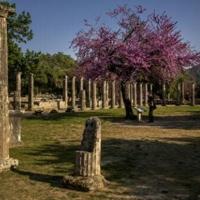
As climate change continues to alter global weather patterns, Greece is grappling with the preservation of its historical treasures amid increasing environmental threats. With wildfires, heatwaves, and rising sea levels becoming more frequent, Greek authorities are intensifying efforts to safeguard archaeological sites that attract hundreds of thousands of tourists each year.
These historic monuments not only enrich the nation’s cultural heritage but also contribute significantly to Greece’s economy through tourism. However, many of these sites are located in rural regions, prompting officials to consider improved evacuation strategies for large tourist gatherings in the event of an emergency.
Following a comprehensive three-year study by top Greek scientific institutions, the Ministry of Culture has identified 19 archaeological sites in urgent need of protection from natural disasters, with plans to extend safeguards to additional sites by 2030. This initiative marks the first extensive nationwide evaluation of its kind.
Among the prioritized sites are Olympia, frequently threatened by wildfires; the ancient theatre of Delphi, where rockslides pose a risk; and the sanctuary of Dion, which is susceptible to flooding. Olympia Mayor Aristides Panagiotopoulos emphasized in an email to AFP the necessity for “constant vigilance” to protect the birthplace of the Olympics.
“Our concern remains acute, as the area of Ancient Olympia is extensive, with a large expanse of greenery and dense, often unregulated, spontaneous vegetation,” Panagiotopoulos stated. Despite significant interventions, he noted that more efforts are needed to fully address the protective needs of the site.
Historically, Olympia suffered devastating wildfires in 2007 that severely damaged the surrounding environment and resulted in over 40 fatalities in the Elis region. More recently, major fires have occurred in 2021, 2022, and 2024, according to Panagiotis Lattas, the head forester for the region.
With this year’s rainfall exceeding the annual average by about 40 percent, Lattas highlighted the necessity of clearing the resulting abundant vegetation in urban and agricultural areas before the onset of wildfire season.
– Long-term Protection Strategy –
In response to soaring temperatures, Greece has already adjusted visiting hours at the Acropolis in Athens to protect tourists during peak heat. However, the increasing frequency of extreme climatic events necessitates broader measures.
Between 2022 and 2025, researchers from the National University of Athens and the National Research Foundation carried out detailed assessments of climate and geological risks at 19 sites, examining past damages to anticipate future vulnerabilities.
The interdisciplinary study, involving climatologists, geologists, architects, and other experts, assessed threats such as fire, floods, heatwaves, and coastal erosion. The study’s findings will inform protective measures for sites including Brauron near Athens, Philippi in the north, and the temple of Apollo Epicurius in the Peloponnese, among others.
Supported by over 20 million euros ($23 million) in EU and national funding, the project also involved research contributions from the National Observatory of Athens and the Demokritos research centre. Culture Minister Lina Mendoni announced plans to extend protection to 40 sites by 2030 during a recent Athens conference.
– Managing an ‘Exposed’ Landscape –
“Our homeland has a uniquely high density and wide geographical distribution of outdoor monuments, inextricably tied to the landscape, which are exposed to fluctuations in temperature, increased humidity, heavy rainfall, and wind,” Mendoni stated at the conference. She emphasized that climate change exacerbates existing risks, increasing their frequency and severity.
The Ministry of Culture plans to install new fire sensors at 21 sites this year and develop fire protection strategies for over 60 archaeological locations. Official statistics reveal that Ancient Olympia attracted over 300,000 visitors in 2024, with Knossos and Delphi receiving over a million and 290,000 visitors, respectively.
Delphi Mayor Panagiotis Tagalis reported rockfalls on the Amfissa-Livadeia road in November 2024, which disrupted access to the site and affected local residents and businesses. In response, the ministry has installed wire mesh on cliffs overlooking the site and cleared a rural road for emergency vehicle access.
“Twenty years ago it was absolutely forbidden to create firebreaks…in protected areas,” Mendoni remarked, noting the shift in mentality towards proactive conservation efforts.
Original Story at www.nbcrightnow.com