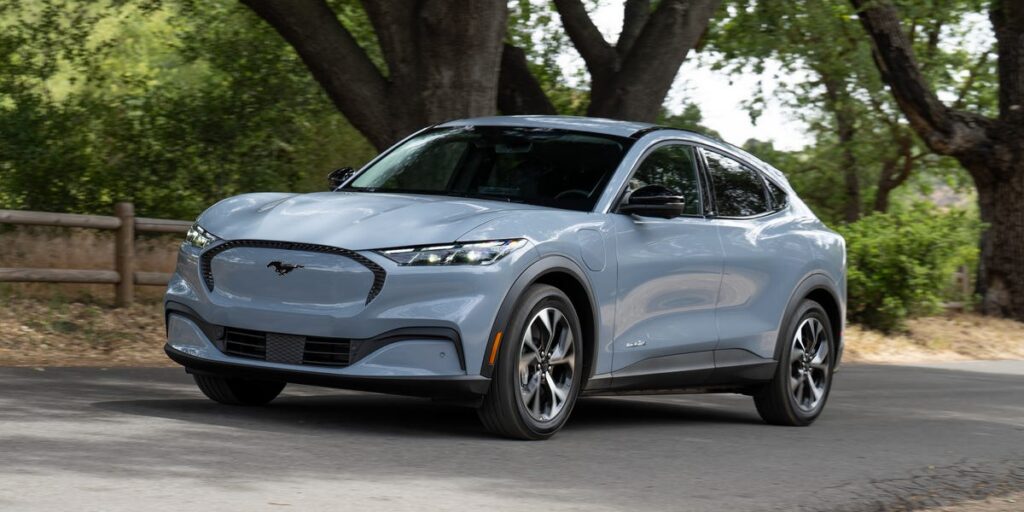
Ford’s Mustang Mach-E is now in its sixth year, and while it has made strides to distinguish itself from its iconic namesake, it still prompts questions from onlookers. Questions like “Is this the only new Mustang?” or “Did you put a Mustang badge on this?” are not uncommon, though the vehicle does indeed come from the factory sporting its signature Mustang emblem. Despite some confusion, the Mach-E has become recognized as a five-seat electric vehicle in the automotive community.
For those interested in a touch of nostalgia, the 2026 model year introduces a new California Special package. This edition mirrors the cosmetic enhancements of the late ’60s originals, transforming the Mach-E GT with features like 20-inch gray wheels, blue hood graphics, and a light-up grille pony. The interior boasts a navy-blue finish and numerous GT/CS logos.
Beyond these aesthetic changes, 2026 brings practical improvements such as grab handles on the rear doors, enhancing accessibility. However, some features, like the frunk, have been shifted from standard to optional offerings.
The Mach-E is available in various trims, beginning with the 264-horsepower RWD Select equipped with a 73-kWh battery offering a 260-mile range. This lineup extends to the dual-motor GT and Rally trims, which deliver 480 horsepower and all-wheel drive, along with an extended-range battery. Buyers can also opt for all-wheel drive and a larger battery for Select and Premium models.
Electric cars are known for their rapid acceleration, and the Mach-E Select is no different, achieving a 0-60 mph time of 5.6 seconds and a quarter-mile in 14.4 seconds. While these figures would have impressed original Mustang enthusiasts, current performance-seekers might lean toward the faster trims, which can hit 60 mph in 3.3 seconds.
For those craving a traditional Mustang experience, Ford continues to offer its classic sporty coupe. However, the Mach-E, priced at $44,215, provides benefits such as a spacious rear seat, versatile cargo capacity, the option for frunk storage, BlueCruise semi-autonomous driving, and the convenience of home charging.
The downside of the Mach-E’s practicality is a less agile driving experience compared to its V-8 sibling. The vehicle’s weight is noticeable during maneuvers, resulting in a 0.79-g skidpad result and a braking distance of 189 feet from 70 mph, which falls short of the Tesla Model Y’s 179 feet.
Despite these drawbacks, the Mach-E excels in city driving with its smooth handling and effective one-pedal driving that brings the car to a complete stop. On highways, Ford’s BlueCruise allows drivers to relax while the car maintains control, offering a stress-free journey.
Charging the Mach-E can be time-consuming, with a peak rate of 115 kilowatts for the standard-range model. This means a 40-minute wait at a Level 3 station to recharge from 10% to 80%. However, an adapter for Tesla Superchargers offers some flexibility in charging options.
Inside, the Mach-E features a modern, screen-focused design with a 10.2-inch display for driving data and a 15.5-inch infotainment screen. The comfortable front seats absorb road feedback, while the back seat offers ample space and additional charging ports, though the rear wheel well can make child seat access challenging. With seats folded, cargo space expands to 60 cubic feet.
While the Mach-E might not capture the raw essence of a classic Mustang, its practicality and sales success, even surpassing the traditional model in 2025, highlight its appeal to a new generation of drivers seeking a quick and comfortable electric SUV.
Original Story at www.caranddriver.com