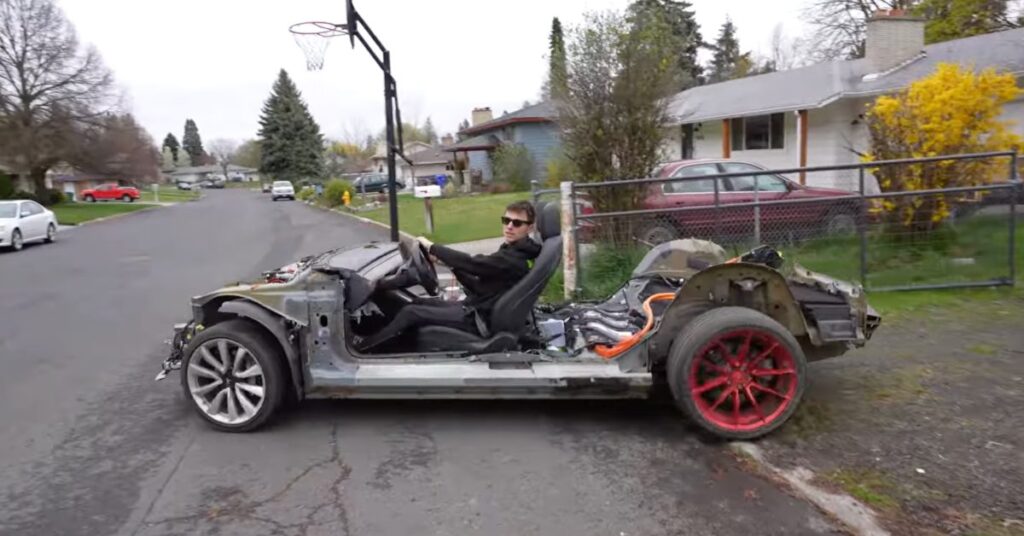
A YouTuber recently embarked on an unusual adventure by acquiring a Tesla Model 3 for a mere $2,000. This wasn’t any ordinary purchase. The vehicle was sans body panels, windshield, and seatbelts, yet it still boasted an impressive 212 miles of range on a full charge. The escapade, documented by Remmy Evans, showcases both the resilience of Tesla’s engineering and the audacious spirit of online creators.
From Abandoned Project to Unique Ride
The saga began with a tip-off about a unique vehicle stored in Idaho. Jake, a friend of Evans, informed him about a Tesla Model 3 that had been reduced to its bare essentials. Originally bought for a conversion project that never materialized, the car was intended to have its drivetrain transplanted into a 1970s concept car. After realizing the extensive 800-hour labor needed, the previous owner, Grayson, abandoned the project.
Negotiations saw the price drop from $3,000 to $2,000, leaving Evans with a functioning rolling chassis. The vehicle retained its seats, steering wheel, motors, battery pack, and screen but lacked essential safety components. Despite being unregistered for over two years, it remained operational.
The trend of using Tesla drivetrains for classic car conversions is growing, with companies like EV West offering Tesla crate motors for such projects. However, Evans took a different route by driving the stripped-down version.
Range and Error Codes Galore
After replacing the deteriorating tires with new ones, Evans discovered that the Model 3 still displayed 212 miles of range. However, the screen revealed 78 error codes, a consequence of missing cameras, sensors, and safety systems. All safety sensors had been disabled, inadvertently enabling the car to drift, which is typically controlled by Tesla’s Track Mode software.
Evans fashioned a makeshift harness using a ratchet strap and took the car on a 25-minute drive to Best Buy. Surprisingly, he encountered no law enforcement issues. Later, he tested its agility through drifting, off-roading, and even jumping on a dirt tabletop. His friend Drew likened the experience to driving “a Polaris Slingshot but way faster.”
The Charging Dilemma
Charging the vehicle presented its own set of challenges. An incompatible adapter at a DC fast charger led Evans to modify a charging adapter with tools from Harbor Freight. Although the modification worked, it was far from ideal.
The lack of CCS fast charging capability posed a significant issue. Enabling this feature would necessitate a software update, which could potentially render the car undriveable by recognizing its missing components. As a result, charging was limited to 7-8 hours on a Level 2 charger or over 14 hours on a standard outlet.
Software Struggles
To avoid further complications, Evans refrained from updating the car’s software. However, connecting the Tesla app to the vehicle triggered “Service Required” messages, complicating its operation. This reflects a common issue with modified Tesla vehicles, where the software restricts functionality due to missing safety components.
Evans hinted at a follow-up video involving a visit to a Tesla service center, likely resulting in an intriguing encounter with the service team.
Electrek’s Perspective
While the video is entertaining, it inadvertently highlights the robustness of electric vehicle powertrains. Despite missing numerous parts, the Tesla’s drivetrain remained operational, showcasing an inherent advantage of electric vehicles: durability due to fewer moving components.

FTC: We use income earning auto affiliate links. More.
Original Story at electrek.co