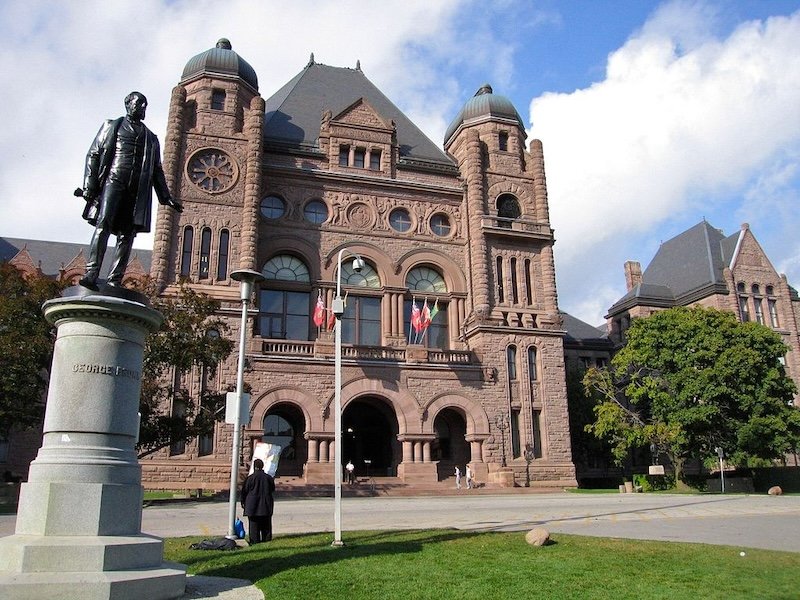
In the midst of growing environmental concerns, Ontario faces mounting pressure to establish a climate plan that prioritizes renewable energy, green jobs, and public health. During an Earth Day press conference at Queen’s Park, various organizations highlighted the urgent need for action.
Prominent groups, including the Ontario chapter of the Canadian Association of Physicians for the Environment, the Registered Nurses’ Association of Ontario, and the Ontario Climate Emergency Campaign, used the occasion to present an Earth Day petition to Member of Provincial Parliament Peter Tabuns (NDP-Toronto Danforth). This petition, which has already gathered 500 signatures, demands the reinstatement of a climate plan for Ontario. The demand comes after the province passed an omnibus Bill 68, which removed protections from Wasaga Beach Provincial Park and eliminated the legal requirement to maintain and update a climate plan. Critics argue this move was intended to avoid a court challenge over Ontario’s insufficient climate record. Read more
The involved organizations plan to continue gathering signatures until the government, led by Doug Ford, provides a climate plan grounded in evidence.
Mark Winfield, a professor of environmental studies at York University, highlighted a concerning trend in Ontario’s energy sector. Since 2017, gas-fired electricity generation has increased fivefold. “The implication of this trend is that rather than decarbonizing, Ontario’s electricity grid is actually re-carbonizing intensively,” he warned. Additionally, Ontario’s future electricity strategy, which could be 75% nuclear by mid-century, raises financial concerns with refurbishment and new builds potentially costing $400 billion over two decades. Explore further
Matt Jamieson, CEO of the Six Nations of the Grand River Development Corporation, stressed the importance of metrics in government actions: “When it comes to business and working with government, what gets measured, gets done.” He called on the province to quicken the pace of renewable energy projects, despite challenges like land use restrictions and municipalities opposing such developments.
The high youth unemployment rate in Ontario, currently at 17%, adds another layer to the climate plan discussion, according to Bushra Asghar, executive director of Organizing for a Youth Climate Corps. She noted, “Across the province, young people are struggling to find meaningful and stable work. Entry-level jobs are disappearing, while the cost of groceries has gone up by 30% since 2020, and our wages have not kept up.” Asghar advocated for the establishment of an Ontario Youth Climate Corps to provide stable employment for young people. Learn more
Chris Ballard, a former Ontario environment minister, emphasized the job creation potential of a robust climate strategy. He suggested that energy retrofits could lead to hundreds of thousands of job years in Ontario. BuildForce Canada indicates a need for 57,000 new workers for residential energy efficiency projects. Ballard argued that Ontario should also invest in manufacturing high-performance building components. Read the full report
Dr. Doris Grinspun, CEO of the Registered Nurses’ Association of Ontario, highlighted the health implications of climate change, linking it to conditions such as anxiety, heat stress, lung cancer, and Lyme disease. She stated, “The bottom line is this: When we delay climate action, people get sick. When we act, we prevent harm.” Her comments reinforced the belief that climate policy is essentially health policy. Additional insights
Original Story at www.theenergymix.com