University of Minnesota, Morris: A Pioneer in Green Energy Solutions
In a groundbreaking move over two decades ago, the University of Minnesota, Morris became the first public university in the United States to harness wind power through its own large-scale turbine. The campus, which later added a second turbine in 2011, now produces more electricity annually than it consumes, thanks to these turbines affectionately named Bert and Ernie.
“It’s windy year-round here in western Minnesota,” states Troy Goodnough, the university’s sustainability director.
The two turbines collectively generate 10 million kilowatt-hours of electricity each year. The university utilizes roughly half of this energy and sells the surplus to Otter Tail Power Co., a local utility. A novel thermal battery pilot project is underway, aiming to increase the campus’s energy efficiency while minimizing its environmental footprint by reducing reliance on methane-powered heating systems during Minnesota’s harsh winters.
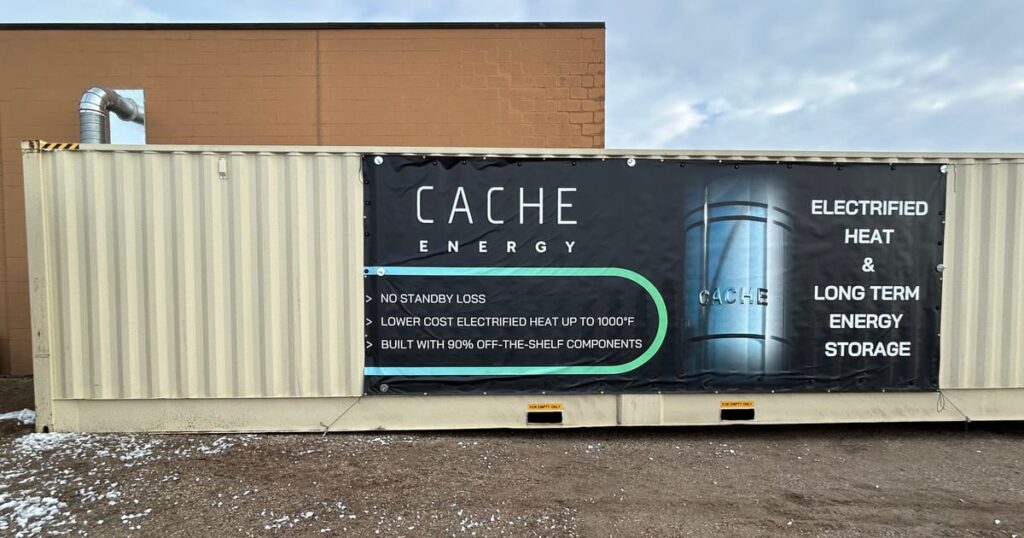
Technicians from Cache Energy, a company based in Illinois, recently installed a battery that converts electricity into high-temperature heat. The unit, capable of reaching temperatures of 1,000 degrees Fahrenheit, was installed near the university’s carpentry shop and began operating on March 24. This system has been continuously heating the expansive, high-ceilinged space since then.
“The cool thing is it’s doing what it’s supposed to be doing,” Goodnough remarks. “It’s working great.”
The thermal battery uses limestone-derived pellets coated with a proprietary binder, ensuring durability over a 30-plus-year lifespan. These pellets, when exposed to moist air, produce sufficient heat to create steam. To recharge, the system uses electricity to dry and cool the pellets.
Sydnie Lieb, assistant commissioner for regulatory analysis at the Minnesota Department of Commerce, emphasizes the importance of utilizing affordable, clean electricity that might otherwise go unused. Her agency supports initiatives like the Cache project through public-private partnerships such as Minnesota Energy Alley.
“The most cost-effective place for thermal batteries is going to be where you have a lot of excess energy being produced,” Lieb explains.
Western Minnesota, with its numerous wind farms, exemplifies such an area. The regional grid operator, Midcontinent Independent System Operator, reported an average wind generation curtailment of 508 megawatts in 2023, equivalent to the output of about 160 modern wind turbines. This issue extends to the Southwest Power Pool, which averages a curtailment of 1,097 MW.
Arpit Dwivedi, Cache’s founder and CEO, acknowledges that the low cost of natural gas presents a challenge for promoting electrification of heating. However, the economic viability of thermal batteries, supported by affordable electricity, offers a promising alternative.
“We know gas is cheap,” Dwivedi concedes, highlighting the need for competitive alternatives.
For institutions like UMN Morris, transitioning from gas to electric heating involves replacing existing boiler systems, potentially creating financial hurdles. However, this shift is crucial for meeting climate targets, including an 87% reduction in greenhouse gas emissions by 2035 and achieving carbon neutrality by 2050. Dwivedi and his team have prioritized affordability in their thermal battery design.
“We knew that if we did not have a low-capex system, we would not have an economic advantage,” he emphasizes.
Cache’s thermal batteries utilize readily available materials such as steel, lime, and water, sourced domestically. The proprietary binder, which is the most costly component, is also produced in the United States, keeping overall costs low.
Cache offers its thermal battery systems through a leasing model, covering delivery, installation, maintenance, and even removal, with an option for purchase at the lease’s end.
Initially launched in 2022, Cache focused on industrial applications, such as providing heat for food and chemical production. However, the company is now expanding its focus to include large-space heating projects, with potential clients like the U.S. Army interested in the technology for resilient energy solutions.
Original Story at www.canarymedia.com